

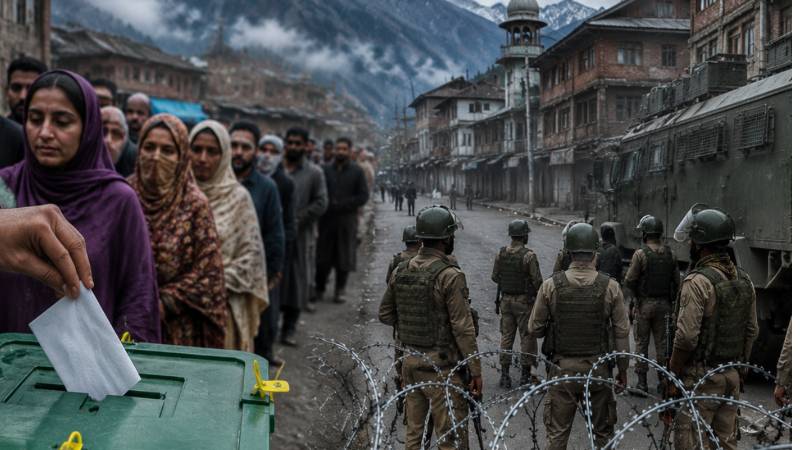
Peace has long been Kashmir’s greatest aspiration, yet it has also been its greatest casualty. The first phase of the elections should have been a celebration of democratic participation. Instead, it unfolded amid the Jammu Kashmir Joint Awami Action Committee’s (JAAC) long march towards Muzaffarabad, intensified violence, heightened security, road blockades and a political climate shaped less by electoral debate than by confrontation. While ballots were being cast in parts of the territory, another contest was taking shape on the streets: one between an increasingly assertive protest movement and a state determined to restore order.
The defining question is not whether the state has a responsibility to maintain law and order—it unquestionably does. The more important question is whether the methods adopted to manage this crisis will ultimately strengthen democratic governance or leave behind a deeper crisis of trust.
The JAAC movement began with socio-economic demands and gradually evolved into a broader challenge to governance in AJK. As the movement expanded, so too did the state's response. Authorities banned the organisation, arrested key leaders, reopened criminal cases against activists, increased security deployments, imposed movement restrictions and, at various stages, suspended internet and mobile services. Officials have defended these measures as necessary to maintain public order and protect state institutions, particularly after violent incidents in which both protesters and police personnel lost their lives. No democratic state can ignore violence or abdicate its responsibility to protect its citizens and public institutions.
However, restoring order is not the same as resolving conflict. States possess the capacity to disperse demonstrations, reopen roads and re-establish administrative control. What they cannot achieve through coercive measures alone is the restoration of public confidence. Political crises are rarely resolved simply because protests subside. They are resolved when citizens believe that institutions are willing to hear grievances, respond through constitutional means and distinguish between peaceful dissent and criminal conduct.
Rebuilding trust between citizens and institutions takes far longer... lasting stability is built not only through the authority of the state, but through the trust of the people it governs.
The events of recent months suggest that a governance challenge has increasingly been approached as a security challenge. Such an approach may produce immediate administrative stability, but it also risks narrowing the political space in which disagreements can be addressed peacefully. Every prolonged confrontation carries consequences beyond the immediate crisis. Arrests deepen resentment among supporters. Restrictions on communication foster perceptions of exclusion. Casualties—whether among civilians or law enforcement personnel—leave lasting social scars that continue to shape public attitudes long after streets are cleared.
As a matter of fact, 17 fatalities during fresh clashes only reinforce this reality. Every loss of life represents a profound human tragedy, regardless of who the victims are. It also serves as a reminder that the longer political disagreements are managed primarily through confrontation, the greater the likelihood that mistrust becomes institutionalised. Stability achieved at the cost of public confidence is unlikely to endure.
Perhaps the most consequential aspect of this crisis has been not only how it has been managed on the ground, but also how it has been presented to the public. Every political crisis is accompanied by a battle over narrative, and in AJK that battle has become almost as significant as the events themselves. Rather than encouraging a sustained discussion about governance, economic hardship and institutional accountability, much of the public discourse has increasingly been framed through the language of national security. In my view, this has diverted attention from the underlying issues that brought thousands of citizens onto the streets in the first place.
Large sections of media and political commentators have been quick to interpret the movement primarily through allegations of foreign influence, hostile agendas and questions of patriotism. Whether hostile actors attempt to exploit instability is a legitimate concern for any state. Pakistan faces genuine security challenges and cannot afford to ignore them. But acknowledging that possibility should not eclipse an equally important question: why did a movement rooted in local grievances resonate so widely among ordinary citizens?
External actors may seek to exploit unrest, but they do not create widespread public dissatisfaction on their own. Governance failures, economic hardship and declining public trust provide the conditions in which unrest can grow. Ignoring those domestic factors while focusing almost exclusively on external explanations risks treating the symptoms of a crisis while leaving its underlying causes unaddressed.
The consequences of this narrative are significant. When political dissent is consistently viewed through a security prism, the space for democratic engagement inevitably contracts. Public grievances risk being judged less on their substance than on assumptions about motive. Dialogue begins to appear as weakness, compromise as concession and enforcement as the default instrument of governance. This may strengthen the state's position in the short term, but it also makes political reconciliation considerably more difficult.
The media has a particularly important responsibility in such circumstances. Journalism should neither romanticise protest movements nor unquestioningly amplify official narratives. Its role is to scrutinise all centres of power, examine competing claims critically and provide citizens with the context necessary to understand complex political developments. A democracy benefits when difficult questions are debated openly. It is weakened when public discourse becomes dominated by accusation instead of analysis and by slogans instead of evidence.
The timing of this crisis has made these concerns even more pronounced. Elections are designed to reinforce democratic legitimacy by providing citizens with a peaceful means of determining political authority. Yet elections alone cannot compensate for an environment of deep mistrust. Democratic legitimacy depends not only upon the conduct of polling but also upon public confidence that political institutions remain capable of engaging with criticism without immediately resorting to exceptional measures.
This has implications beyond AJK itself. Pakistan has consistently argued on international platforms that democratic participation, representative institutions and the protection of fundamental rights are central to its position on Jammu and Kashmir. Developments within Pakistan-administered Kashmir are therefore observed with corresponding interest. The manner in which internal political disagreements are managed inevitably shapes international perceptions of those broader arguments. Demonstrating confidence in democratic institutions strengthens Pakistan's case far more effectively than allowing domestic political disputes to become prolonged security confrontations.
None of this is to argue that governments should tolerate violence or abandon law enforcement. Individuals responsible for criminal acts should be investigated and prosecuted through due process. Public order remains an essential responsibility of every state. But democratic governance requires proportionality and political judgement. Peaceful dissent must not become indistinguishable from criminal violence, and security measures should not become substitutes for political engagement.
History offers a consistent lesson. Governments rarely lose legitimacy because protests occur; protests are a recurring feature of democratic societies. They risk losing legitimacy when citizens conclude that peaceful dissent no longer has a meaningful place within constitutional politics. Roads can be reopened within days, communication networks restored within hours and demonstrations dispersed within minutes. Rebuilding trust between citizens and institutions takes far longer.
The next government in AJK will inherit more than the outcome of an election. It will inherit the responsibility of repairing relationships between institutions and the public, restoring confidence in constitutional politics and ensuring that future disagreements are addressed through dialogue rather than escalation. That task cannot be accomplished by security measures alone.
Ultimately, history is unlikely to remember this period simply for the protests or the elections. It will remember whether those entrusted with governing responded to a complex political challenge with the confidence to engage, reform and persuade—or whether governance gradually gave way to securitisation. In my view, the lesson of this crisis is clear: lasting stability is built not only through the authority of the state, but through the trust of the people it governs. Without that trust, order may be restored, but confidence will remain elusive.