

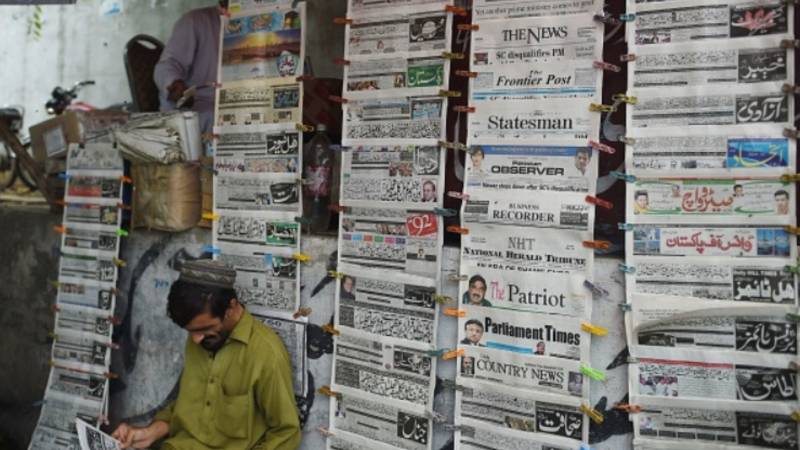
There are many kinds of journalists out there – what kind are you?
Some are proper professional journalists who have gone through the ropes, starting from the traditional newsroom as a desk or sub-editor or a reporter, and rising through the ranks to senior sub or senior reporter, and eventually to editor.
When I started off in journalism in the mid-1990s, there was no scope for being a journalist unless you wanted to join the state-run, dull and drab PTV or – equally dull and drab – Radio Pakistan. In any case, both these organisations usually take in those who have passed the civil services exam and join them through the information group.
There was – and remains – also the Associated Press of Pakistan, or APP, which is the official government news agency. Its main task has always been to report on the daily events and meetings of the president, the prime minister, the ministers of the federal cabinet, the armed forces chiefs, the chief justice of the Supreme Court, the high courts, and so on. Basically, it was also a boring job – and much of it went against the basic grain of being a journalist, which often means being a watchdog of the government and its policies and actions, and of speaking truth to power.
This is the kind of journalist I was – or at least I think I was. Of course, how good one is at one’s profession is usually for others to judge.
A journalist who wants to be professional and report what an actual journalist is supposed to report on may find it difficult to deal with owners who act as editors
And then there are journalists who basically work not for their newspaper or the policies set out by the editor but who work either on their agendas or in accordance with the whims of the owner. In Pakistan, by and large and especially nowadays, owners tend to be editors themselves, and that’s something to be avoided if you want to be a professional journalist or reporter/editor.
And the reason for that is very simple: the priorities of a professional journalist or editor are to report the truth, the facts, so to speak, and to be as objective and neutral as possible. This is usually done in reporting by presenting both, or all, sides to a story, a happening or an event.
The priorities of the owner, however, are usually not the same; he or she sees it as a way to make money, or to gain influence with the government of the day, or both. Therefore, decisions relating to coverage and editorial policy are not guided by the imperatives of reporting the facts, the truth, or speaking truth to power, but are instead motivated by the maximisation of revenue and profit, or of the owner’s influence with powerful groups in society – in particular, those that run the government.
A journalist who wants to be professional and report what an actual journalist is supposed to report on may find it difficult to deal with owners who act as editors. Either they take the title of editor-in-chief or chief editor, or they don’t – but they still go over the editor they have hired and direct news coverage. In the process, they end up undermining their editor, and that’s not good for a news publication’s credibility.
And that brings me to the next point – that there are a handful of rare owners who are real editors, in the sense that they know what it takes to make a news publication or website credible, and act and think like professional journalists. They also understand one very important thing, which a lot of media owners either overlook or don’t realise the importance of – and that is: a news publication or website that is credible will gain a loyal audience and see its readership grow. That, in turn, is precisely what makes a news outlet profitable. Hence, it is in the owner’s interest to let professional journalists run the publication and/or website, because that will increase its credibility, which, in turn, will bring more eyeballs and more advertising revenue.
That all said, one has to concede that eyeballs don’t always come with news that’s credible and true. If anything, social media has shown that the more divorced from reality and truth a report or post may be, the greater the likelihood of it being seen by tens of thousands, if not millions, of people. This is the definition of what it means to go viral in today’s digital and social media world. A post, even just a few sentences long, on a social media platform may get hundreds of times more views than a lengthy op-ed in a major newspaper. And the only way that this lengthy op-ed can go ‘viral’ is if its link or excerpts are shared on social media.