

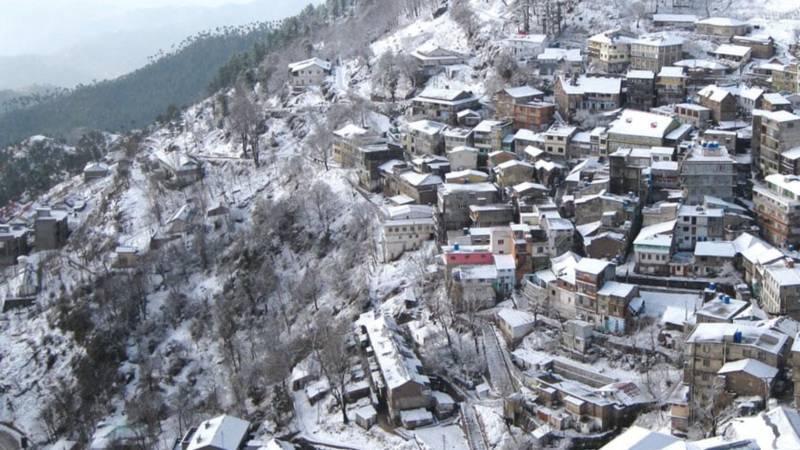
I write these words not as an observer, an academic, or a consultant, but as a son of Murree, one who carries the town not only in memory, but in the marrow of his life. My desire to restore Murree to its original colonial-era architecture is not driven by nostalgia or aesthetics; it is an act of loyalty to a place that once knew how to live with dignity.
I am a native of the Murree Hills. In the early seventies, I walked its streets when the town still obeyed the hills. It did not dominate them; it listened. The air was clean, not by accident, but by design. Buildings were placed with restraint, streets followed natural contours instead of cutting through them, and there was an order so precise it felt effortless, a cleanliness that mirrored the clarity of mountain light. Murree did not aspire to grow endlessly. It aspired to endure.
In those days, my own home stood far from the Mall, in a remote village. It was not elegant, but it was honest. Thick stone walls bore the cold patiently. A corrugated GI-sheet roof sang during the rains. The false ceiling was low, barely eleven feet, designed to trap warmth in winter and shelter a family from the mountain’s severity. It was architecture shaped by survival, by quiet knowledge passed from one generation to the next.
Yet when I walked towards Kashmir Point or along the Mall, I encountered another philosophy of building altogether. The colonial architecture of Murree did not deny the climate; it negotiated with it. High ceilings allowed hot air to rise and escape. Wide verandas softened the sun. Steeply sloped roofs carried away snow without protest. Chimneys stood ready—not decorative, but necessary. These were not indulgent designs. They were calculated responses to altitude, snowfall, wind, and time.
Many of these buildings employed the Dhajji Wall technique, wooden framing infilled with stone and mud plaster, a local seismic strategy refined into elegance. It was a marriage of imperial planning and indigenous wisdom. Where my village home sought intimacy and warmth, these structures sought balance and longevity. One was built for a family. The other was built for a town meant to last.
Murree’s architectural inheritance was deliberate, not accidental. The Holy Trinity Church on the Mall, constructed between 1850 and 1857, remains a Neo-Gothic monument of extraordinary endurance. Its pointed arches, stained glass, and stone masonry have survived earthquakes, storms, and more than a century and a half of political change. The Town Hall, Tudor in style, once anchored civic life with symmetry and dignity, while the Viceregal Lodge, built in the Scottish Baronial tradition, projected authority not through vulgar height but through proportion and restraint.
Beyond the Mall, the Old Garrison Church and School at Gharrial, Saint Margaret’s Church near the military headquarters, the Catholic Church at Kashmir Point, the Lawrence College Chapel at Ghora Gali, and the chapel at Saint Denys School formed a quiet constellation of ecclesiastical and civic architecture. These were not isolated monuments. They were parts of a coherent urban grammar, a language of stone, timber, and space that Murree once spoke fluently.
Murree does not need to be reinvented; it needs to be remembered and obeyed
What the British left behind was not merely buildings. It was town planning: height controls, sightlines, open spaces, respect for slopes, and above all, the understanding that hills are not empty land waiting to be monetised, but living systems that punish arrogance. This inheritance survived wars, independence, and decades of neglect. It did not survive greed.
Between 2002 and 2007, and in the darker years that followed, Murree’s destruction accelerated beyond repair. The Nazim of that era possessed the authority, resources, and legal instruments to declare a heritage zone, enforce by-laws, and halt illegal construction. Instead, conservation laws were ignored. He built his own ten-storey hotel and enabled the construction of more than four hundred and fifty high-rise structures. The Naib Nazim protested and documented the violations, but his voice vanished into a machinery of complicity, and in that moment, the law lost its meaning.
In the Nazim’s shadow, concrete towers rose where stone cottages once stood. Ridgelines were crowded, then erased. Hillsides were blasted not for safety or shelter, but for parking plazas and shopping arcades. What foreign rulers preserved for a century, local rulers destroyed in a few years.
Let it be said clearly and without evasion: not India, not Israel, but local traders, hotel owners, and politicians of Murree ruined Murree—just as Hulagu Khan reduced Baghdad to ashes in 1258, nearly seven hundred years ago. That destruction was swift and brutal. Ours was slower, quieter, and therefore more shameful.
The Old Cecil Hotel, once a proud colonial landmark, was reduced to a footnote, dwarfed by neon-lit monstrosities and concrete slabs. The Holy Trinity Church, which once captured mountain light through stained glass, now stands visually imprisoned by encroaching walls. The historic GPO of 1867, once the communications heart of the region, was suffocated by illegal high-rises erected by a patwari who transformed bureaucratic proximity into unaccountable power, shielded by political connections.
This was not development. It was an occupation.
What deepens the tragedy is that this collapse was never inevitable. I have seen another path. I have walked through Shimla twice. Each visit unsettled me, not merely because of envy, but because of recognition. Shimla faced pressures similar to Murree: population growth, tourism, and political neglect. Yet its colonial architecture was restored, not erased. Institutions such as INTACH led systematic conservation of landmarks, including the Viceregal Lodge, the Gaiety Theatre, and the Town Hall. Jacobethan and Tudor styles were preserved. Height controls were enforced. Heritage was treated as a strength, not an obstruction. Shimla chose memory over amnesia. Murree chose profit.
Today, there are signs of belated awakening. The Government of Punjab has initiated land-encroachment drives in areas such as Jhika Gali. This is welcome, but insufficient. Illegal hotels constructed over the past twenty-five years cannot be regularised simply because their owners have earned billions. Illegality does not mature into legitimacy through profit.
An equally urgent task awaits the Chief Minister of Punjab and the apex judiciary: a comprehensive audit of Evacuee Trust lands in Murree. These lands, left behind by Hindus and Sikhs during the 1947 Partition, are vested in the Federal Government. Yet through the connivance of the Evacuee Trust Property Board and the local administration, vast tracts have been released into the hands of land grabbers. One glaring example involves a cloth merchant from Rawalpindi who rose to billionaire status through illegal construction on such land. This is not merely a planning failure. It is a moral one.
Restoring Murree is politically difficult, but technically straightforward. The original town planning exists. Architectural drawings exist. Height limits are known. Sightlines can be restored. Illegal structures can be removed. Colonial buildings can be rehabilitated. What is required is not invention, but will.
This is where international cooperation becomes possible. UNESCO has established frameworks for heritage towns. The governments of the United Kingdom, Australia, and Canada possess technical expertise in hill-station conservation. Funding, advisory support, and training could be mobilised. Murree does not need to be reinvented; it needs to be remembered and obeyed.
I write this not as an outsider, but as someone who knew Murree before it forgot itself. I have seen what was lost. I have seen what can still be recovered. Restoration is not nostalgia. It is governance across generations. A town that forgets its design forgets its limits. A nation that forgets its hills forgets its future.
Murree can still be saved, but only if we accept the hardest truth of all: the past was never the problem. It was the solution we abandoned.