

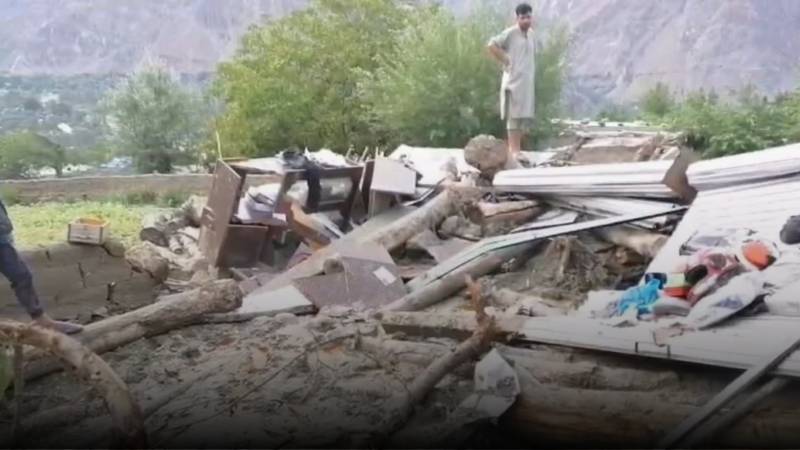
Gilgit-Baltistan is drowning in water, in mud; in grief and in impending climate-driven apocalypses. Valleys are flattened. Homes swept away. Lives uprooted. Destruction, despair, disbelief and shock everywhere. The scale of devastation is beyond words. Never in the region’s history has such destruction been witnessed. It is not only the rivulets and waterways that have overflowed their bounds, but every other mound of earth has turned into a flood-like, destructive fury.
The other day, Ghizer witnessed the most ruinous floods in GB’s history. Talidas of Roushun, in the middle of the night, received the mountain-sent viscous muddy glacial debris that flowed expansively, covering the whole village and flattening everything that lay in its way. No matter how deep-rooted the trees were or how strongly built the architecture, all were razed like a harrow drawn over ploughed land. Fortunately, no human life was lost. It was the indigenous wisdom that saved hundreds of lives.
Shepherds (read saviours) Kifayat, Wasiat, and Karim were in the seasonal pastures with their herds. It was in the middle of the night, when everything gives into silence, they narrate: we heard an explosive sound, an unusual sound that alerted us to look for the cause. We saw the flood flowing down. In frenzy, we called back home. Signals often play hide and seek, but this time they too came to the rescue, and a phone call back home enabled hundreds of villagers to evacuate safely. These are the true saviours of humanity. Their mindfulness and selfless service need to be celebrated.
Similarly, earlier this week, Ishkoman and Yasin valleys also witnessed equally devastating floods, causing human casualties and huge financial losses. As for the affected of all these areas, they are displaced, shell-shocked, and in despair, with nothing left of their life’s valuables except the clothes they wore and the loved ones they cling to. Rehabilitation is afoot, yet the scale, magnitude, and adequacy are far short of what needs to be done.
These are not the isolated tales of nature’s wrath. There are numerous other cases of devastation in parallel, as Tehsil Phander of District Ghizer was cut off from the rest of GB for a good twenty-two days. The victim here fortunately, was just the road that was submerged into the Ghizer River as a result of the Ghizer River diverting its way on account of climate change-induced flooding. The road, being on the foothill of a mountain, left no way to cross. Despite the biggest names—NHA, RADC and NLC—being there working on the Ghizer Shandur Road, it took three weeks to relink. All this while, the people of the entire Tehsil Phander were obliged to scale the slippery, steep mountain on foot, and needless to say that elders, children and patients suffered the most. On top of it, necessities of life were acutely in short supply and life was miserable, to say the least.
One of the most deplorable aspects of this devastation is the lack of transparency and accountability in managing the funds that pour into climate-related initiatives
The scale of devastation due to floods is so unprecedented that some areas have been completely defaced. In certain places, the accumulated boulders and gorges appear insurmountably vast and devastating. It goes without saying that rehabilitation and any return to a semblance of normality will take many years. In the worst-case scenario, these communities may never return to what they once were.
The accounts of climate-driven miseries are quite numerous and widespread across GB. Last month, we witnessed the most heartbreaking incident as five brave volunteers, sons of the soil, while repairing a water channel in Danyor, were caught in the wrath of nature’s fury. Clearing the channel on their own with cudgels and sheer volunteerism, they were trapped beneath the mounds that fell on them, forcing them to give up their lives; for what? They fell victim not to accident. Not to coincidence. But to the devastating reality of climate change.
As for the realisation regarding climate change:
Only when the last glacier is melted; only when the last mountain is crumbled; only when the last river is polluted; only when the last school is underwater; only when the last bridge is uprooted; only when the last clinic is torn from its foundation; only when the last road is swept; only when the last mosque is buried in silt; only when the last crop is drowned; only when the last hearth is awash; and only when the last child is missing; will we realise that CLIMATE CHANGE is a reality and needs our immediate attention.
Who can forget the tragic incident that happened in May, when four friends from Gujrat, who were on an excursion, went missing in GB? Later, their ‘calling-for-help’ corpses were found; they had met a tragic car accident caused by climate change. After days of search operations, it was discovered that the climate conditions had led them to their eternal abode; their journey of joy turned into a journey of perpetual rest. Apart from these documented accounts, the sporadic, undocumented tragedies that mountain communities face daily tell a tale of neglect, one that most of us, especially those in policy-making positions, have completely ignored or wilfully put on the back burner.
It is noteworthy that one of the most deplorable aspects of this devastation is the lack of transparency and accountability in managing the funds that pour into climate-related initiatives. Take the example of the GLOF-II project, meant for identifying and managing risks associated with GLOFs, strengthening public services, and improving community preparedness and disaster response. Instead, it became a tale of flagrant corruption.
According to a report by Ibex Media Network (IMN), out of 10.3 billion rupees, 350 million were spent on TADA, irregularities in hiring were rampant, 200 Early Warning Systems were to be installed for 160 million, and 95% of the population was to be made aware of flood risks, yet none of this seems to have been fulfilled. Given that this region has 13,200 glaciers, with 300 dangerously close to triggering GLOFs, amid this impending horror, one wonders: where did the money go? Obviously, into the visibly invisible hands. Who will hold them accountable and, more importantly, who will account for the lives lost due to the corruption of a few? How long will we keep pocketing this money while debating climate change in cosy, air-conditioned seminar rooms?