

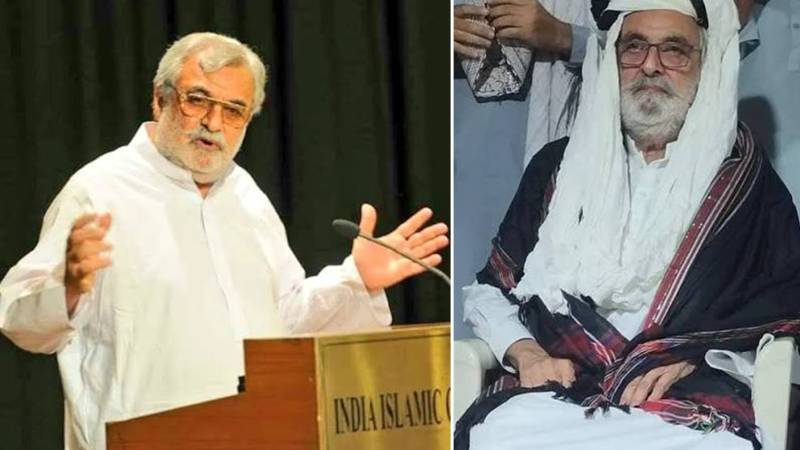
Three years ago, a warrior who fought for human rights departed this Earth. Born to privilege, he chose the path of the people—eschewing comfort, enduring scorn, and becoming a pillar of strength for the poor and oppressed.
Lalah Yousuf Musti Khan was born on 16 July 1948, in Karachi to Akbar Musti Khan. He was born into a well-settled family, and he grew up playing in the streets of Karachi. He received his education from Pakistan's finest institutes, and later in life, he held a high-ranking position in the Burma Shell Company. Had he wished, he could have indulged in worldly pleasures, amassed wealth, travelled around the world, and lived a life of ease. However, the political training from the Baloch Students Organisation and the affection and companionship of the Mir Ghous Bakhsh Bizenjo moulded him from an ordinary employee into a great political activist and then into a principled leader.
He, although a politician, was a proponent of truth and justice, one who challenged exploitative forces. He was a comrade of workers and the peasants, and the voice of the oppressed. Despite his good nature and compassion for the people, sticking to his principles in a country like Pakistan was not an easy task for him. His life was filled with difficulty, hardships, and severe trials. He was either found in a prison cell or rallying with a crowd for their rights. He was sometimes found playing the politics of constituencies and at other times, he would be protesting shoulder-to-shoulder with factory workers. Yet, despite these hard trials, Lalah had learned to live with a smile on his face.
He would often say: 'I have two mothers, I have a debt to repay to both of them: one is Balochistan and the other is Sindh.' He was a man of his word, and so, his entire life was spent in the service of these two mothers
He (Lalah Yousuf Musti Khan) was a custodian of left-wing politics, but at the same time, he was also well aware of its bitter realities. He was a true Baloch nationalist leader. He wanted the Baloch national movement to be based on an ideology rather than emotions. He was a steadfast communist leader and therefore always stood shoulder-to-shoulder with the oppressed and subjugated nations, including the Baloch. He was a staunch opponent of the Sardari system, feudalism, and capitalism. Within him resided the consciousness of Gul Khan Nasir, the insight of Ghous Bakhsh Bizenjo, and the courage of Lal Bakhsh Rind.
He was among the founding members of Awami Workers Party, a standard-bearer of the class struggle and a voice for liberation from Pakistan's obsolete system.
Yousuf Musti Khan also battled cancer in the later part of his life. He lived up to 74 years of age, but till the end, he did not stop attending meetings and conferences. He was a multifaceted and fearless leader. He began his political career with the Baloch Students Organisation (BSO) in the 1960s, and after his student era, he joined the National Awami Party (NAP). During that time, in Lyari, Masti Khan played a significant role in promoting Balochi literature and culture. During Bhutto's regime, NAP was banned, but Masti Khan, despite that difficult situation, continued his work in secret.
Pakistani politicians never had a spot for those of leftist ideas, which was evident since the days of the Muslim League in 1941. Those who spoke of workers' and peasants' rights had been called Russian and Chinese agents, communists, atheists, and even traitors. This is the tragedy of Pakistani politics, and the same trends still continue. The establishment and all state institutions have always perceived progressives as an obstacle to their interests. Yet, the people of the left-wing have always fought against poverty and for social justice, suffering imprisonment, lashes, and even being executed. Yousuf Masti Khan also served as the president of the National Democratic Party (NAP - Sher Baz Mazari), which was established in opposition to General Zia's dictatorship and was part of the MRD. Masti Khan joined the Pakistan National Party in 1983, and after the death of Ghous Bakhsh Bizenjo, the PNP merged into the Awami Jamhuri Party, which gave birth to the National Worker Party later.
In 2010, the National Worker Party and the Communist Workers Peasants Party merged and formed the Worker Party of Pakistan. Yousuf Masti Khan served as the Vice President of the Workers Party of Pakistan. He was also a part of the Sindh Progressive Committee, which included the Workers Party, Labour Party, Awami Party, and other left-wing and nationalist groups. In 2012, when the present Awami Workers Party was established by merging three small leftist parties, Yousuf Musti Khan became a part of it and was elected as its Senior Vice President in 2016. After the death of the party's president, Fanoos Gujjar, in 2018, Yousuf Musti Khan was elected as the president of the Awami Workers Party.
He continued his work on issues like land grabs by Waderas, agricultural reforms, women's rights, student politics, and the restoration of student unions. Musti Khan also played a significant role as a leader of the Baloch United Mahaz and the Sindh Rights Alliance. In recent meetings of the PDM, Yousuf Musti Khan represented the Awami Workers Party, but prior to that, an anti-state case was filed against him based on a speech he gave in Baloch United Mahaz. He was arrested in September 2021 after a PDM meeting and was accused of being an anti-state individual because he had raised his voice in the "Gwadar haq do tareeq " movement in Gwadar and for the recovery of missing persons. The charges against him include sections 153, 124A, 123A, 121, and 109.
He was arrested and accused of being an anti-state because of raising his voice to protect the people of Gwadar who were being displaced and rendered unemployed. The people of Gwadar were demanding that foreigners be stopped from fishing in their area, as it was causing locals to become unemployed and homeless. Their makeshift settlements were removed to build headquarters for these foreigners. Yousuf Musti Khan lived a full life of resistance, raising his voice on such regional, national, and class issues. Young people entering left-wing politics can learn a great deal from Yousuf Musti Khan's political life.
Lalah was a resident of Karachi and belonged to its indigenous people. That is why, until the very last moment of his life, he struggled for the rights of the indigenous people of Sindh. He was the one who founded and led the Sindh Indigenous Front.
He would often say:
"I have two mothers, I have a debt to repay to both of them : one is Balochistan and the other is Sindh."
He was a man of his word, and so, his entire life was spent in the service of these two mothers.
Three years have passed since Lalah's departure, but his memory, his smile, and his courage are still with us.