

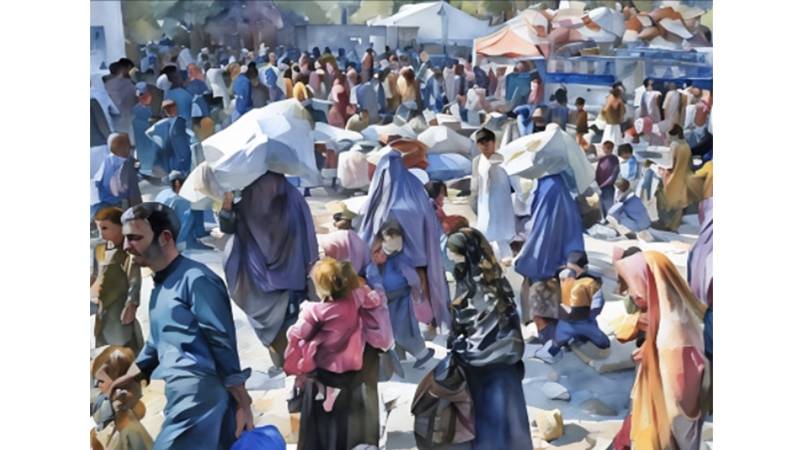
It was the last winter of the 1970s when the wind shifted and changed the frontier. The Soviet Red Army rolled across the Amu Darya in December 1979 and thundered into Afghanistan. Radios in Peshawar crackled with the news. For centuries, the Khyber Pass had carried pilgrims, traders and plunderers. Now it carried refugees and war.
In Gulbahar Colony, neighbours gathered at gates, their faces pale with foreboding. In Wazir Bagh, men huddled under bare trees, their voices low. In Shahi Bagh, families still strolled as they always had, but their laughter was thinner, as though even joy had grown cautious.
At first, just a trickle of Afghans arrived — families on foot, elders on donkeys, women clutching infants. Then the trickle became a flood. Camps mushroomed in Kacha Garhi, Haji Camp, and hastily carved-out tracts of Hayatabad. In the Qissa Khwani Bazaar’s stories, Dari and Uzbek mingled with Pashto. New breads appeared, new lullabies, new accents. Peshawar absorbed them all, as it always had.
We had always known jihad as an inner struggle, a tightening of the will before doing right. But in the Peshawar of 1980s, it grew legs and shouldered a rifle.
“Jihad Fī Sabīlillāh!” — Jihad in the path of God — was daubed in red paint on walls, unfurled on banners, thundered from pulpits. It travelled in cassette sermons, in madrassa courtyards, in refugee tents. Boys memorised verses; men counted border crossings.
The military dictator in Rawalpindi, as bigoted as a talib in Akora Khattak, declared: “We will reverse the situation.” Washington, never slow to scent opportunity, saw its golden chance. Afghan courage, Pakistani soil, American dollars, Saudi zeal — a recipe written not in books, but in blood. Peshawar became the headquarters of the world’s most ambitious proxy war.
By this time, I was no longer a boy of marbles and transistor radios. I was a fighter pilot of Pakistan Air Force (PAF), patrolling the Durand Line. Our briefings were stark: “If the Afghans fail to hold, the next target is Peshawar. From there, Karachi. The centuries-old dream of the Russian Tsars — warm waters — will be realised.” For us, it was not theory. It was duty. We were told to be the guards on the wall, and sentinels in the sky.
From 30,000 feet, Afghanistan was a jagged quilt scarred with fire. From the mess, the maps looked neat — grids, arrows, markers. But from Gulbahar Colony, it was my mother’s anxious brow. From Qissa Khwani, it was the hush that fell when someone whispered “Russians.” The elephants were trampling Kabul. We knew the grass to be crushed next was ours.
Some of our F-86 Sabres — proud veterans of the Korean War — had grown too old for the sky. They sat parked, heavy with nostalgia. Then an American CBS news crew arrived, eager to make a documentary and create a charade that would tug American heartstrings and loosen purses. Someone devised a spectacle. A grounded F-86 was hooked up to a tractor and towed down the tarmac. In the cockpit sat a “pilot” — helmet strapped, flying suit zipped, oxygen mask clipped in place. The cameras rolled. The commentary rose like theatre: “Look at these brave people, facing a superpower with Korean War-retired F-86s…”
We, the real pilots, nearly collapsed laughing. Imagine a warhorse of the 1950s being paraded like a circus pony, a poor chap sweating inside the cockpit as the tractor lumbered along! It was tragicomedy disguised as patriotism. But the Americans bought it. So did Charlie Wilson, the flamboyant Texan congressman. He grinned, voted the funds, and soon the CIA’s money began to flow. It was, at least in its opening act, his war. He would change the laughter to lethality.
The irony is that we did get our F-16s. Sleek, sharp, uncompromising machines. Once they arrived, the laughter ended. PAF went on to shoot down and damage close to 30 Soviet-piloted aircraft. Among the men who fell from our skies was one who would, in later years, rise to become the Vice President of his country. History plays its cruel tricks: one day you’re strafing over the Kunar valley, the next you sit in a gilded Kremlin office. For us, the memory was simpler: we had done our duty. We had guarded the wall. We had guarded the sky.
While we flew, the city below was remade. Tongas gave way to Toyota pickups, bristling with fighters. Villas in University Town became discreet offices where curtains never opened. Hotels and guesthouses filled with CIA men, Gulf sheikhs, journalists, and commanders. In Darra Adam Khel, the Kalashnikov became as common as the shawl. In the discrete hideouts, rival Afghan faction blew up each other. In Karkhano Market, smuggling became industry, and industry became empire. Even the air carried a new hum — the rumble of convoys, the chatter of strange accents, the whisper of missiles.
True to its nature, Peshawar absorbed. We housed families, shared food, found room where there was none. But the strain showed. Rents soared, crime grew bolder, schools swelled with refugee children. Yet, life insisted. Shia and Sunni mourned Karbala together. Weddings in Androon Sheher still lasted a week too long. My in-laws’ regiment of cousins could still assemble a marquee in an hour and empty a deg in ten minutes. Even sorrow in Peshawar remembered to pour tea before it raised its voice.
Men like Sethi Abdul Ghafoor had once shown us faith as refuge — giving a Jewish family a room in his Haveli during Stalin’s terror. In the 1980s, faith was also a recruiting cry. Pulpits split: some called for patience, others for powder. Peshawar held both lantern and landmine in its chest. When the Soviets finally withdrew in 1989, there was no parade here, only the weary sigh of a wave collapsing far out to sea. The elephants had finished their dance. But the grass remembered.
Peshawar had become both rear base and refuge, both market and monastery.
The flowers did not vanish. They learned to bloom through wire.