

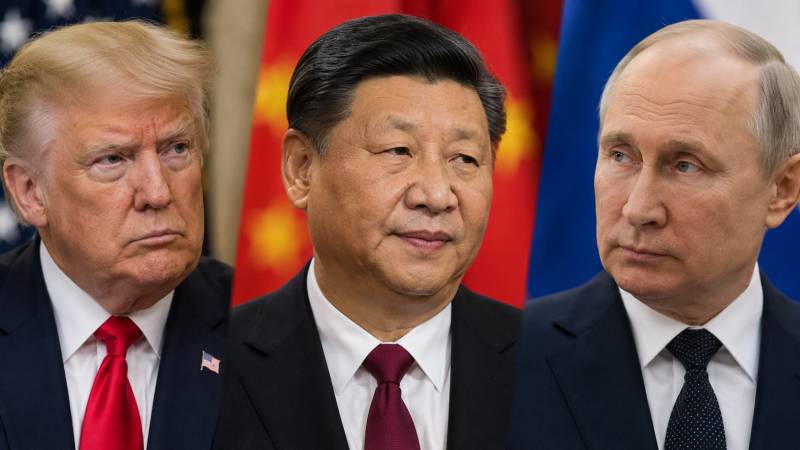
The USA and Chinese relationships are a classic illustration of the metaphor, “Bad marriage”. Analysts, commentators and historians have used this terminology to highlight their connection dynamic, signifying deep interdependence, mutual resentment and repeated attempts at reconciliation. Divorce is an option, but the resultant severe consequences, not only for them but for the entire planet, make it a no-no option.
Russian and Chinese relationships are a classic illustration of the metaphor, “Marriage of convenience.” Analysts, commentators and historians have used this terminology to highlight their pragmatic alliance driven by necessity, not affection. Fear of the USA and the Western world, a different way of life and the yearning for a multipolar world with its own spheres of influence keep their bond strong. But the Chinese idiom that “One mountain cannot accommodate two tigers” captures the essence of their latent rivalry, succinctly.
History seldom announces with a bang that it is changing direction. 1914, 1939, 1945 and some other years are remembered as those which led to cataclysmic changes in the international order, with lasting effects to date.
May 2026, in all likelihood, will be remembered similarly. Never before in the history of China has any President hosted both the American and Russian Presidents within a week of each other. The choreographed method adopted during these two visits has portrayed the stature of President Xi Jinping as the leading statesman of the world.
The sequence was extraordinary. China had hosted heads of governments of Canada, the United Kingdom, Spain, France and a host of other Western nations before May 2026. But President Trump and President Putin represent the world’s two foremost nuclear powers, and are engaged in a serious adversarial duel not only in Ukraine but also in different spheres across the world.
What is the message? Simple. Not only the USA and Russia, but the world finds itself compelled to engage Beijing, which increasingly projects itself as the stabilising pole in an emerging multipolar global order.
But the deeper significance lies not only in the protocol. It lies in the geometry of shifting global power.
Together, these three countries, with Europe as a corollary, will define the architecture of the coming years
After the Second World War, the USA became the dominant hegemon—militarily, culturally, economically and socially. NATO was formed and was opposed by the Warsaw Pact till 1989. After the fall of the Berlin Wall, it became the sole superpower.
However, in its hubris, instead of acting as a responsible and peaceful force, American interventions post 9/11 eroded its moral authority, which Washington had enjoyed after the Cold War. With its military defeat in Afghanistan and during the recent Iran war, the American military facade has developed serious cracks, and the credibility that it can overthrow and subjugate any country in the world through military force has been weakened.
Russia invaded Ukraine on 24th February 2022, starting the largest and deadliest war in Europe since the Second World War. Four years on, after hundreds of thousands of soldiers and approximately 16,000 civilians have been killed, according to official and intelligence estimates, the war goes on. Moscow itself has been attacked for the first time since 1945. The asymmetric usage of the war machine by Ukraine, supported by Europe led by the USA, with drones, rockets and AI becoming the most potent weapons, the might of the Russian bear stands exposed.
Moreover, with stifling sanctions imposed on Russia, its economic progress has been tamed. And with an ever-increasing war budget, President Putin finds himself in a tight spot.
Emerging as China’s most influential figure after Mao Zedong died in 1976, Deng Xiaoping consolidated political power and guided the country into an era of reform and opening up that transitioned the nation towards a socialist market economy. Credited as the “Architect of Modern China”, he is recognised for shaping both socialism with Chinese characteristics and Deng Xiaoping Theory.
China decided then that its focus would only be economic progress and the defence of the motherland. Despite its phenomenal increase in military power, China has abstained from any foreign intervention.
Resultantly, hundreds of millions of Chinese have been lifted out of poverty. This has never been witnessed before in history. China has become the world’s manufacturing superpower. Authoritarian capitalism, enforced by the Chinese Communist Party, has become a powerful rival model to the Western philosophy of governance. And China has established its status as a mature, balanced, non-hegemonic power, especially during the last decade.
So, three men. And the world.
The sojourn to China by the American and Russian Presidents within a week has cemented the status of President Xi as a stabilising force for the world. Both Trump and Putin courted the Chinese leadership, cognisant of the fact that China is the emerging new superpower and, with the world economy so intertwined and the military machines so deadly, any weakening or animus developing between China and the other two would be extremely detrimental to people across the planet.
Moreover, President Trump came for economic deals and recalibration of the relationship, with President Xi continuously messaging about avoiding the “Thucydides Trap”. However, no major bilateral agreements could be signed, and Taiwan remained the major point of difference.
President Putin, on the other hand, came for reassurance that even if China–USA relations improve, the strategic partnership between Russia and China would not be weakened. Russia and China signed over 40 intergovernmental, inter-agency, and corporate documents. This massive package included over 20 major bilateral agreements signed directly in the presence of both heads of state.
The sweeping agreement committing both nations to push for a “multi-polar world order” and expressing strategic coordination is maybe the most consequential of all and a direct challenge to the American order of international politics.
The triangular relationship between Presidents Trump, Xi and Putin will define the short-term future of great power politics. They have neither an alliance nor hostility. Rather, there is a constant shifting rivalry, dependence, strategic necessity and balance of power.
America and China are deeply connected economically but with deep mistrust; Russia and China are deeply connected tactically, yet shadowed by latent competition; America and Russia continue to confront each other across geopolitical fault lines.
Together, these three countries, with Europe as a corollary, will define the architecture of the coming years.
Whether the 21st century witnesses managed co-existence or catastrophic confrontation shall depend largely on the sagacity, wisdom, restraint and ambitions of Presidents Trump, Xi and Putin.
Let’s hope peaceful co-existence is the recipe chosen.