

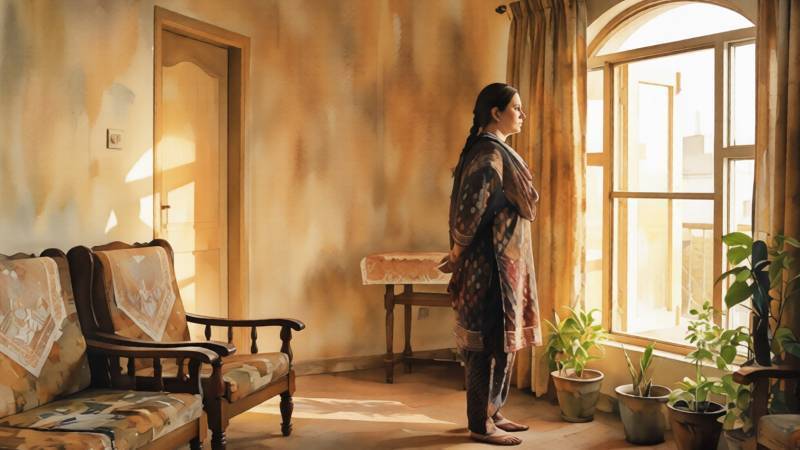
By my mid-20s, I had slipped quietly into the role of Alice, wandering through a Wonderland of my own making. Like her, I started to spiral down a rabbit hole, hoping to enter a world that existed only in the margins of possibility. But my Wonderland was not a whimsical fantasy; it was a means of survival. In this self-created world, the vocabulary did not revolve around the judgemental voices of being called ‘azaad khayal’ or ‘too modern’, and there was no imminent fear of ‘log kya kahenge’. Here, curiosity was not a crime, defiance was not a scandal, and I could stretch my mind and body without fear of social reprisal.
As Dostoevsky wrote, “I invented a life for myself, so that at least I’d live somehow” (Dostoevsky), and so I built my own alternate reality, a world whose sole occupant was me, because stepping into the real one often felt like walking into a tightening noose of moral policing, family honour, and societal conformity. Even if my escape was brief, I at least had a chance to question, explore, and shape my identity without negotiation.
Tools of Social Control
This self-created Wonderland of mine is not just my sanctuary, but a reflection of countless women who are trying to place themselves within Pakistan’s rigid social structure—one that shuns any form of individualism. In a society where female autonomy is constantly kept under surveillance, any assertion of independence is labelled as being ‘azaad khayal’ or ‘modern’. One could argue that such terms are insecurities of the modern mind, yet the reality is that for today’s progressive woman, these labels have become tools of social control. They have become markers used to distinguish what is deemed acceptable from what is dismissed as ‘bigari hoi auladain’—those who supposedly stain the very fabric of our society.
Labels like ‘modern’ have become mundane instruments of repression, defining acceptable femininity and making conformity the default path to survival for women
Calling upon women in such a manner subtly reinforces the idea that belonging comes only through adherence to intergenerational rules, and those who go against them are pushed to the margins, made to feel like the “other,” the “oddity,” and the one who is in the “wrong.” In this way, such mundane labels begin to operate as modern instruments of repression: they define acceptable femininity and reinforce Foucault’s idea that “the individual is the product of power”, making conformity the default path to survival for women.
The times are changing, and people around the world are becoming more open-minded and accepting. Yet this is not entirely the case in Pakistan, where even outward acceptance is often met with internal hostility and judgement, especially at the hands of one’s own family and relatives. A woman who wants to pave a path for herself, build a career, or simply focus on her own self—who carries dreams and goals she hopes to achieve—is met with the scripted dialogues of desi aunties: “pur lag gaye hain issay.” And if a woman so much as thinks of taking a stand for herself, differentiating right from wrong, seeking financial independence, or even saying “no” to any of the elders, she is suddenly labelled as being ‘modern,’ which in other words signals her dissociation from the rest of society.
The Burden of Awareness
As Foucault explains, modern power operates not through overt coercion but through subtle normalisation: “Surveillance is permanent in its effects, even if it is discontinuous in its action” (Foucault). Normalisation, in his words, involves constructing a “model” and pushing people to conform to it. Those who do not adhere to this social monitoring, those who refuse to align with the model, are marked as (in this case), ‘modern’ or ‘azaad khayal’. When a woman steps outside societal expectations—rejecting the imposed disposition of an arranged marriage, demanding equal career opportunities, or speaking her mind—these labels then serve as social and cultural markers that marginalise her. As Dostoevsky writes, “I swear, gentlemen, that to be too conscious is an illness- a real thorough-going illness.” For women who see their own marginalisation with this kind of painful clarity, awareness itself becomes a burden.
A well-known feminist thinker, Fatema Mernissi, addresses this marginalisation when she writes that women are “frozen into the passive position of an object whose very existence depends on the eye of its beholder” (Mernissi). Those who do not sit well within this structure of social policing and conformity are made to pay a price—social ostracism, familial pressure under the weight of ‘log kya kahenge’, and the slow deterioration of mental health that ultimately isolates them.
It is deeply problematic that such labels are used to stifle autonomy. This form of normalisation is not merely enforced; it is woven into the fabric of society, internalised, reproduced, and rendered invisible. Conformity then becomes the only navigable route through which women can move, shape, or even understand their identities. The so-called ‘modern woman’ is permitted to dream only within boundaries carefully outlined by society.
Reclaiming ‘Modern’
There is only one way for Pakistani society to move forward: to recognise that belonging should not require compliance with a predetermined “model”; that labels must not function as instruments of repression; and that a woman’s autonomy cannot be conditional. Only with a shift in vocabulary and mindset can women truly embrace their womanhood and explore the full spectrum of their potential. It is time that the term ‘modern’ be reclaimed—not as a mechanism of discipline, but as a celebration of individuality. It is time to change the narrative that a woman becomes acceptable only after she has been moulded and diminished into a box built from unreasonable expectations passed down through generations.
So yes, my Wonderland was an escape—but women should not need alternate worlds to breathe freely. The labels shaping our social reality must be questioned, redefined, and ultimately reclaimed. Only then can women exist without negotiating their existence. And until that world arrives, “I say let the world go to hell, but I should always have my tea” (Dostoevsky).