

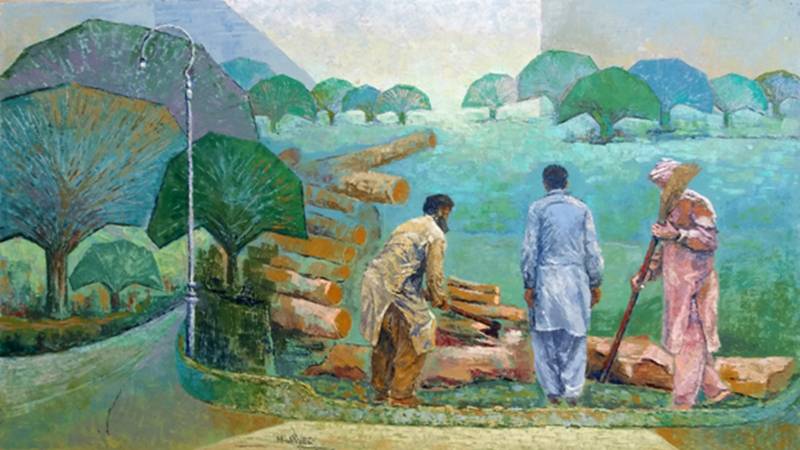
When asked what art means to him, Muhammad Javed gave a simple but powerful answer. He said that art is life itself. According to him, real art shows everyday life in such a way that we begin to feel its true energy and movement. Things that we usually ignore—because they seem routine or ordinary—actually carry a deep sense of life. Through art, these small and common moments become visible again. In this way, art does not just copy life; it helps us see the beauty, rhythm, and meaning that already exist around us but often go unnoticed. That is why Muhammad Javed’s depiction of Lahore feels so different from many other artists who have painted the city over the years. Instead of focusing only on famous landmarks or idealised views, he looks at Lahore from many angles. He pays attention to small, subtle details—things that are usually ignored or considered too ordinary to matter. These details give his work a sense of realism and depth. As a result, his paintings do not just show Lahore; they make us experience it, in all its movement, complexity, and everyday life.
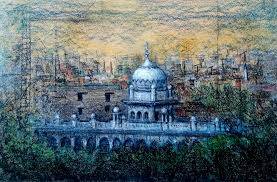
In Pakistan’s art world, where many artists have focused on tradition, abstraction, or elite themes, Muhammad Javed took a different and more grounded path. His innovation lies not just in how he paints, but in what he chooses to see. He turns ordinary urban life into art—showing that the streets of Lahore, in all their chaos and movement, are full of meaning.
A graduate of the first batch (1962) of the National College of Arts (NCA), Javed belongs to a generation that helped shape Pakistan’s early modern art. But unlike many of his contemporaries, he did not limit himself to studio ideas or classical inspiration. He stepped outside and observed the living city—its roads, crowds, protests, traffic, and everyday struggles. Over time, this became his signature style.
In Pakistan’s art world, where many artists have focused on tradition, abstraction, or elite themes, Muhammad Javed took a different and more grounded path
What makes Javed truly unique is his choice of subjects. He paints what most people ignore. Lahore’s underpasses, for example, are not usually seen as beautiful or meaningful spaces. They are simply places people pass through quickly. But in Javed’s paintings, these underpasses become part of the city’s story—showing movement, transition, and sometimes even isolation. He captures how the city flows above and below, creating layers of urban life.
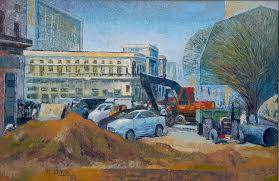
Similarly, his paintings of traffic rush reflect a reality every Lahori knows too well. From Regal Chowk to Canal Road, congestion is part of daily life. Cars, buses, motorcycles, and even tangas move together in a kind of organised chaos. While this scene is familiar, it is rarely treated as a subject of art. Javed changes that. He paints traffic not just as movement, but as energy—as a sign of a growing, struggling, and constantly shifting city.
His work also engages with protest, especially along Mall Road, which has long been a centre of political activity. For decades, people have gathered here to raise their voices, demand rights, and challenge authority. These protests are often captured by photographers for newspapers, but very few painters have taken them seriously as a subject. Javed is among the first to do so. He turns these temporary moments into lasting images, allowing us to reflect on their meaning.
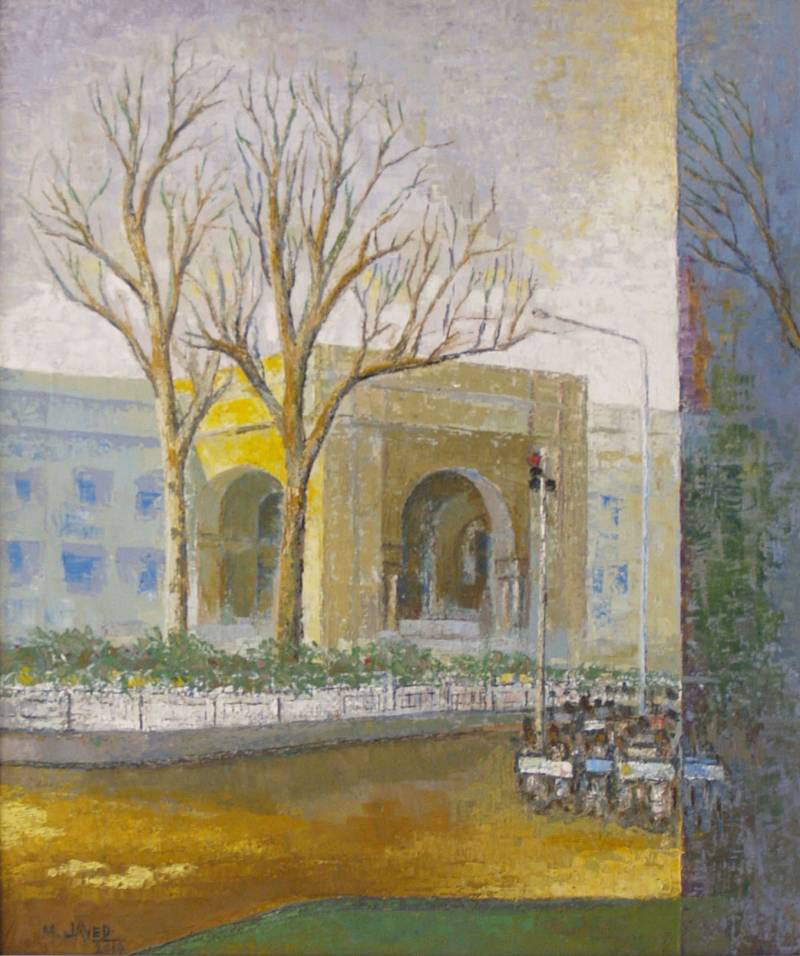
In one of his paintings, he even explores the presence of road barricades—but this is just one example among many themes in his work. These barricades, especially after 9/11, have become a common sight in Pakistani cities. They are part of the security system—placed to control movement and manage public gatherings. We see them every day, yet we rarely think about them. By painting such an object, Javed draws attention to how our public spaces have changed. He shows that even a simple barrier can carry deeper meanings about control, fear, and authority.
The theme of digging has remained a persistent and recurring feature of urban life in Lahore, yet it has seldom received meaningful attention from artists. It speaks not only to the constant material reshaping of the city through excavation and construction, but also to the disruptions and dislocations embedded in everyday urban experience. In this sense, digging becomes more than a physical act; it emerges as a metaphor for neglect, and continuous reconstruction. The subject thus opens up a rich visual and conceptual field that calls for deeper and more focused artistic engagement.
Another unusual theme in his work is the depiction of shopping malls—particularly electric stairs, or escalators. These are symbols of modern life, consumption, and changing lifestyles in urban Pakistan. Yet they are almost never painted. Javed’s decision to include them shows his awareness of how cities evolve. He is not only interested in old Lahore, but also in the new spaces that define contemporary life.
This wide range of subjects—underpasses, protests, traffic, barricades, malls—shows that Javed is not limited to one theme. Instead, he is interested in the experience of the city. His work reflects what many art critics now call the “urban turn,” where artists around the world focus on cities as spaces of social and political life. International artists like Ai Weiwei and Banksy have also explored public space and power, but Javed’s work is rooted firmly in Lahore.
What makes him different is his approach. He does not create loud or shocking images. He does not exaggerate. Instead, he observes carefully and paints with patience. His work invites the viewer to slow down and notice things they usually ignore.
An important moment in his career was his solo exhibition organised by the Department of Art History at the Institute of Global and Historical Studies, Government College University. This exhibition brought his work into an academic space, where students and scholars could engage with it seriously. It showed that his paintings are not just visual works, but also documents of social and historical change. The exhibition held at the Art Gallery of the Department of Art History, Institute of Global and Historical Studies, was organised by Shifa Ahmad and emerged as a significant academic and artistic milestone. The event received notable appreciation from the Vice Chancellor, Dr. Omar Chaudhry, who commended its scholarly and creative dimensions. Dr. Husain Ahmad Khan also expressed his appreciation, acknowledging the intellectual rigor and cultural value reflected in the exhibition.
Over more than fifty years, Javed has received many honours, including the Pride of Performance in 2022. But his real contribution goes beyond awards. He has changed the way we think about art in Pakistan. In a fast-moving world, where images come and go quickly, Muhammad Javed’s paintings ask us to pause. They remind us that the ordinary is not meaningless. A crowded road, a protest, an underpass, or even an escalator—these are all part of our shared life.
In the end, his message is simple but powerful: the city is not just a place we live in—it is a story we are part of. And through his art, Muhammad Javed makes sure that this story is seen, remembered, and understood.