

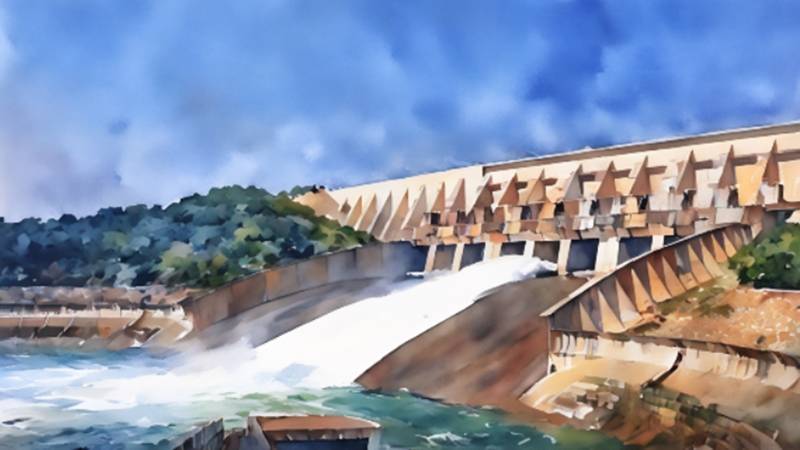
Signed in 1960 under Cold War pressure and immense geopolitical compulsions, the Indus Waters Treaty (IWT), now held in abeyance by New Delhi, has been often hailed as one of the most enduring water-sharing agreements between two South Asian neighbors —India and Pakistan. But beneath its façade of stability lies a more troubling legacy: ecological collapse. By slicing the Indus Basin into water quotas without regard for its environmental rhythms, the treaty has triggered the slow death of one of the world’s great river systems.
The IWT gave India exclusive rights to the eastern rivers—Ravi, Beas, and Sutlej—while assigning the western rivers—Indus, Jhelum, and Chenab—to Pakistan. The decision, engineered with technical input from the World Bank, aimed at avoiding future conflict, but it ignored the interconnected hydrology that had sustained the basin’s complex ecosystems for millennia. In the name of peace, rivers were treated as commodities, floodplains as wastelands, and seasonal tributaries as irrelevant. The most damning omission was the Hakra River.
Stretching approximately 1,100 kilometers, the Hakra originates in Haryana, India, and once meandered across Rajasthan, Cholistan, and Tharparkar before dispersing into its own delta in Badin. It was a vital floodway of the Sutlej, carrying seasonal flows that recharged aquifers and supported life across a largely arid region. Though now dry for most of the year, its channel tells a story of a living system ignored by political engineers. The IWT made no mention of the Hakra, severing it from the ecological and legal framework of the Indus Basin. With upstream diversions in India and no transboundary conservation mechanisms in place, the Hakra vanished from maps—and with it, the last lifeline of southern Punjab and Sindh’s desert communities.
The world has celebrated the IWT as a model of conflict avoidance, but in an era of climate disruption and water scarcity, survival demands more than avoiding war—it demands restoring life to rivers that sustain over 300 million people
The consequences have been devastating. Groundwater tables in the Cholistan desert have dropped alarmingly, often beyond the reach of mechanised borewells. In Rajasthan and Gujarat, where Sutlej waters were diverted via the Indira Gandhi Canal, the ecological returns have been negligible—impacting less than one percent of the desert area, while immense volumes of water evaporate or seep away. What was once a naturally recharging transboundary system has become an inefficient, loss-ridden contest of control.
Even more damaging has been the obliteration of Indus Basin’s floodplains—those seasonal, fertile zones that once absorbed monsoon overflows, filtered sediment, nurtured biodiversity, and sustained traditional livelihoods. With river flows now arrested behind upstream dams and canals, these floodplains have been starved of water and life. Once rich in grasses, fish nurseries, and migratory bird habitats, they have turned into cracked wastelands or have been aggressively converted into irrigated monocultures with little ecological value. The disappearance of seasonal flooding has broken the ancient rhythm between land and water, eliminating the very cycles that made subsistence agriculture viable in marginal zones.
For countless communities, the floodplains were not just ecosystems—they were economies. Pastoralists depended on the seasonal bloom for fodder. Fisherfolk thrived on breeding cycles aligned with monsoon pulses. Local farmers used the nutrient-rich silt deposits to grow crops without artificial inputs. With these patterns destroyed, so too are the livelihoods that were in harmony with nature. In their place, unsustainable pumping, chemical agriculture, and land salinisation have taken root—fuelling rural poverty and accelerating migration.
Further downstream, the Indus Delta has borne the brunt. This once lush ecosystem, sustained by 25 million acre-feet (MAF) of freshwater annually and 400 million tons of sediment, now receives less than 5 MAF and under 30 million tons of sediment. Over 90 percent of its wetlands have dried up. Mangroves have vanished. Sea intrusion has advanced 80 kilometers inland, displacing communities and salinising agricultural lands. What used to be Pakistan’s richest fisheries zone is now collapsing under the twin burdens of ecological neglect and policy indifference.
The real tragedy is that the Indus Basin’s ecological implosion is not a natural disaster—it is a political artifact. The IWT treated rivers as divisible rights rather than indivisible lifelines. It failed to account for shared aquifers, sediment flows, flood regimes, and the dynamic interplay of tributaries like the Hakra. In doing so, it locked both countries into a zero-sum framework of extraction, not sustainability. Today, both nations are rapidly exhausting their groundwater. Punjab’s water table is dropping by a meter annually. In many regions, arsenic contamination is rising due to over-pumping. The basin is bleeding out.
Repairing this ecological disaster will require far more than reinterpreting an outdated treaty. The first step is acknowledging that the Indus is a single, shared ecosystem, not a set of tradeable units. Any revised framework must begin with environmental flows, for both rivers and the delta, based on ecological necessity rather than political convenience. A second step must include the restoration of the Hakra corridor, not as a relic of the past, but as a shared recharge zone vital to the survival of Thar and Cholistan. Managed flood releases, wetland revival, and transboundary aquifer protection are all necessary components.
What’s needed is a shift from engineering control to ecological stewardship. A cooperative mechanism should be established to monitor flows, manage sediment, and involve communities on both sides of the border. The time is ripe for an ecological annexure to the IWT—one that introduces climate resilience, biodiversity safeguards, and delta preservation into the heart of water diplomacy.
The world has celebrated the IWT as a model of conflict avoidance, but in an era of climate disruption and water scarcity, survival demands more than avoiding war—it demands restoring life to rivers that sustain over 300 million people. The Indus cannot be managed as a fossilised accord between two states. It must be revived as a shared ecological trust.