

I do not know exactly how or, more precisely, whether, if at all, we were related, but Mamo, maternal uncle Moulai, was how he was known to everyone in the town, not just the family.
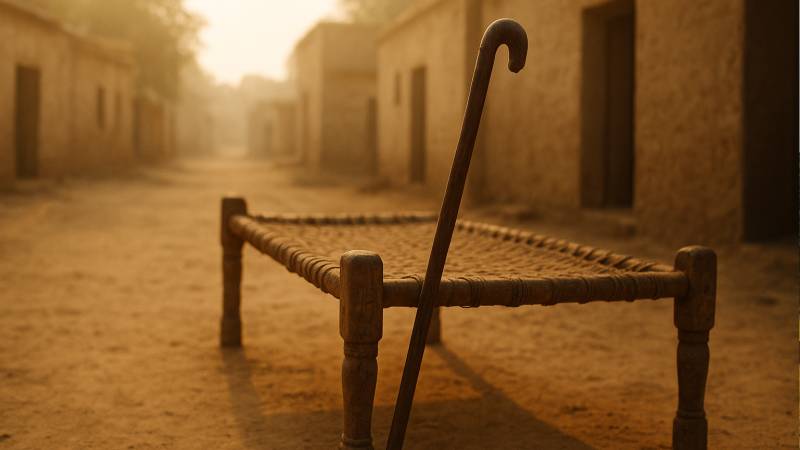
A small, delicately framed, octogenarian man with an unusually roaring voice, Mamo Moulai sported a mucky white beard and an equally dirty light turban that might have been white at some point in distant history. Underneath the discoloured piece of cloth, he wore a pair of dated round spectacles, one of the temples of which had been lost in time. The thick lenses, which made his eyes look bigger and, when he wanted to, dreadful, were constantly tied to his right ear with a string for want of the missing arm. On winter days, one always saw him wearing a suit jacket that must have been stylish and expensive when it was originally bought way back then. And, of course, he carried a raw wooden staff for support as well as to fend off stray dogs.
Even though I remember seeing him the way I describe him now, he was not always like that, however. From what I heard, Mamo Moulai had been quite debonair in his heyday.
In his youth, the word went, he was a flamboyant, fashionable young man who wore the best of the best clothes, spent money on expensive cigarettes, and lived his life to the fullest.
Even in later days, when the men around his own age, or a few years younger, gathered at a wedding or some other event, Mamo would be teased about his past escapades. On those special occasions, hoping to catch a juicy story or two, I would try to linger on the edges, feigning disinterest. Sometimes, my invisibility paid off. Other times, I would be shooed away.
But what I gathered was interesting. For example, someone present would playfully ask him to recount the story of how, hooked by a woman on a train, he had ended up following her all the way to Khanpur in Punjab. Or how, while visiting a friend in some other town and seeing a damsel gazing at him from the window of a neighbouring house, he had to climb the walls of her house twice in the night, once to meet her, and then again to extricate himself when her parents got up. Or when… A shy, innocent smile would appear on his wrinkled, toothless face. Pretending to protest, he would ask them to shut up in a manner which indicated that he was enjoying the teasing and endorsing the stories.
But he was a fearless man, no doubt. I vividly remember one incident from my childhood. One early summer morning, I was woken up by an unusual hubbub. The house right across the street from ours had been broken into during the night. While everyone was sleeping in the courtyard, intoxicated by the famous cool southern breeze of Rohri, in the wee hours, the thieves entered the house and took away everything. Empty, broken suitcases and trunks were spotted on the nearby barren, desert hills. The family, knowing full well that nothing would come of it, dutifully reported the incident to the police nonetheless.
The man walked to the affected house with the swagger of a king, completely ignoring the curious bystanders
Presently, a rickshaw arrived at the crime scene, from which a fat man in the uniform of a police sub-inspector (SI) emerged, with two constables on bicycles in tow.
The man walked to the affected house with the swagger of a king, completely ignoring the curious bystanders. A chair was arranged hurriedly for him, and a small table was laid in front of it. The family’s women, although devastated by their loss, quickly prepared tea, which was presented to the king with a plate full of biscuits. The tea was also presented to the constables, who had settled themselves on the charpoys, pretending to investigate the matter.
As the SI sat majestically with one leg over the other, devouring his tea and biscuits with an air of indifference, only occasionally throwing a contemptuous look at his subjects as if all of them were thieves, in walked Mamo Moulai.
He looked around as if to inspect the site. As his eyes moved towards the police officer, he paused for a moment and then, unfazed by his uniform, in a condescending tone said to the SI, “Arre! Toon Deen Mohammad ta nahen, jeko railway mein gangman huyo?” (Oye, aren’t you Deen Mohammad, who used to be a petty gangman in the railway?)
The crude words fell like a bomb on the spectators’ and, more so, on the target’s unbelieving ears. Everyone, stunned at the downright sacrilege, watched the SI with bated breath for his reaction.
Shocked by this sudden dressing down, the SI immediately rose from the chair as if to discipline the blasphemer, but then, unexpectedly, as he recognised the man, his facial expressions changed. In a low tone, he said, “Ha Mama. Maan uho ee Deen Mohammad Ahiyan” (Yes, Mama. I am the same Deen Mohammad).
“Tadahen ta sanhro hoondo huyen,” (You were very thin then), Mamo continued, “Haane dando thi payo ahen” (Now you have become quite a fatso!).
“Ha, Mama. Haraam lago ahe,” (Yes, Mama. Graft has gotten on me), replied the officer brazenly with a nervous laugh. But he did not stay long afterwards. Leaving the investigation to his subordinates, he never returned.
Some in the family, us brothers especially, owe their education to Mamo Moulai.
He would collect a few boys from the neighbourhood and have the slacker tango taali-ed, danda doli in Urdu, lifted by his arms and legs, all the way to the school
Now a successful, educated man, in his primary school days, one of my brothers, let us call him ‘Mr P’ for the sake of secrecy and to protect his now-acquired respect, was not very keen on going to school. My father found the solution in the shape of Mamo Moulai and entrusted him with the task of ensuring our brothers’ attendance at school every day.
From that day on, without fail, immediately after sunrise, the household would be woken up by loud knocking at the gate to our compound. It was Mamo Moulai, reporting for duty with the punctuality of a military academy drill sergeant, hitting the door with his staff feverishly until the door opened.
Once inside, with the brashness of a Subedar Major, he would shout “Jaldi kayo” (Hurry up), make a beeline to one of us brothers’ charpoys and start hitting the bed legs with his staff until all of us got up. Mamo would then make himself at home on a charpoy, enjoying a piyalo, a porcelain cup, formal tea and dinner sets rested on the wall-mounted racks for the formal guests, of hot tea, shouting intermittently “Jaldi kayo,” (Hurry up) until all of us got ready and fell in. He would then escort us half a mile to the school.
For the days when Mr P did not feel like going to school, Mamo Moulai had other arrangements in place. He would collect a few boys from the neighbourhood and have the slacker tango taali-ed, danda doli in Urdu, lifted by his arms and legs, all the way to the school. Up until the gate of the school, Mr P would keep on crying and using the choicest expletives, “tunhenji maa…,” “tunhenji bhen…” for Mamo Moulai and the boys carrying him. Mamo Moulai quietly endured the barrage of curses with a big grin on his face. At the school gate, however, Mr P would request to be set down. Once released, Mr P would wipe his face, straighten his clothes, and walk to school graciously as if nothing had happened.
In the matter of his duties, Mamo Moulai was a strict disciplinarian. He listened to no one. One day, when Mr P made an excuse that he was not feeling well, my father requested Mamo Moulai to spare Mr P. This intervention so enraged Mamo Moulai that he did the unthinkable. He hit my father with his staff, shouting, “Wich mein na pao” (Do not interfere in my duty). My father quietly stepped aside and let him have his way. Mamo had Mr P carried to school triumphantly.
This did not end well, though. Accustomed to taking us brothers to school without obstruction from parents, he thought he enjoyed the same impunity with my cousins as well.
One morning, as he came to send us off to school, he noticed that one of my cousins was making excuses. He went to his bed, hitting the bed leg, and shouted in his booming voice, “Tiyar thi” (Get ready). The boy got scared and started crying loudly. Seeing this, my uncle, the boy’s father, turned to Mamo Moulai and, in the same loud voice, said to him, “Do not you dare shout at my kids.”
Silence descended on the whole house. Mamo Moulai was stunned for a moment. He looked at my uncle in disbelief. Then, with his head hanging low, he slowly turned to my father. With moist eyes and a voice choked with pain, he said to Baba, “Mushtaque Ahmed Khan, I shouted at your kids. I hit them with my stick. I even hit you. You are the head of the family, the elder of the whole clan, and still you never said a word to me.”
Mamo Moulai then wiped his eye, turned around, and, despite my father’s pleas to stay on and take us to school, with drooping shoulders and heavy steps, walked away.
That was the last time. We never woke up to the loud banging on the gate at sunrise ever afterwards.