

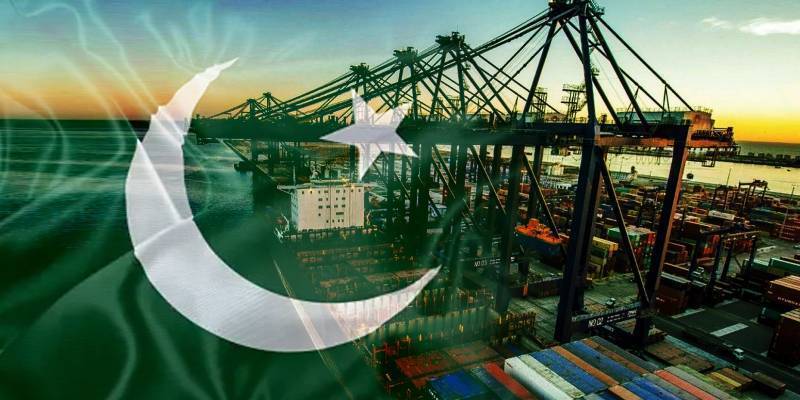
In April 2026, Gwadar Port handled around 11,000 shipping containers, more than it handled in all of 2025. Officials in Islamabad are calling this proof that a decade of investment has finally paid off. The numbers tell a different story when you look at what was happening at Karachi at the same time, and at what it has been costing importers across the country to find out.
The Strait of Hormuz has been effectively closed since late February, when the United States and Israel launched military operations against Iran. Major container lines suspended transits. Cargo bound for Iran, Central Asia, and parts of the Gulf needed a new way through. Pakistan, by accident of geography, sat at the alternative: Gwadar is 400 kilometres from Hormuz on the safe side of the Arabian Sea. Around 3,000 Iran-bound containers piled up at Karachi and Port Qasim through March and most of April, until the government activated a land transit corridor on 25 April. Karachi's own transhipment volumes rose to 8,860 containers in the first 24 days of March alone, more than the city's port handled in all of 2025.
That headline number masks a much harder one. The average vessel waiting time at Karachi in early April was 5.5 days, compared with 1.5 days at Colombo and 1 day at Chennai. Cargo that arrives at Pakistani ports does not move out of them at a competitive speed: average clearance dwell ranges from three to six days against an international target of 48 hours for imports, and a 2024 report by the Pakistan National Shipping Corporation found that 63 percent of containers at Karachi exceed their free-time allowances.
Demurrage charges in Pakistan run from $85 to $290 per container per day. A vessel with 1,000 containers, held a week past free time, can bleed importers tens of thousands of dollars before a single box reaches a warehouse. The Afghanistan transit closure earlier this year showed what that bleed looks like at scale: roughly 10,000 stranded containers, an estimated $40 million lost over three months, and demurrage of about $120 per container per day eating into a trade that normally generates around $160 million in annual revenue for Pakistan. The Hormuz surge is not earning that revenue. It is testing whether the system can carry it, and the system is buckling at exactly the seams we already knew were weak.
Gwadar cannot relieve the pressure. The port's approach channel is maintained at roughly 12.5 metres, compared with a designed depth of 14 metres, due to insufficient dredging. Vessels with a 13- to 14-metre draft for standard global container services cannot dock there. A port that cannot receive the world's working container fleet cannot become a regional hub, regardless of the scale of investment behind it.
Pakistan's geography has not changed in 5,000 years. What changed in 2026 is the world's willingness to detour through Pakistan when it had no other choice
No international shipping line has scheduled a permanent route to Gwadar; every vessel currently calling there is doing so on a temporary or transhipment basis. The China-Pakistan Economic Corridor master plan of 2015 projected that Gwadar would handle 400 million tons a year by 2045. Actual throughput has stayed in the low single-digit millions, a gap of two orders of magnitude that no revised model has been published to explain.
Dubai's Jebel Ali and Colombo, meanwhile, are doing what Gwadar was designed to do: receiving the world's largest container vessels, maintaining scheduled routes, and clearing cargo faster than Karachi can clear it through customs. Neither port has Gwadar's geographic advantage. Both have what Gwadar lacks: a system that delivers on its promises.
This is not the first time an external disruption has tested the system. When the Ever Given blocked the Suez Canal in March 2021, ports on alternative routes via the Arabian Sea saw a brief spike in activity. Vessel calls rose. Press statements followed. The spikes ended when the disruption ended. The 2026 Hormuz surge follows the same pattern. When the Strait reopens, the surge subsides, and what remains is what was already there.
Successive governments have not been unaware of the problem. Karachi port charges were cut by 50 percent in July 2025. A high-level committee on container dwell times set a 70 percent reduction target in the same month. Gwadar's transhipment tariffs were cut by 40 percent in May 2026. Each measure addresses the symptom and not the cause. A tariff cut cannot dredge a channel. A discount cannot move a container through Karachi customs any faster. A discount cannot persuade a major shipping line to commit to a route that the port physically cannot yet receive.
Two fixes would change the trajectory, and neither is exotic. The first is to dredge Gwadar to its designed depth of 14 metres before the next disruption forces the question again. Maintenance dredging costs a small fraction of what has already been spent on terminal construction, airport development, and port security. Without it, no scheduled route is coming. With it, the conversation with the world's shipping lines changes from charity to commerce.
The second is to reduce Karachi's customs and clearance dwell times, with accountability for delivery. The Ministry of Maritime Affairs finalised a set of dwell-time recommendations in August 2025 and directed the Federal Board of Revenue to prepare an implementation plan within two weeks. Nine months later, importers are still waiting at 5.5-day vessel queues and paying $85 to $290 per container per day for the privilege. The problem is not that we lack recommendations. It is that no one is held responsible for delivering them.
Pakistan's geography has not changed in 5,000 years. What changed in 2026 is the world's willingness to detour through Pakistan when it had no other choice. A stress test arrived, uninvited, and the system failed it in exactly the parts we already knew were broken. The next disruption will come. The question is whether we will have used this one.