

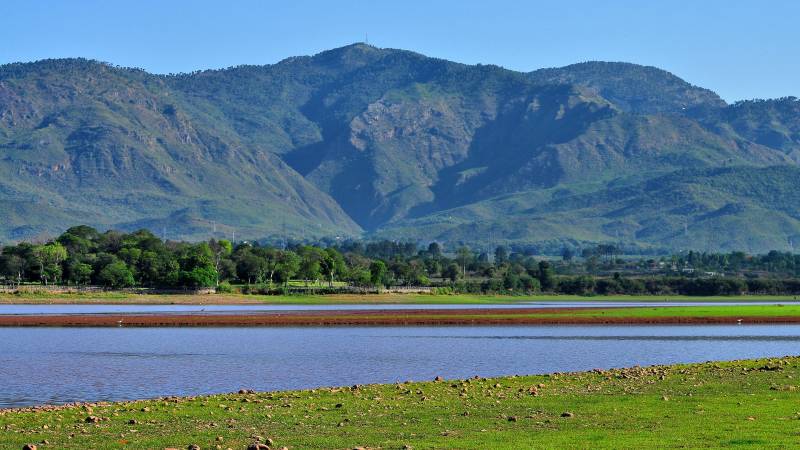
We write as concerned citizens on a matter that deserves the Prime Minister's direct, personal attention: the slow collapse of the watershed that supplies drinking water to Rawalpindi and Islamabad — the Rawal, Simly and Khanpur catchments, fed by the forests stretching from Murree to Patriata.
This appeal carries new urgency because India has already suspended the Indus Waters Treaty, placing the future reliability of the western rivers themselves in doubt. At a moment when the security of our shared river system is under direct challenge from across the border, it would be a grave failure of foresight to simultaneously allow our own local watersheds — the ones entirely within our control, costing nothing to protect — to collapse through neglect. We cannot control what India does with the Indus, Chenab and Jhelum under a suspended treaty. We can control whether Rawal, Simly and Khanpur survive.
The British administration that once governed this region treated watershed protection as a matter of military necessity, not aesthetics. Sir John Simon's 1872 report on the cholera epidemic in Rawalpindi documented, in stark detail, how contaminated water sickened a garrison cantonment that depended on it. Later, another report by Charles Moore Jessop, M.E.C.P., Brigade Surgeon, H.M.'s British Forces, London, in 1883, reinforced the lesson the colonial administration took seriously enough to place the forested springs feeding Murree, Rawalpindi and the cantonment under formal protection. The conviction behind that policy was simple: an army cannot be sustained on contaminated water. We ask the government to revive that same conviction today, for the soldiers and families of GHQ Rawalpindi, PAF Chaklala, and all other citizens of the Twin Cities who depend on this same watershed.
The Prime Minister's Office issues frequent statements affirming its support for, and pride in, the Pakistan military. We take that sentiment at face value — but sentiment alone does not protect anyone's health. The most concrete, least rhetorical way to honour that support is to guarantee that GHQ Rawalpindi and the families living around it have safe, uncontaminated drinking water, rather than supplying that support only in speeches while the watershed feeding their cantonment continues to be encroached upon, deforested, and polluted by untreated sewage. Praise is free. Protecting the water supply of the men and families it is meant to honour is not, and it is well past time that one was matched by the other.
India faced the same crisis in Delhi, Mumbai, Bengaluru and Chennai, and chose to act. Mumbai placed its Tansa and Vaitarna catchment forests under Eco-Sensitive Zone protection. Delhi protected the Asola-Bhatti forest belt that feeds its aquifers. Across the Western Ghats, entire catchments received binding legal protection specifically to secure drinking water for tens of millions of people. Where India fenced its watershed forests and posted guards, our own catchments above Rawal Dam have been left open to encroachment, unregulated construction, and untreated sewage discharge into the Korang River. India treated its water as a matter of national security. We have not yet done the same, and we believe Pakistan still has time to choose differently.
A government that cannot find the money to expand FEWS coverage, modernise FFC's flood-design standards, or fund a basic watershed protection scheme should not be financing a glass train as a matter of prestige
We ask, first, that the watershed corridor from Rawal Dam to Murree, together with the full catchments of Simly and Khanpur, be formally declared a National Protected Area — placed on record with UNESCO, the World Bank, the European Union, and the UK High Commission, whose archives at the British Library and the FAO's own Running Pure study document precisely how this watershed was once managed and protected.
We respectfully acknowledge the Punjab Government's anti-encroachment drive in Murree as a genuinely necessary and overdue step, and we ask that it be matched by an equally firm decision at the federal and provincial levels to halt further mega-tourism development on these forested slopes — new hotels, large-scale housing, and transport infrastructure built directly on the catchment that sustains two cities. Tourism revenue today cannot be allowed to come at the cost of water security tomorrow; the cost of replacing a destroyed natural catchment will always exceed whatever short-term revenue its destruction generates.
This is precisely why the proposed Murree Glass Train and the broader push to remake Murree into a mega tourist destination deserve public scrutiny rather than celebration. At a time when Pakistan is in fiscal crisis, servicing a punishing debt burden and asking the public for sacrifice on every front, financing an elevated tourist railway into an already overcrowded hill station is not infrastructure — it is a showpiece. It will not solve Murree's water crisis; it will deepen it by bringing a larger volume of tourists onto slopes that already cannot support the people living there, and by adding a new construction burden to the very catchment this letter asks the government to protect.
A government that cannot find the money to expand FEWS coverage, modernise FFC's flood-design standards, or fund a basic watershed protection scheme should not be financing a glass train as a matter of prestige. The same money — and far less of it — would do more lasting good if spent on reforestation of the denuded slopes above Rawal, Simly and Khanpur, and on the overdue eviction and removal of illegal housing societies that have been allowed to encroach directly onto the Rawal Dam watershed. One path buys a photograph. The other buys the drinking water of two cities for the next fifty years.
We raise the alternative because we anticipate the objection: if Rawal, Simly or Khanpur fail, can water simply be lifted from the Indus instead? It cannot, in any practical or fiscally sound sense. The elevation gain required to deliver Indus water to Islamabad and Rawalpindi exceeds 850 feet. Lifting and conveying that volume of water over that height would require continuous, large-scale pumping infrastructure, sustained high energy consumption, and a conveyance and pumping system whose civil works, energy costs, and redundancy requirements would cost no less than USD 3 billion to build — effectively constructing an entirely new water supply system from scratch for a purpose no existing scheme on the Indus was designed to serve.
The capital cost is only part of the concern. A scheme of this scale carries a permanent, substantial recurring energy and maintenance bill that would have to be paid indefinitely, year after year, regardless of rainfall. Recurring expenditures of this magnitude, routed through agencies such as the Capital Development Authority and WASA Rawalpindi, create exactly the kind of large, discretionary, hard-to-audit cash flows that have historically invited financial mismanagement in public utilities of this kind. We say this not to prejudge any individual or institution, but as a structural governance risk that should itself weigh against choosing an expensive engineered fallback over protecting a watershed that costs nothing to preserve, and a great deal to replace.
The decision before the government is, in the truest sense, a rare one: a single act of protection that secures the water, and by extension the health and security, of two cities and the forces headquartered within them, for generations. We ask that this be treated as a personal priority by the Prime Minister, and we stand ready to provide the full technical record — historical, hydrological, and comparative — that supports it.