

In Sindh, particularly late period of the Talpur era, one could find a wealth of Hindu Sants’ poetry devoted to the life of the Prophet Muhammad (Peace be Upon Him) and the tragedy of Karbala. Likewise, some prominent writers penned biographical works on the Prophet’s life and Islamic heroes. In this vein, the kalam of Sufi Aasuram Faqeer stands as a prime example. This tradition endured well into the earlier decades of the English period, and to some extent, the Theosophical Society and other pluralistic institutions played their part in sustaining this culture of co-existence and compassion. Other contributing factors included common Maktabs, the Persian language, and shared Murshids. The Bhakti movement, Sufi tradition, and the influence of Shah Inayat Shaheed, even Sindh’s unique geography, may also have shaped this ethos.
As mentioned earlier, Sufi Aasuram Faqeer’s poetry is a vivid testament to pluralism. It is fitting, therefore, to present a brief biographical note on him. He was born in 1854 in Old Hala, then Hyderabad District (now Matiari District). His father was Daandu Mal, who belonged to the Brahmin Khatri lineage. Daandu Mal had two sons: Ramchand, the elder, and Aasuram, the younger.
From childhood, Sufi Aasuram possessed a thoughtful, reflective personality. He often sought the company of Sadhus and Faqirs, or found solace by the banks of the Indus River and within its riverine forests. During those early days, Sufi Aasuram was intimately acquainted with Syed Faqeer Ali Shah, also a resident of Old Hala. Syed Faqir Ali Shah was blind, yet he had mastered traditional medicine (Unani Hikmat) and certain Sufi traditions. Aasuram, even before formal schooling, was a frequent visitor to Syed Faqeer Ali's Mutab or Autaq. Later, he was admitted to a school. However, at the age of 12, his family began to notice traits of an eclectic spirit.
After finishing primary education, he passed the Sindhi Final (a vernacular examination for junior government jobs) in 1871. This qualification allowed him to secure a position as a Primary School Teacher. In those days, early marriages were common, and so Aasuram was also married within the Brahmin Khatri community. He had one son and two daughters. However, in between time-bound job and family affairs he sliced some to enrich his informal learning by studying fundamental texts of Hinduism, Islam, and Christianity. The Bible, Quran, and Bhagavad Gita were his constant companions by his nightstand. It is said he had even memorised the entire Diwan-e-Hafiz. He also transcribed the Holy Quran with his own hand, a manuscript still preserved by his family members with deep reverence and respect.
Beyond Sindhi, his mother tongue, he was equally adept in Arabic and Persian. Yet, he often journeyed, either alone or with like-minded friends, to Sufi dargahs, shrines, mandirs, and gurudwaras. In all his spiritual quests and drives, Saeen Vilayatrai of Hala was his steadfast companion. Afterwards, his years of service made him eligible for admission to the Teachers’ Training College in Hyderabad. In those days, this in-service course spanned three years.
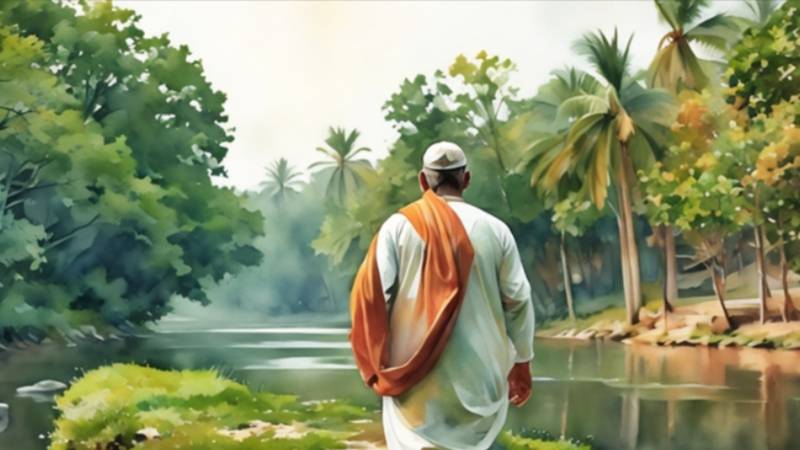
He often sought the company of Sadhus and Faqirs, or found solace by the banks of the Indus River and within its riverine forests
Sufi Aasuram Faqir completed his course from the Teachers’ Training College in 1874. Soon after, he was appointed as an Assistant Teacher and posted in the village of Phaka, Taluka Johi, District Larkana (now village falls into Jamshoro district), Sindh. He was later transferred to Johi town, Kahndo and Nasarpur, and also served in other villages and towns across Sindh. When was posted at Nasarpur after his official duties, he would seek the company of Syed Misri Shah Rizvi. During this same period, he became familiar with Jhok Shareef. The Jhok tradition enriched his ideology of “Oneness”. His frequent visits deepened his ideas of pluralism, co-existence, and respect for nature. He composed many poems in praise of Jhok saints. He regularly visited Jhok Shareef, where a dedicated space, known in Sindhi as a 'bbari', was set aside for him to sing spiritual songs with his disciples.
His love for Shah Inayat Shaheed was boundless; he also marked the 17th of Hazrat Shah Inayatullah Shaheed and the 11th in honour of Ghaus-e-Azam Hazrat Sheikh Abdul Qadir Jeelani. At both gatherings, his disciples would recite his poetry, and a communal meal was served. In both events, Muslims and Hindus alike, his followers, and even common folk, were welcomed to listen and partake of the shared meal. He maintained this tradition until his death, though after some years, due to Partition and other socio-culturally unsupportive conditions, his family members were unable to continue this communal tradition of pluralism.
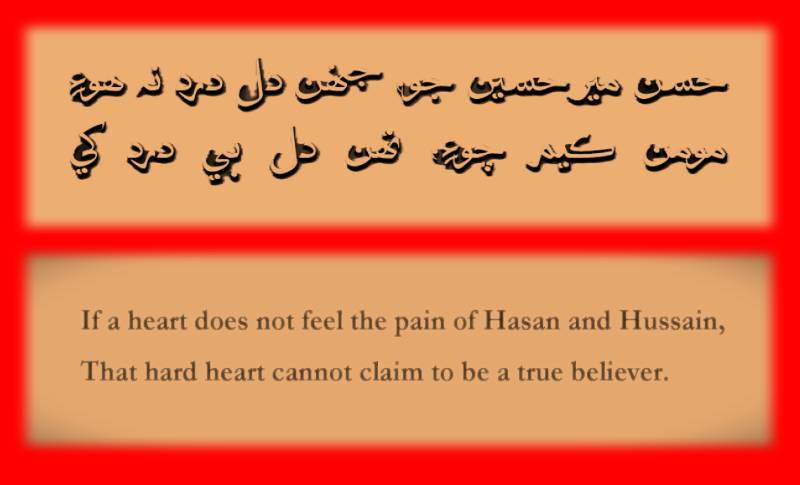
Additionally, in his poetry, he lauded the Prophet Muhammad (Peace be Upon Him) and sadly depicted Karbala and the sacrifices of Imam Hasan and Imam Hussain.
In most Sufi thought, having a murshid is a universal practice. Two sources affirm Sufi Aasuram's search for a murshid, offering some clues. The Janam Saakhi Shabd, authored by Sufi Aasuram himself, states that he found his murshid at the age of twenty-two. However, Moroo Mal Dhandha's Sindhi Brahmin Khatrian jo Dharmik aen Samajhak Ithas suggests that Sufi Aasuram became a disciple while he was a teacher in the village of Phaka in Johi. Apparently, both facts seem correct, but we only need to correlate his age at the time of his posting at Phaka village. However, the most significant detail missing from both sources is the name of his murshid – what was his name, and to which Sufi tradition did he himself belong?
According to his great grandson Aakash Asswani told me by quoting Thanwar Das that Noor Muhammad Shah of Tando Muhammad Khan was Sufi Aasuram's murshid (he was the brother of Pir Abdul Sattar Shah-Awal, the sixth gaadi nasheen of the Jhok shrine). While many scholars have, until now, held reservations about the murshid's name, some of Sufi Aasuram's own poems settle the matter, confirming Noor Muhammad as his spiritual guide.
Various sources mention that Sufi Aasuram, apart from his spiritual nature, was also renowned for two other acquired abilities. One was Hikmat. He was well-known and, in Sindhi, was called a Vejj (expert traditional hakim). In this regard, he always acknowledged Syed Faqeer Ali Shah as his teacher. He retired from his teaching position at the age of 55 in 1909, and soon, he established his davakhano (clinic/dispensary). Soon, people flocked to him. He blended psychological insights and prayers with his medicine, and notably, he charged nothing for his services. He took his grandson, Bhagat Odhab Das, under his wing and trained him. After Sufi Aasuram’s death, this became a family enterprise and continues to this day.
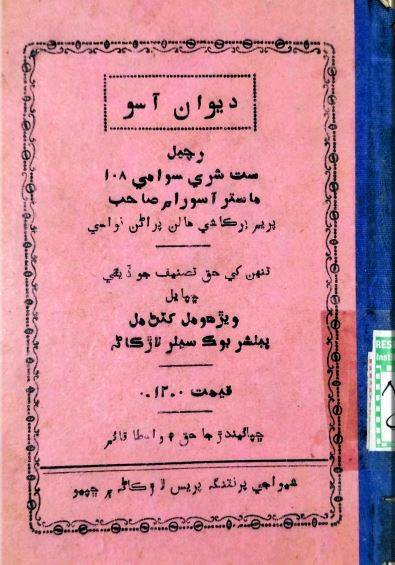
At that time (after his retirement), Sufi Aasuram adopted Sufi attire, which included a geru patko (ochre turban), a qameez (long shirt), and shalwar (wide Sindhi-style trousers). Additionally, he always carried a berragin (a wooden stick, commonly used by saints and dervishes in those days). He also ceased trimming his hair, allowing his long locks to part and fall over his shoulders, and his Sindhi-style beard, coupled with his tall stature, added to his persona as a Sindhi saint. As mentioned earlier, he spent most of his time in contemplation and expressed his thoughts in kafi, ghazal, vai, and bait. Regarding Aasuram’s poetic development, scholars generally agree that his reflective and sublime nature was the main reason he became an iconic Sufi poet, but they also add that Syed Misri Shah’s company played a profound part. His poetry can be found in his published anthology and various manuscripts. Sufi Aasuram’s only known anthology, titled Diwan-e-Aassu, was a posthumous publication. The credit for this publication goes to Verhomal Khatanmal, who was a book seller of Larkana. It was printed at Shivajee Printing Press, Larkana. It contained poems from his manuscripts such as Weraag Namoo (also called Prem Gunchah) and Rissalo Aassu Mal Sufi.
An unexplored aspect of the Sufi tradition of those times is to trace the influences of various poets, saints, and dervishes’ suhbat (company, conversation, meeting) shaped their thoughts and poetic styles. In this connection, it seems apt to assume that Sufi Aasuram’s ideas and poetry were shaped by both the companionship and the poetic works of his contemporaries. Some of his contemporaries included Syed Faqeer Ali Shah, Faqeer Miskeen Shah, Syed Misri Shah Rizvi, and Syed Saman Shah Sarkar. Various documents indicate that Syed Misri Shah and Syed Saman Sarkar visited him in Old Hala on several occasions. Other notable contemporaries were Faqeer Nawab Wali Muhammad Khan Laghari and Syed Rakhyal Shah.
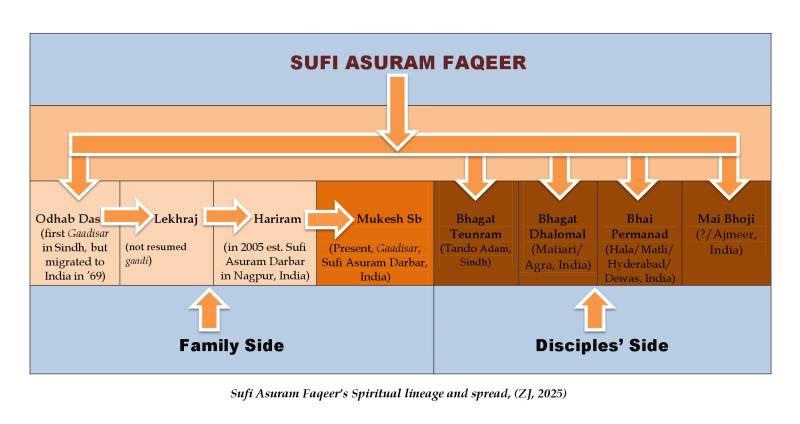
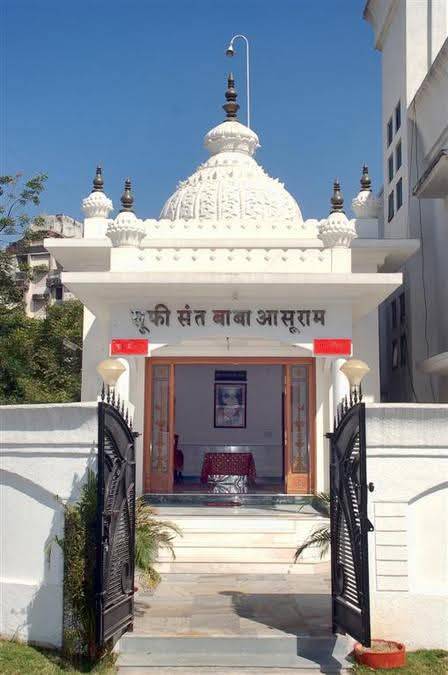
Sufi Aasuram Faqeer passed away on 15 February 1941, at the age of 87. In keeping with Hindu tradition, his body was cremated. However, he had conveyed to his family that the hair on his fingers would not burn and should be preserved. This proved true; none of the hair on his fingers was consumed by the flames. His family members preserved these relics, and a samadhi (shrine) was erected where he used to pray and sing devotional songs. After Partition, the family members dismantled the samadhi and again preserved the relics, which were then handed to Hariram, who took them to Nagpur, India. There, they were buried, and a darbar was constructed. The disciples of Sufi Aasuram Faqeer were scattered across other areas of Sindh. Among them, Bhagat Teunram became a famous spiritual personality. In fact, while Sufi Aasuram was a teacher at village Khandu (now Taluka Hala New, District Matiari, Sindh), Bhagat Teunram, as a boy, was deeply influenced and became his disciple at a quite early age. Besides Bhagat Teunram, there was another devout follower named Mai Bhoji, who was a regular at his satsangs.
Other equally famous devotees included Bhagat Dhalomal and Bhai Permanad. Of all of them, Bhagat Teunram was the one who continued his tradition. However, the gaadi nasheeni (succession to the spiritual seat) of Sufi Aasuram Faqeer has, however, been maintained through his family line. Aakash Asswani, a grandson of Sufi Aasuram Faqeer, informed this scribe that after Sufi Aasuram Faqeer’s death, his grandson Bhagat Odhabdas was seated on his gaadi. However, soon after Partition, he migrated to India, and Hakeem Lekhraj was asked to continue the gaadi, but he did not. Afterwards, Bhagat Hariram was made head to continue the spiritual lineage of Sufi Aasuram Faqeer. But he, too, soon migrated to India, taking the sankhs (sacred bones of the deceased) with him, where he established Sufi Aasuram Faqeer’s darbar in Nagpur, India. Now, his son Mukesh Kumar is the gaadi nasheen of Darbar Sufi Aasuram Faqeer. Sufi Faqeer Aasuram's versi/urs (death anniversary) was held in Old Hala before Partition. But after Partition, it is celebrated on Mangh 18 of Sindhi calendar, in Nagpur, India. Additionally, Mai Bhoji, a disciple, also celebrated it at Ajmer Sharif. Now, her grandson Daryano Mal holds a similar fair there.
Let me end this write-up with a personal note: as I reached the end of this account, some questions arose in my mind about how Partition so fragmented the coherent culture of the subcontinent. Just imagine, how scholars, authors, and poets were once working side by side, praising the lives of Muhammad (Peace be Upon Him) and other Sufi scholars – it is a huge loss that no time machine could ever reverse.