

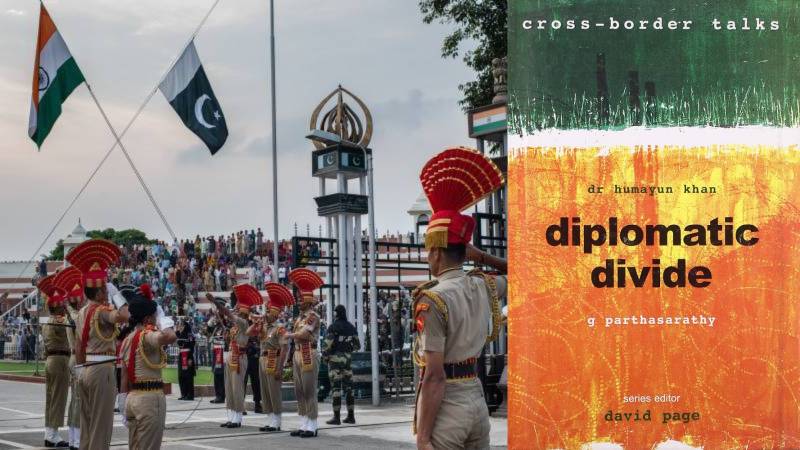
Diplomatic Divide is a highly readable, informative and interesting published initiative by the star of the Pakistan Foreign Service, Dr Humayun Khan, who retired as the Foreign Secretary of Pakistan.
This initiative is, in fact, the work of two senior diplomats who served as the heads of their diplomatic missions in India and Pakistan. Dr Humayun was the Pakistan High Commissioner in India, and Gopalaswami Parthasarathy was the Indian High Commissioner in Pakistan.
The prevalent opinion in Pakistan about India has always been that India has never accepted the partition of India and that a cardinal initiative of all Indian political leaders has always been to destroy Pakistan. Dr Humayun Khan very loudly and openly disagreed with this opinion, whereas Mr Parthasarathy appears to be extremely anti-Pakistan with rather rabid extremist views about India–Pakistan relations.
This account of relations between the two countries covers the period from the 1980s to the present time. Some historical events and happenings covered are the end of the Cold War, liberalisation of world trade, the growth of fundamentalism and the communications revolution.
The account gives extensive coverage to historical personalities of both countries such as Indira Gandhi, Rajiv Gandhi, Atal Bihari Vajpayee, Zia ul Haq, Benazir Bhutto, Nawaz Sharif and Pervez Musharraf. Dr Humayun, in Delhi, played a significant role in the service of Pakistan during the crisis of the Indian massive exercise code-named “Operation Brass Tacks” and was instrumental in defusing the crisis.
The Agra Summit Conference and the Kargil skirmish are dealt with in a very professional manner, while Vajpayee’s peace initiative and the bus journey to Lahore provide some very interesting details of this historic event. This thoughtful and insightful work by two senior diplomats appears to be a sincere effort to bridge the divide between the two nuclear-armed neighbours of South Asia.
In the words of Dr Humayun Khan:
“Acting on the basic assumption that India’s ultimate aim has always been to destroy Pakistan (an assumption I have never subscribed to) it was argued that internal unrest in a border state weakened the enemy’s military bridgehead and consequently reduced the danger of an invasion. This is quite understandable in a country which is obsessed with its security.”
Successive Pakistani governments have paid more attention to forging regional and global alliances to attain parity with India than to improving living conditions for its people
And on the other hand, G. Parthasarathy opines:
“Pakistan is today at the crossroads of its history. It can either choose the path of giving primary importance to issues of economic and human development or continue with its present policies of confrontation with India, advocacy of jihad and worldwide Islamic causes. If it chooses the former path, then India should be prepared to reciprocate.”
Dr Humayun Khan passed away on 22nd September 2022, and Pakistan lost a true patriot, brilliant diplomat, thinker, philosopher and a sage of very high calibre. He has been described as a Pashtun in the mould of the Frontier Gandhi, Khan Abdul Ghaffar Khan, who believed passionately in complete peace between India and Pakistan and diplomatic relations similar to those between the USA and Canada.
Dr Humayun was a great humanist and believed in moving above the tactical, looking forward to a common and secure future for both states. He devoted his life to the cause of India–Pakistan peace and friendship but left this world without the culmination of his fond wishes.
Humayun Lala, as he was fondly called by people near him, believed passionately that to remove the animosity and acrimony between the two countries, India must show magnanimity and a large heart, and Pakistan must develop a more thoughtful head. With courage and new initiative, all problems and irritants between the two countries could be removed.
Dr Humayun belonged to a distinguished family of Peshawar and received his early education at the Bishop Cotton School in Simla. He later achieved a Tripos from Trinity, Cambridge University. He joined the Civil Service of Pakistan and later moved to the Pakistan Foreign Service.
He also held a Master’s degree from Cambridge, was called to the Bar from Lincoln’s Inn, London in 1954, and earned another MA and a doctorate from the University of Southern California. He moved to the Foreign Service in 1973 and served in the country’s missions in Moscow and Geneva, as Ambassador to Bangladesh, Ambassador to India and High Commissioner in the UK.
This book deals in detail with how India and Pakistan have behaved and traded messages in a neighbourly relationship that defies logic or rational diplomatic behaviour. This is an imaginative first volume on relations between the two countries under the banner of cross-border talks.
Indians and Pakistanis alike can analyse and discuss the issues that divide the two countries as elaborated in this insightful account. Within the pages of this book, two highly educated and experienced diplomats who have served in both countries elaborate on the points of difference in the context of their personal experiences and professional opinions.
As the series editor David Page underlines in his introduction, this dialogue is crucial “if the two countries are to put the spectre of nuclear war behind them and to ensure a more secure and prosperous future for their citizens”.
This volume has appeared at a time when relations between the two countries are at their nadir. Dr Humayun stressed the stupidity of the two countries living in a state of permanent hostility and animosity:
“For more than a year, they have not even been talking to each other. This is a sad reflection on the wisdom of their leaders.”
On his part, Parthasarathy offers a thought that must have been prompted by the circumstances prevalent at the time he was writing his account:
“While we adjusted soon to the new situation, Pakistan sadly lacked the leadership or people with vision to recognise that the days of its presumed indispensability to the western world were over.”
Both the authors of this book appear to have a consensus that India–Pakistan relations depend on changing the mindsets in both countries and thinking out of the box.
Dr Humayun makes no secret of his distaste for the dominant military mindset in Pakistan that deals with India solely based on military capabilities, with no other consideration. This results in conjuring worst-case scenarios and in foreign policy being formulated based on these precepts.
Parthasarathy also notes the fusion of the feudal structure of Pakistan with its military elite, which harbours illusions about Pakistan’s endless strategic importance to the United States and the Western world. Successive Pakistani governments have paid more attention to forging regional and global alliances to attain parity with India than to improving living conditions for its people.