

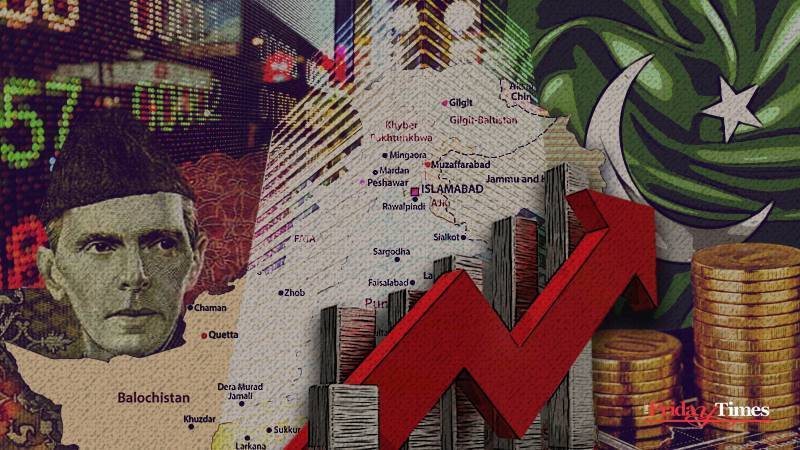
Pakistan's persistent economic failures mirror political and governance dysfunction. It has become a fact deepened by our national fallacy of doing the same things again and again and expecting different outcomes. Without changing this self-indulgent, insulated mindset, we will keep dramatising and fictionalising our poor performance as triumphs.
While researching this subject, I came across a revealing exchange in national newspapers last October: Imtiaz Gul's critique, "Planning Commission or Graveyard of Fantasies," and its rebuttal from Minister Ahsan Iqbal, "Vision vs. Fantasy: A Reality Check". Gul slammed the Planning Commission under Iqbal's leadership for failing to deliver. He added that Uraan Pakistan 2035 is nothing but the same failed template and recycled Vision 2025.
Whereas Iqbal argued that Gul's critique is rhetoric lacking substance. He also claimed Gul cherry-picked successes while blaming stop-go cycles for the deeper rot. Apparently, something out of the political hedging playbook: Deny–Deflect–Defuse (3Ds).
Pakistan's development history is a "Same Script Economy Failure," and dead models are laid to rest in the Planning Commission's necropolis. The repeated cycles of announcements, abandonment, and reinvention of visions and plans synchronise with political shifts since the 1960s.
The first incarnation of the economy began with Ayub's USAID-driven military enterprise and crony capitalism that enriched 22 families. This exacerbated inequality and hastened the 1971.
The second incarnation saw Bhutto's reactive tackling of socialism and the birth of inefficient state-owned enterprises. This resulted in corresponding losses: Rs. 832B in FY25 alone, accumulated losses at Rs. 6.53T, equity erosion at Rs. 3T, and a debt portfolio has risen to Rs. 9.57T.
The third incarnation came under Zia's Islamisation, which added distortion to an already fragile economy. It included partial reversal of Bhutto's policies, deepened military influence, and poor governance, breeding a shadow economy.
The fourth incarnation developed during the 1990s. Nawaz Sharif brought crony privatisation and a consumption-driven growth bubble, while Benazir Bhutto added the Independent Power Producer curse. This was later compounded by Nawaz Sharif's China–Pakistan Economic Corridor Independent Power Producer debacle.
Current geopolitical events may provide a smokescreen for the already visible decline in economic performance under PDM 2.0, potentially triggering cost-push inflation
The decade ended with Nawaz Sharif's second term (1997/99), burying Vision 2010 under nuclear sanctions and economic collapse.
Today, the outdated 1990s economic model has become our eternal present. It is trapped in a structurally flawed economic landscape: low-yield and land-crippled agriculture, narrow and unproductive industry, an Independent Power Producer capacity charges curse, a debt trap, chronically low savings, poor tax collection, and weak investment.
The inevitable outcome is a consumption-growth bubble. This is marked by weak agricultural output, low-value stagnant exports, circular debt spirals, mounting public debt and repayments, state-owned enterprise losses, and a devaluing currency that is artificially stabilised. It also includes a balance of payments crisis.
All these shortcomings, compounded by ever-increasing military expenditure, leave no fiscal space to tackle poverty, inequality, and poor human development.
Musharraf (1999–2008) escaped default and brought stability through 9/11 aid and debt relief. However, he repeated the same consumption-led model.
He offered Vision 2030, which fell victim to the global financial shock and political collapse. This left the country with enhanced inequality, an energy crisis, and balance of payments stress.
The Pakistan Peoples Party (2008–13) inherited a flawed structure and continued governance rot amid floods and energy crises. It magnified past ills, heightened poverty, and left another balance of payments crisis.
Nawaz Sharif's third term (2013–18) revived Vision 2025, which was boasted as transformational. However, the export-led model collapsed into a consumption-growth bubble marked by governance failure.
China–Pakistan Economic Corridor became another example of debt-heavy investment with limited productivity impact. It led to massive repayment exposure, while high power tariffs strangled the industry.
What followed was a repeat of the past, ending with another balance of payments crisis in 2018.
Imran Khan's government (2018–22) inherited this mess and failed to stabilise external accounts. It broke down under Covid shocks, commodity spikes, and its own policy incoherence.
This left the country with more of the same, magnifying inflation with record-high interest rates and exposing it to near default.
The PDM/Shehbaz government claimed credit for International Monetary Fund-backed stabilisation. Once again, a new development vision has emerged — Uraan Pakistan 2035, a glossy framework promising efficiency, reforms, and high growth.
Targets such as $60B in exports by 2029 and a $1T economy by 2035 are not plans; they are slogans. They lack investment, changes in productivity base, and credible revenue trends.
Uraan exports would require an 18% compound annual growth rate. Pakistan's peak was 15% in the 1960s, and the current five-year average is a mere 1.5%.
Uraan's promise of reducing poverty, unemployment, and inequality has gone astray. National poverty stands at 28.9%, inequality is at an all-time high, and unemployment remains elevated.
The grand Uraan vision has become a castle in the air, heading towards its final resting place.
The pinnacle of irony is that Pakistan keeps debating visions without addressing the entrenched post-colonial power structure that makes reform impossible. As long as the post-1948 framework remains intact with veto players, aligned institutions, and political proxies, no development plan can survive.
Economic managers cannot escape responsibility for misleading the public and continuing with misaligned policies that ignore ground realities. This adds to the decline.
They cannot explain away failure through blame-shifting, nor hide the choices that have been made. Each new regime trashes the last plan, repackages old failures, seeks International Monetary Fund stabilisation, and enjoys a short-lived uptick before the next crash.
Pakistan ranks near the bottom across governance, corruption, rule of law, rights, economic freedom, and business climate indicators. Without improvement in these domains, private investment will continue to avoid Pakistan, regardless of "visions".
The Special Investment Facilitation Council's $25–30B foreign direct investment promise in June 2023 targeted $70–100B over three years. However, it managed only around $1.9B by May 2025 (State Bank of Pakistan), while the first half of fiscal year 2026 saw foreign direct investment plunge by over 41%.
Our ambitions remain confined to photo opportunities and promises. Current geopolitical events may provide a smokescreen for the already visible decline in economic performance under PDM 2.0, potentially triggering cost-push inflation.
Pakistan neither lacks competence nor a roadmap, which has already been crafted by policymakers, academics, analysts, and institutions over past decades. Ironically, it is ignored due to entrenched interests.
Instead, the country moves closer to a choke point, repeating an outdated model of consumption-led growth and producing the same outcomes: debt, deficits, decline, and balance of payments stress.
It is simple to deduce, and surely not rocket science.
The choice remains ours, but we keep choosing collapse disguised as visions.