

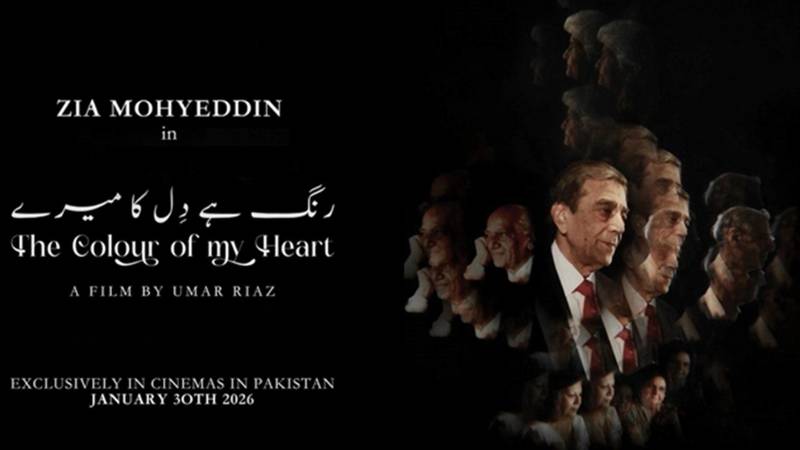
If plaudits at the screening I attended are to be believed, the new Pakistani documentary, The Colour of My Heart (directed by Umar Riaz), releasing in cinemas on 6 February 2026, is going to be a gamechanger for the country’s fledgling film industry. Among a scatter of other things, the 100-minute long film follows the life and works of the British-Pakistani actor and Urdu aficionado, Zia Mohyeddin. Yet despite its triptych of chapters, the documentary seems arbitrarily structured and unfocused and, as a result, feels wholeheartedly disinterested in expressing anything more complicated than a saccharine lament for a culture and people lost to time.
In the prologue, the late educationist Dr Arfa Sayeda Zehra briefly expands on the film’s titular theme, the multifold meaning of the love between a lover and his beloved in the specific context of the Urdu ghazal. Zehra argues that the ghazal must always dance around its central assumption—the inability of the poet to stop his pursuit of the unattainable beloved; in the literary genre of the ghazal, the task of the poet then becomes not to merely describe the beloved’s beauty, but in doing so – in demonstrating his journeying ever closer to that ultimate unreachability – discover his own soul.
Instead of a nuanced portrait of a flawed genius, the audience gets an agreeable assortment of recitations that fails to utilize the full potential of the documentary medium
In what is by far the film’s most aesthetically coherent, emotionally affecting, and intellectually arresting first chapter, Riaz frames Mohyeddin’s life in this lover-beloved dichotomy. He casts Mohyeddin the artist as the lover and artistic perfection – which Mohyeddin, ever the classically trained textualist, defines in the arts of both acting and oratory as the singular quality of the performer to understand and enunciate the subtext behind the written word – as the beloved. (Naturally, Mohyeddin’s lifelong quest to attain this perfection becomes the journey that will reveal his soul.) To achieve this, Riaz sketches a hurried portrait of Mohyeddin: childhood in pre-Partition Lyallpur (now Faisalabad); studying in London to become a prominent actor at the West End and then Hollywood; coming back to Pakistan to headline a popular talk show that, its commercial success notwithstanding, Mohyeddin himself admits was artistically barren; finally, becoming a professional orator of Urdu poetry and prose and a mentor to aspiring students of theatre and oratory.
Like a Wikipedia biography straining to come to life, this is a lot to cover for the film’s first thirty minutes. Even so, and despite Riaz barely dwelling on them, and distracting us instead with Malick-esque interjections of the dependably high-cheekboned Fatima Hassan swaying behind a sheer veil as the poets’ elusive beloved, some moments do stand out. Chief among them is that of an eighty-ish Mohyeddin watching his decades younger self perform King Lear on a projector screen. In perhaps the film’s most textured shot, Riaz positions his camera to allow the audience a snatch of the performance’s reflection in the glass window behind Mohyeddin: flitting one’s gaze between the two Mohyeddins – one seemingly closer to death yet clearly alive before us as an audience to this audiovisual resuscitation of his younger self that may seem eons from death yet is in the past and therefore temporally dead, and while Mohyeddin’s fictional monarch folds himself into a shriveled old man in the performance’s overlaid audio while sobbing at his deceased daughter’s feet (“Why should a dog, a horse, a rat have life, And thou no breath at all?”) – one reflects, not unlike the living Mohyeddin, on art, artmaking, and what it means to devote a lifetime to being a creator and/or interpreter of texts that, with studied seriousness, intend on outlasting their maker’s last breath.
If only the rest of the film were this nuanced and not full of unobserved details; striking revelations about Mohyeddin come and go without registering any lasting effect on the filmmaker. All three of Mohyeddin’s partners flag his (insufferable) fastidiousness about how their daily routines must be run, with the second wife, the kathak maestra Nahid Siddiqui, also hinting at an especially toxic domestic environment by singling out Mohyeddin’s unbridled temper as their ten-year marriage’s Achilles’ heel. Yet Riaz seems neither uncomfortable nor unwilling but positively uninterested in excavating these patterned criticisms of his idol for more than a few seconds. It was imperative for Riaz to interrogate this aspect of Mohyeddin not out of an obligation to political correctness or to flesh a believably flawed protagonist for its own sake, but because this impatience with and aggression towards others’ supposed shortcomings was a side-effect of a quality of Mohyeddin’s that Riaz himself admires—a self-anointed obsession with being perfect, artistically or otherwise. And not unlike the poets who yearn after their beloveds despite the latter’s callousness and practiced indifference, staying with his subject’s flaws for longer would’ve enriched Riaz’s own love for Mohyeddin, warts and all.
In the second chapter, Riaz flips his attention to the Urdu poet, Faiz Ahmed Faiz. This is the film’s weakest chapter primarily for two reasons: it bears scant narrative connection to what precedes or follows it – Mohyeddin admits he only met Faiz twice in his life – and most erringly, Faiz died almost half a century ago due to which there is barely any footage of him for us to develop a connection with this new protagonist. Hence, this chapter, which is narrated by Faiz’s daughters Salima and Muneeza Hashmi, plays out at best as a private family video and at worst as a PTV interview about an iconic poet. And due to this structural weakness, the emotional denouement of this chapter – a lingering pan from a teary eyed Salima Hashmi to a visibly crying Muneeza Hashmi as they describe their father’s final moments – falls flat.
From here on, Riaz’s chronic avoidance of his subjects’ interiorities assumes a decidedly surface-level sheen which even flattens Mohyeddin. In a question that lances at the heart of the film’s greatest omission – the unnaturally natural ease with which Punjabi urban elites like Mohyeddin have discarded their mother tongue in favor of a UP-ised Urdu and clipped English – the protagonist of the third chapter, Dr Daud Rahbar, who was a cousin of Mohyeddin’s, and whose accents of Urdu and English are unceremoniously Lahori, asks Mohyeddin why he doesn’t speak with him in Punjabi, the language of their childhood? Like Riaz, Mohyeddin, who previously demonstrated enough integrity to describe his talk show gig as a vanity project, skirts around the question and uncharacteristically excuses himself by guessing that this may be because he is no longer as fluent in Punjabi as he is in Urdu.
My point isn’t to shame Mohyeddin for not speaking Punjabi, or for insufficiently explaining his militant refusal to speak the language even when prompted by a childhood buddy. It is also not to ascribe a negative value judgement on the historical phenomenon of the erosion of Punjabi in post-Partition Model Town. My point in the previous paragraph, and throughout this review, is to highlight Riaz’s aesthetic disinterest in interrogating the uglier underbelly of his subjects’ beauty; it is only after uncomfortably staring ugliness in the face that one can appreciate beauty for not just its superficial exterior but also, à la Mohyeddin, for its sub-textual meaning. (In the first chapter, Mohyeddin describes an early memory of him climbing to the tallest point of his house in Lyallpur from where, his mother later told him, two of his older brothers had died by falling down. Was Mohyeddin’s arriviste drive to erase all traces of his Punjabi, and almost fanatical devotion to reinvent himself in English and Urdu, a way to rise above the middleclass ordinariness of the Lyallpur still nestled in his cosmopolitan mind? We’ll never know because for Riaz, as was assumedly for Mohyeddin, the answer might’ve entailed accepting his hero as being pettily human and, therefore, less than perfect.)
Despite the herculean effort that must’ve gone into producing this film (which was fourteen years in the making), it is disappointing to see how little multi-dimensionality Riaz is able to capture in either the high literary culture of Lahore or in the individual who may be the most widely recognised personification of it. Unlike the religious marsiya, where good (Husain) and bad (Yazid) can neither be changed nor morally muddled at the poets’ discretion, the secular documentary – with its possibilities of cross-cutting, audio overlay, mise-en-scène, and above all, ease with nonlinearity – allows for characterisation of almost novelistic complexity. It is a headscratcher then, and certainly not a gamechanger, as to why Riaz eschews much of that barely containable human messiness for rosy-eyed praise. For the task of the director begins where the job of the technician ends—to question the information being recorded, filter it through his own deservedly biased point-of-view, until we, the audience, get not an agreeable assortment of Instagrammable poetry recitations delivered by an orator whose mastery of craft no one is questioning; rather, we get the fruit of a human mind observing his human subject as if this may be his last time—which, in the case of Mohyeddin, who died on 13 February 2023, sadly turned out to be true.