

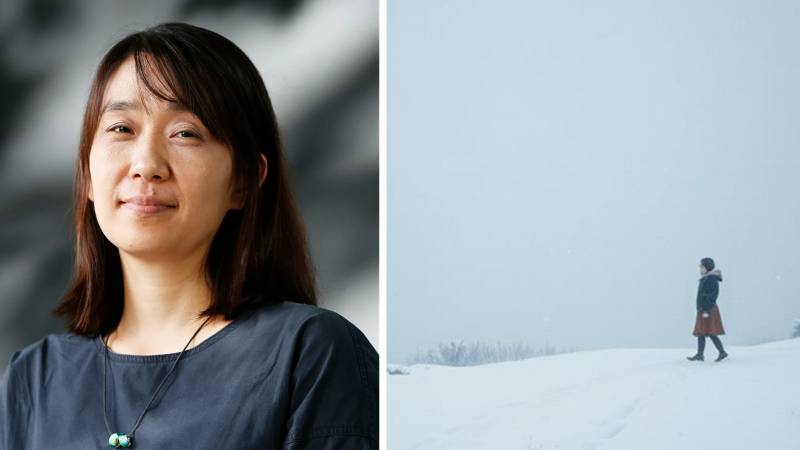
Han Kang, born in 1970 in South Korea, made her literary debut as a poet in 1993 and published her first short story in 1994. For her book The Vegetarian she won the Man Booker International Prize and was shortlisted for The White Book. She was awarded the Nobel Prize in Literature “for her intense poetic prose that confronts historical traumas and exposes the fragility of human life.”
The novel follows the life of a South Korean woman named Kyungha as she travels to Jeju Island for the sake of her friend, Inseon. Inseon calls her in Seoul after a work accident in which she has injured her hands and tells Kyungha to travel to Jeju to look after her bird who will starve to death if Kyungha doesn’t reach Inseon’s house in time. Kang writes with great sorrow, as she explains Kyungha’s inner turmoil with facing death, she writes:
“Life was exceedingly vulnerable, I realised. The flesh, organs, bones, breaths, passing before my eyes all held within them the potential to snap, to cease – so easily, and by a single decision.”
Kang describes dreams very vividly in her book, through Kyungha’s experience of dreaming: “Sometimes, with some dreams, you awake and sense that the dream is ongoing elsewhere. This dream is like that. I eat my meals, drink my tea, ride the bus, walk hand in hand with my child, pack our bags ahead of a trip or walk up the countless stairs out of a subway station, to one side of me it is perpetually snowing, over a plain I have never visited.”
How vivid is the author’s imagination, one can only sense from the above paragraph and the book is filled with such intense paragraphs of clear and honest imagination and image building. She describes a world of white, beset by icy wind and snow squalls and shows Kyungha struggling through this world as she wonders if she will arrive in time to save the beloved pet bird.
The friendship between Inseon and Kyungha is reflected upon throughout the book till Kyungha says about it: “Clogging the marrow in my bones and shriveling my heart…That was when I realised. That love was a terrible agony.” Kyungha describes Inseon with such love and detail throughout the novel that it gave me an insight into female friendships and how beautiful they are in their own way. It made me reflect on my own such strong friendships and how they have been instrumental in my journey in life.
As Kyungha goes through the rather dangerous and tiring journey through the island in the midst of a cruel snowstorm, she races against time to save Inseon’s bird from dying of starvation, and in this way learns more about Inseon’s family and deals with the history of the island and the Jeju massacre. Kang writes about the massacre: “Rapes, kidnappings and murders had become so commonplace that anyone with a young daughter was anxious to have them married off as soon as they found a decent match.” She also details in the narrative the number of people killed in the massacre: “It’s no coincidence that thirty thousand people were killed on this island that winter, and another two hundred murdered on the mainland next summer. The governing US military ordered that everyone on the island, all roughly three hundred thousand people, be wiped out…”
We Do Not Part mostly occurs on Jeju Island, decades after the Jeju massacre and mentions the island’s entire history as Kyungha travels across it to find Inseon’s pet bird. The book also makes references to the Manchukuo Imperial Army, the Bodo League massacre and the involvement of South Korea in the Vietnam War. When delivering her lecture on the Nobel Prize for Literature Kang said:
“Whereas, until the autumn of 2021, when We Do Not Part was published, I had considered these two problems to be the ones at my core: Why is the world so violent and painful? And yet how can the world be this beautiful? For a long time, I believed that the tension and internal struggle between these sentences was the driving force behind my writing.”
Kang’s novel is a powerful reminder that humans can survive, even through massacres and war, turmoil and devastation. Even if love is agony, just as Kyungha was willing to go to great lengths to save Inseon’s pet bird – their friendship overrides all else. If love is true, humans go to great lengths for their loved ones and do great acts of service – as many individuals are shown to do in the novel including Inseon’s mother, for her family. Kang’s work is a reminder in today’s war-torn world that families sacrifice for one another, so do friends, even if the scars of massacre remain – love persists, even if it is sometimes mere agony.