

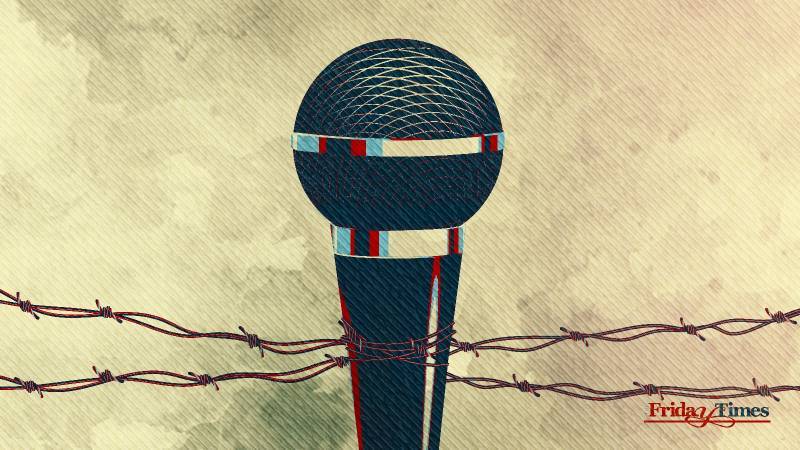
In Pakistan, journalism has turned into a punishment—one meted out for daring to speak or write beyond the sanctioned narrative. Abduction, unemployment, and even murder have become the grim costs of truth-telling. I have lived with this reality for the past decade, bearing its weight myself and watching countless colleagues fall victim. The cycle shows no sign of ending. If it continues unchecked, the day may come when all true voices are extinguished, leaving no one to question the dictatorship that hides beneath the mask of democracy.
There are two ways left for a journalist to survive in Pakistan: either surrender to those in power and go with the flow for personal safety, or quit. Journalists who chose any other option have been picked up from their offices, jailed, or killed.
At least 23 journalists were killed in Pakistan between 2022 and 2024. Yet recent reports by organisations such as Reporters Without Borders and UNESCO claim that no journalist has been killed or detained in the country since January 2025. This discrepancy raises serious questions about the accuracy of international monitoring and the attention given to the plight of Pakistani journalists, whose suffering has only deepened in recent years.
I still cannot forget how outspoken journalist Asad Toor was beaten and tortured inside his home, how Hamid Mir was forced off air from Geo TV, and how Matiullah Jan was abducted and silenced. Even Imran Khan, then prime minister, admitted that the real centres of power lay elsewhere, while he himself served as a puppet under General Qamar Javed Bajwa and DG ISI Faiz Hameed. After regime change, the pressure only intensified. Shehbaz Sharif’s government presided over the killing of senior journalist Arshad Sharif, the abduction of Imran Riaz, and the use of sedition charges against many others. The question is: how long can Pakistan continue down this path?
History witnessed the end of Zia’s toughest dictatorship dramatically, but the system of this country has not changed—it has always been a dictatorship under the cover of democracy
The political status quo or the parties that used to flag the anti-establishment narrative and win elections are now sitting in the laps of the current regime setters, strengthening this authoritarian type of democracy. I now ask the senior leadership of those parties: what slogan will they raise next, after “vote ko izzat do” or “democracy is the best revenge”?
Today, only a handful of journalists, human rights activists, and a few politicians are standing up for democracy. It has been three years since Imran Khan’s government was removed, with the justification that Pakistan was on the verge of default. But where does the country stand now in 2025? In the past three years, foreign reserves have sunk to historic lows, the rupee has kept falling, inflation and unemployment have soared, and Pakistan has suffered its worst-ever brain drain. The country’s brightest minds are leaving, not just in search of jobs, but because they have lost faith in the system.
In 2022, more than 800,000 Pakistanis left the country, rising to one million the following year. At least 350,000 people have left in the last six months, not just for job opportunities but because they lost faith in the system. Those who could not afford to leave are desperately searching for ways to do so.
My journey as a political journalist in Pakistan has been a mix of memorable stories and painful misadventures, but today it feels as though independent journalism can hardly breathe. No one willingly abandons a profession they love, yet many are forced to do so. Journalism has been reduced to press releases and celebratory notes, while those who try to practise freely face constant threats and insecurity. What surprises me even more is the indifference of the international community, despite the growing assault on free speech and the journalist fraternity in Pakistan.
History witnessed the end of Zia’s toughest dictatorship dramatically, but the system of this country has not changed—it has always been a dictatorship under the cover of democracy. Philosophers and historians claim that every artificially imposed system collapses under its own weight. But when and how this change will happen, and how many lives and generations it will take before we see that free moment, remains an open question.