

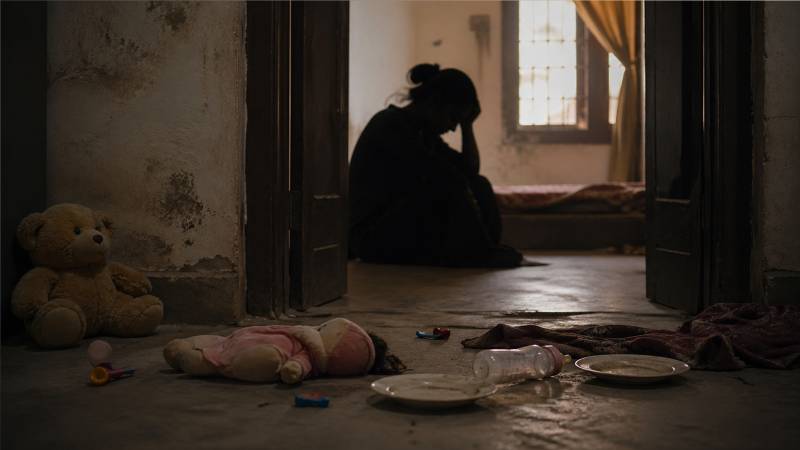
Just a few days ago, shockwaves went through the country as a horrendous case of triple child murder was reported in Ichhra, Lahore. The children were identified in early reports as three siblings, and police said the mother was arrested and sent on a five-day physical remand. That is the factual floor we have right now. Everything else, especially motive, is still moving ground.
Police have claimed the killings were linked to estrangement with the husband, and some reports say the accused reportedly confessed during interrogation, but that remains an allegation, not a tested conclusion. Some accounts begin to sketch a more suffocating domestic backdrop of the husband’s repeated taunts questioning the children’s paternity, hints of a household already strained to breaking point, and a fight reported the night before.
Layered onto this are quieter, more haunting details of deprivation, claims that the day had been held together by just two rotis for both mother and children, and an infant’s feeder left empty.
That matters because the story is already being turned into a morality play. One version makes it a story about a bad mother, another makes it a story about a bad marriage. Both are too neat. The harder question is what moral weight we give children inside the family.
The UN Convention on the Rights of the Child says every child has the inherent right to life, and that states must protect children from physical or mental violence while they are in the care of parents or guardians. UNICEF also notes that children in Pakistan remain vulnerable to violence and exploitation, and that the country still lacks a coordinated child protection case management and referral system aligned with international standards.
So the moral lens has to work in two directions. On one side is the woman, who is instantly judged through a thick layer of respectability. Public reactions tend to collapse quickly into moral binaries of ‘monstrous mother’ and ‘characterless woman’.
Patriarchal systems see motherhood as sacred and infallible, and that does more harm to children than women themselves. Mothers have been abusers, con artists and criminals, and putting them on a pedestal, at least in public policy, distorts law and morality.
Then there is also a gendered asymmetry where a violent father is ‘provoked’ or ‘financially stressed’, yet a violent mother is treated as a moral aberration, which does no good to a system that should be predicting and preventing such lapses before they happen.
When something catastrophic happens, we suddenly remember our vulnerability. The rest of the time, we treat their resilience as proof that they are fine
On the other hand are the children, whose rights are supposed to be absolute but are often treated as folded inside family privacy. In our settings, children are not always seen as independent individuals but as extensions of their parents, like property, expected to absorb whatever happens inside the home.
Discipline slips easily into punishment, and punishment is softened with familiar phrases like ‘maar mein bhi pyaar hai’. More lethal is the layer of religiosity that insulates that toxic view, with parents being absolutely immune to wrongdoing.
It sounds harmless, even affectionate, but it blurs a serious line. When obedience is valued more than well-being, children’s rights fade quietly inside the very space that is supposed to be their haven.
That is why the psychological side has to be handled carefully. Not everything is a serious mental illness, and I am not in a position to claim it anyway. But day-to-day stress does cause distorted cognition, and one useful term here is learned helplessness.
In plain English, it means repeated uncontrollable stress can make a person stop believing their actions can change anything. That does not explain a murder, and it certainly does not excuse one, but it does help us think about how people can become emotionally trapped before they become violent.
The financial side sits underneath all of this. In a household where a woman is economically dependent, where leaving a marriage is expensive in money and stigma, and where the home is the only stable shelter she knows, marriage equals confinement.
As police allege, the woman might be having an affair on the phone with a man in Jhang, and it would not be surprising if it turns out to be true. If any imagined exit route is later found to be part of the story, I would still read that less as gossip and more as a psychology of escape.
People are often pulled by the promise of a bigger life, a cleaner life. Social psychology calls it the significance quest, which argues that people are driven by a need to matter, a narrative that gives that need shape, and networks that reinforce it.
Violent extremist propaganda has also been shown to sell women promises of empowerment and piety. I am not comparing this case to extremism but pointing to a simple human vulnerability: the seduction of a better elsewhere.
That is also where the historical angle matters. In South Asia, women have long been made to carry the burden of family honour, sexuality and public morality. They, unfortunately, seek weaker targets to pass that bitterness on.
Children in such cases often become the burden instead of individuals with inner lives, hopes and aspirations. In many homes, children are expected to adapt to adult realities rather than the other way around.
They learn early to read moods. That emotional labour goes unnoticed because it is seen as maturity. But it also means children are absorbing instability they have no power to change.
When something catastrophic happens, we suddenly remember our vulnerability. The rest of the time, we treat their resilience as proof that they are fine.
As a mother, this was especially hard to write because the children at the centre of the story make every abstraction collapse. A child is not a prop in an adult conflict or a moral accessory to a marriage.
A child is a rights-bearing person whose whole world is the home, which is exactly why the home has to be examined under the lens of state and public policy, not only fragile values. The social failure here is not only one woman, one affair or one home.
It is the wider system that leaves family life private, untouchable and under-scrutinised until the ending is already unbearable.