

There are many ways to tell the story of Peshawar — the city of caravanserais, resistance, and resilience. Some begin at the Qissa Khwani Bazaar; others drift towards Bala Hissar or the poetry of Khushal Khan Khattak. But there’s another Peshawar — less sung, no less glorious — the one that ruled the world not with gunpowder or verse, but with a rubber ball and a racquet.
Yes, that too is Peshawar — the city that transformed barefoot village boys into world champions. It began, as all epics do, with near impossibility of a squash court marker becoming the monarch of the game at world level.
In the dusty courts of the British Officers’ Mess in Peshawar, a young boy from the nearby village of Nawakilli worked as a marker. A humble role: wiping sweat, retrieving balls, quietly studying the angles of the game he wasn’t allowed to play. His name? Hashim Khan. He had no shoes. His racquet was a relic. His kit donated by kind-hearted officers of the Royal Indian Air Force, which would later become the Pakistan Air Force (PAF). The real gift, however, bestowed on him was access to the court — and the belief of those who saw something feral and fated in the way he moved between the walls.
In 1951, PAF took a gamble. With more conviction than cash, they sponsored Hashim’s trip to the British Open. He was 37. No formal training. No professional matches. Just an unrelenting will. He returned not humbled, but triumphant — defeating the reigning champion and lifting the trophy. A barefoot boy had conquered the Empire at its own game.
Hashim didn’t stop. He went on to win seven British Open titles, becoming Pakistan’s first international sports legend. Long before cricket, long before the World Cup, we had already taken our place on the podium — thanks to a boy from Nawakilli and the faith of the Pakistan Air Force.
If Hashim was the spark, the PAF was the oxygen. The Air Force recognised early what few institutions did — that sport was not a distraction, but a declaration of national strength, discipline and pride. The PAF institutionalised squash; not as a hobby but as a strategic culture.
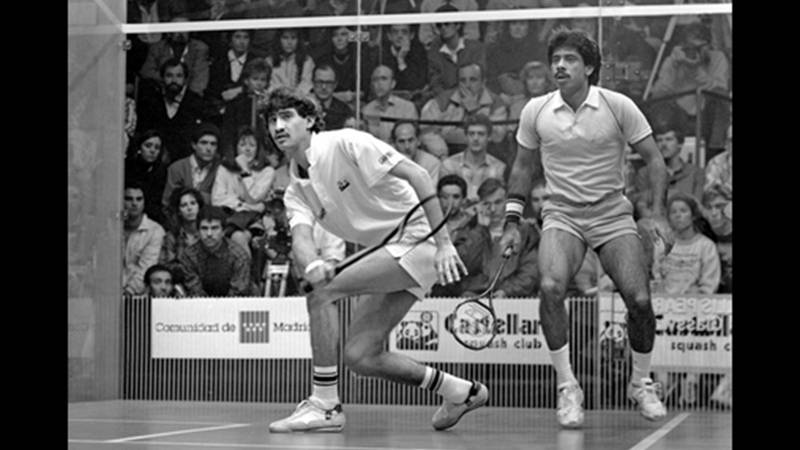
They were the triumvirate that defined a golden age: Jahangir the unstoppable force, Jansher the masterful strategist, and Qamar Zaman the gentleman genius
PAF built courts at every major base, scouted talent, especially from humble origins, recruited promising players as airmen, technicians, or clerks — giving dignity, purpose, freedom to train, funded travel, sponsored tournaments and housing to those who would’ve otherwise been lost to obscurity.
In those formative decades, it was PAF’s silent scaffolding that made it possible for champions to rise. Hashim’s brothers, cousins, and sons followed. Some became players, others became coaches and PAF remained the faithful guardian of this legacy in building a dynasty of Champions: Jahangir, Jansher, Qamar & Co.
From the same soil — and often the same family — came a golden generation. Titans who didn’t just win matches, they ruled eras. Jahangir Khan, perhaps the greatest athlete in any sport ever with 555 consecutive wins and unbeaten for over five years. His dominance was so complete that opponents began to dread the draw. To lose to him was an honour. Then came Jansher Khan — master of angles and artistry. He won eight world titles and displayed grace and grit in perfect balance. Where Jahangir overpowered, Jansher outsmarted. Then there was the gentleman genius; Qamar Zaman. Crowned British Open champion in 1975, he was known for his immaculate touch, guile, and sportsmanship. Hailing from Quetta but forged in Peshawar, Qamar was part of the triumvirate that defined the golden age of squash. He was friends with Jahangir and Jansher, and admired by all. His battles on court were ballets, not brawls. For years, he remained a beloved mentor and ambassador of the game. His role in training and nurturing future champions — especially under the umbrella of PAF and national programs — is nothing short of legendary.
Then there were others; Roshan, Torsam, Mohibullah, and more — all from Nawakilli or its orbit. A single village became the Wimbledon of Squash, producing more world-class players than entire continents. But behind them, always, was the PAF — uniforms crisp, budget tight, hearts wide open.
PAF also built a temple to the memory of the original champion, now known as the Hashim Khan Squash Complex. This author was tasked with supervising the construction of the Hashim Khan Squash Complex in Peshawar. Not just another sports facility — this was sacred ground. A temple of sweat and glory. When it was time to inaugurate, we called in the legends and they came. Jahangir, Jansher, Qamar, Mohibullah, with their old British and Australian rivals. They were now men with wrinkled faces and straight backs, united by a shared past and the reverence of a city that remembered. They cracked jokes, swapped stories and teased each other over old matches. A quiet pride hung in the air like perfume. It was the kind of gathering where time stops, where history smiles and where a once-poor ball boy watches from the heavens, and says: “Look what we built.”
Even today, the PAF continues this quiet tradition. PAF Academy Risalpur, where cadets are as fluent in squash courts as they are in flight simulators. PAF Bases Masroor, Sargodha, and Chaklala are home to some of the best courts and training programs in the country. Retired champions now coach the next generation — not just to win, but to represent the best of Pakistan. PAF didn’t just build champions. It built a culture of discipline, humility, and national pride.
Today, squash may no longer dominate headlines. Other sports have taken centre stage. The medals may have slowed, the flashbulbs may have dimmed. But the story remains. And what a story it is. A barefoot boy from Peshawar. A ball bouncing off old colonial walls. A military that saw potential, not pedigree and a country that ruled the squash world for decades.
Let the world forget. We shall not. Because every time a ball hits the wall in Peshawar, an echo returns from London, Melbourne, and Cairo—whispering the same truth: this, too, was Pakistan. This, too, was PAF.
And yes — this, too, is Peshawar.