


My introduction to the world of Rashid Rana came in December 2024, at an event whose significance I did not fully grasp until I walked into the hall. He had generously invited me to a ceremony that brought together leading figures from Pakistan’s cultural, academic, diplomatic, architectural, and artistic spheres. I was one of the youngest individuals present among established professionals.
It was on that day that he was appointed UNESCO Chair on Inclusion Through Art, an honour belonging to a globally selective network of Chairs, with only a limited number in Pakistan and even fewer dedicated to the arts. The ceremony was not merely a formal recognition; it was a testament to the scale of Rana’s impact; nationally, regionally, and internationally.
It was this ceremony, that I was introduced not only to him but to the astonishing visual and conceptual world that has shaped his career. Rashid Rana’s World. Later, I presented him my book which he warmly accepted and shared his upcoming projects as well.

Rashid Rana is widely recognised as one of South Asia’s most influential contemporary visual artists, an innovator who transformed the role of the image in the region’s artistic practice. His work moves beyond aesthetics; it interrogates perception, identity, and representation through mosaic.
One of his most publicly visible contributions was the Pakistan Pavilion at Dubai Expo 2022, which won the Best Exterior Design Award (Burj CEO Awards). The Pavilion featured 28,000 individual units, each slightly different, arranged to reflect the immense diversity of Pakistan: geographical, cultural, climatic, racial, and ethnic.
His artistic journey bears many notable milestones, including becoming the first living artist to have a survey solo exhibition at the Musée Guimet in Paris in 2010
Speaking at Hum Bridal Couture Week in 2025, Rana explained:
“This diversity of colour, these 28,000 units all fractionally different from each other, come together in a harmonious order, and so can we as a nation.”
The philosophy embedded in that statement aligns closely with the mandate of his UNESCO Chair: pursuing inclusion not through policy or rhetoric, but through the universal language of art.
Rana’s work continues to resonate across the world. In 2025, one of his pieces became the emblem for Biennale Danza 2025, part of the 19th Venice Dance Biennale directed by Wayne McGregor. The adopted work, Notions of Narration II (2012), belongs to his Transliteration Series, in which he reconstructs historical images, such as paintings by Rubens, into fragmented and reassembled mosaics. The result is a complex visual tension between the carnal and the violent, between the original and the reinterpreted. However, this isn’t the first international milestone of this Sitara-i-Imtiaz recipient.
His artistic journey bears many notable milestones, including becoming the first living artist to have a survey solo exhibition at the Musée Guimet in Paris in 2010, being listed by GQ in 2015 among the twelve Pakistanis influencing Indian pop culture, and his work being represented among 239 objects spanning global human history at the Singapore Art Museum culled from the British Museum Collection. With over twenty solo exhibitions and more than seventy group exhibitions, his work now resides in major collections such as the Metropolitan Museum of Art in New York, the British Museum in London, and the Fukuoka Museum in Japan. Together, these achievements position him not simply as an artist who emerged from South Asia, but as one who helped expand the world’s understanding of it; just a few of the many understated yet significant milestones that define his career.
But for me, what inspires most is his mastery of technique, embodied so powerfully in one of my favourite works.
As an author and someone who instinctively pauses at the sight of bookshelves, I have long found Everything and Nothing (2010-2011) to be one of Rana’s most intellectually provocative works. The piece possesses a familiar pull; a visual instinct that leads one to stop, look, and expect the comfort of a library.
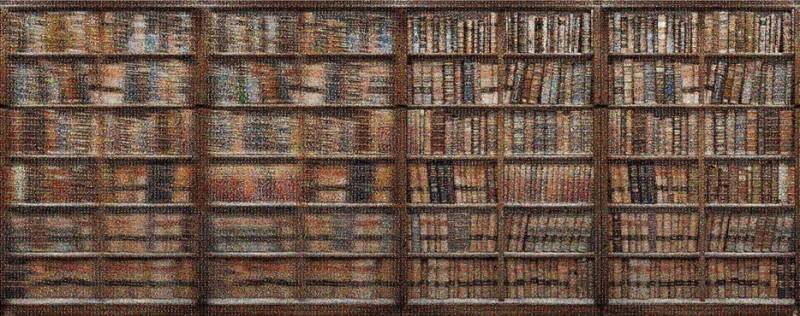
2010-2011
LightJet print + DIASEC
Each pane 304.8 x 241.94 cm
For a viewer encountering it, the first impression is deceptively simple: a bookshelf. Row after row of orderly spines, arranged with quiet precision. But as the viewer steps closer, the bookshelf begins to shift. It gently pixelates, as though made of dust and memory. A few inches further, and the illusion collapses entirely, the “books” are revealed not to be books at all, but hundreds of Renaissance and post-Renaissance European paintings from the 16th to 19th century. It unfolds in stages: with every step forward, you are pulled deeper, inch by inch, into a completely different world.
Collected over several years, these paintings form vast photomosaic panels. From afar, they mimic the geometry of a library; up close, they reveal a world of bodies, gestures, mythologies, and brushwork. Rana flips many of these images horizontally, creating a visual tension, sharp images blur into books, blurred books sharpen into images. The viewer oscillates between recognition and disorientation, between knowing and unknowing. The blur is sharp, sharp is blur; meta vs micro…it’s all so fascinating!
As Mr Rana shared, at its core, Everything and Nothing interrogates the relationship between textual knowledge and visual knowledge. “It questions the translation of textual knowledge from the West and refers to the gap between verbal and visual traditions.”
The question then needs to be answered, “How do we learn, and unlearn, the cultural frameworks through which we interpret the world?”
Rana suggests that knowledge can be “everything”, vast, layered, collective. The work emphasises the collaborative gaze of art’s pedagogy, that things are done and looked at together - selection, editing, contemplating, acknowledging, learning, and unlearning. It mirrors the ongoing human effort to understand the world; an effort necessarily incomplete.
In its interplay of illusion and revelation, text and image, archive and surface, Everything and Nothing stands as one of the clearest expressions of Rana’s artistic philosophy: that seeing is never singular, and meaning is always layered.
Mr Rana reconfigures images not merely to transform their appearance, but to challenge the assumptions that structure how we see and interpret the world.
That December 2024 gathering marked a new chapter in his already remarkable trajectory, but it also illuminated the continuity of his vision, one grounded in inclusion, complexity, and intellectual rigor. As his work continues to appear on global stages, the significance of his contribution to contemporary art becomes all the more evident: he has not only expanded the visual vocabulary of South Asia, but has reshaped how the region is seen, understood, and imagined. He is an asset of Pakistan.