

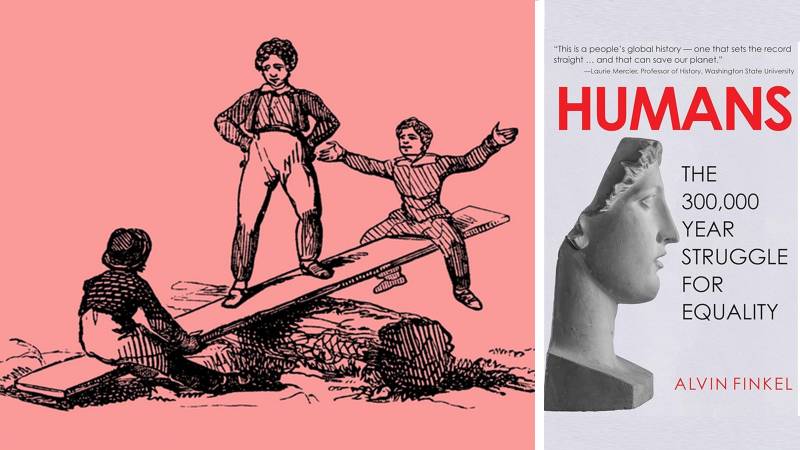
I came across Alvin Finkel’s book, which aims to provide a people’s history that emphasises equality, democracy, and reciprocity. He argues that successful societies are measured through equitable participation instead of economic growth and that societies are forged through the collective action of the 99% against the resistance of the 1%.
He goes all the way back to foraging societies to argue that with the shift to agriculture, people’s labour was captured by few elites. This undermined democracy and economic equality, as people overworked to produce dazzling monuments for the elite. Some things do not change and even today we witness how cheap labour is used for skyscrapers in the Middle East and giant statues in India in service of corporate interest or an ideology.
Reviewing religions, Finkel highlights dissent against inegalitarian traditions. Thus, while Buddhism rose as a popular movement against inequality, it was co-opted by the state. This happened when Ashoka provided welfare services but used brute force to suppress the forest people who challenged his expansionism. On Islam, Finkel argues that it attracted people as a “religion of protest” against social and economic inequalities. He notes that vested elite interests were threatened by the new religion, which instigated big merchants to oppose Islam. Thus, instead of theology, Finkel focuses on the push against inequality, as the defining feature of nascent religions.
He delves into colonialism and sets it apart from the usual conquest in the age of empires. He mentions that the first Crusaders who marched on Palestine were genocidal. They did not spare women and children and expelled the indigenous people. In contrast, Muslim conquest was aimed at collecting tribute and left local populations intact. Moreover, Arab and Central Asian conquests were focused on territorial expansion and conversion was secondary. This means that contrary to the narrative of forced conversions under Islam that emanates from Hindu nationalists, it was the elite members of the conquered people that converted to Islam for material gains. Villagers continued to follow their traditions.
Some things do not change and even today we witness how cheap labour is used for skyscrapers in the Middle East and giant statues in India
Finkel views colonialism as an extractive enterprise. He shows that the British East India Company subjugated Bengal with forced monoculture in farming, made the locals dependent on the Company for food, rejected relief based on the idea that the Company responsibility was to shareholders not workers, and forced starving farmers to pay taxes. Thus, he bolsters the argument that in contrast to traditional imperialism, European colonialism went beyond the simple acquisition of tribute, as it forced monoculture on the conquered people.
Moving into the 20th century, he notes the rise of Hitler and writes that the ultra-nationalist Nazi party gained from the bickering between left-wing parties. This is instructive given the intense divisiveness in the 21st century where activist groups focus more on purity politics than on forging solidarity across ideological divides.
Hitler associated Jews with “effeminate pacifism” and banned trade unions. This too is instructive, as right-wing forces exert toxic masculinity and as unions have become a shadow of their past from the 1960s and 1970s. Finkel also notes that many Congress representatives and business leaders were pro-fascist. This helps draw parallels with the pro-Israeli politicians in the US today. Thus, it becomes apparent that Muslims are the new Jews today.
On post 1980 neoliberalism, Finkel states that it is “socialism for the rich and capitalism for the poor”, a system where jobs were outsourced to more pliant workers in developing countries, and where unemployment was used to elicit worker submission in advanced economies. He argues that white anger targets undocumented workers instead of the employers that exploit them at low wages. Moreover, he explains that low-income workers who lost under hyper-globalisation end up supporting charismatic far-right leaders that promise opposition to immigration. Thus, the divisiveness of colonialism is very much alive in the form of neoliberalism.
Moving into the 21st century, Finkel notes that American interference in the Middle East contributed to the rise of ISIS and the civil war in Syria. He adds that post war construction in Iraq and Afghanistan allowed US companies to rake in huge profits. On Israel, he argues that Netanyahu provided “tacit support” to Hamas and that the Likud party is opposed to a Palestinian state. Thus, he traces Middle East conflicts back to neocolonial interests of the US and Israel.
Overall, ranging from foraging societies to the 2020s, Finkel provides a history that centre stages people’s concern of equity, the usurpation by imperial interests, and the rise of far-right populism under conditions of inequity and unemployment. The idea that stands out is that usurpation and extraction simply changed form from colonialism to neocolonialism.