

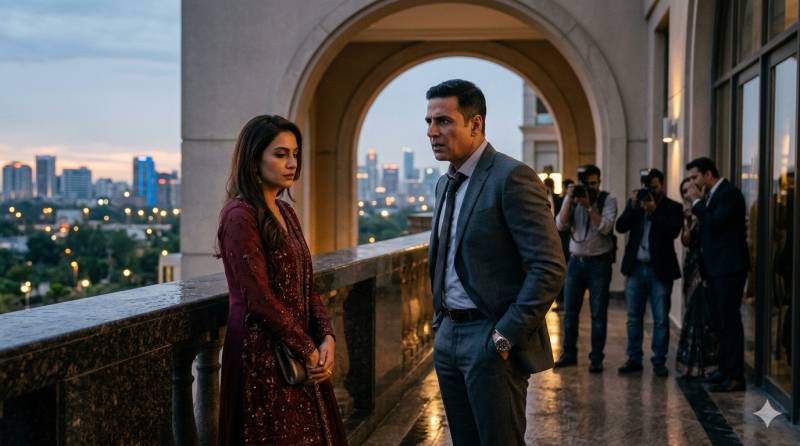
A powerful man and woman with above-average looks and a complicated history, end their relationship. And then, suddenly, conversations become transactional.
We have seen this story before. We are seeing it again right now. A recent case involving a public figure has reopened every conversation Pakistan pretends it has already settled. What it has actually done is become very good at performing the debate while never actually moving through it.
So let us try to move through it.
The first thing that happens, every single time, is the money argument. It emerges early, usually from the man's side, and it lands with the kind of quiet devastation that only a well-prepared legal team can deliver. She received financial support worth millions. Gifts, help with her career, contacts, and a luxurious lifestyle. The figure is always large enough to sound damning. And the implication, never stated directly but never far from the surface, is: she took his money, a humungous sum, so now what?
This argument is as old as the institution of the kept woman, and it rests on a very specific assumption: that financial support during a relationship creates a debt that survives the relationship. That if a man funds a woman's life while they are together, she owes him something permanent. Her presence, her silence, or her compliance. And certainly, her permission before she moves on.
Nobody asks whether the terms were ever stated. They were not, but they were privately assumed by the man providing the support. He called it love at the time, or perhaps generosity, or an investment in a future he was certain they would share. But the moment she left, those unspoken assumptions became the basis of a public case against her character.
A relationship is not a contract with a guaranteed return. Gifts given during a relationship are not loans, and they do not accrue interest. They do not come with veto power over whom she eventually marries.
The money argument is not really about money. It is about the belief that financial support purchases a form of ownership, or prostitutes the partner, if we are being blunt. And when the woman exits anyway, the legal system, the press conference, the leaked details — all of it becomes the mechanism for reasserting that ownership.
The scale of what is available to a powerful man when he decides to make someone pay for leaving him, the institutions, the legal system, the press conference that is not a human failing, it is structural
But here is the part nobody wants to say out loud either, because it complicates the clean narrative. Some women do enter these relationships with calculation. Who read the room and decide that proximity to power is worth something. Who accept the money, the contacts, the favours, with full awareness of what is being offered and why. This exists, and it is not rare. And the men on the receiving end of this, the ones who genuinely believed the relationship was real and later discovered that they were mostly being used as an ATM with political connections, have a legitimate grievance too.
The problem is that this real grievance gets weaponised indiscriminately, applied to every woman who has ever accepted help from a man she was involved with, as though receiving support automatically makes her suspect and automatically makes him a victim. It does not. The concept of dialectics suggests that two things can be true at once: some women do use men financially, and some men use the accusation of that to punish women who simply choose to leave.
Then comes the history because, in every case like this, a woman's past surfaces. Something she did not disclose, or disclosed too late, or disclosed to the wrong person. This history is presented not as information but as evidence of character. Evidence that she is not what she seemed. Evidence, somehow, that what is being done to her now is more understandable, if not quite justified.
Meanwhile, the man's history, his existing family, his own prior relationships (and current marriages), his years of alleged concealment while pursuing her — all of that gets filed under complicated circumstances. It is not evidence of anything.
This asymmetry is not new, and it is not accidental. A woman who has had a relationship, especially without a nikah, is permanently auditable in this country. Her romantic past is always fair game. It can be produced in a press conference and whispered by strangers on the internet at two in the morning. A man's equivalent history rarely follows him in the same way.
And before anyone says this is purely a class or education problem, look at the comment sections. The harshest judgments are frequently not coming from men.
Does she owe him anything for ending it? Nothing. She owes him nothing. Not continued access to her time. Not her silence or her plans. A woman ending a relationship is not committing an act of aggression, even when the man experiences it that way. What tends to reveal the real grievance, in cases like these, is who else gets targeted. If the complaint were truly about her, it would stay with her, but it rarely does.
The new partner gets threatened. The family receives calls. The upcoming wedding becomes the focal point. Because the actual wound is not what she did. It is that she chose someone else, and did so publicly. And in our cultural architecture, a powerful man being visibly moved past by a woman he considered his read not as heartbreak but as humiliation. Those are different things. Heartbreak you survive privately. Humiliation, apparently, requires a response.
Humiliated powerful men are dangerous; it does not take much to know this. We build legal systems specifically to manage this. The question is whether ours is designed to actually do that work, or whether it mostly defers to the man with the connections and the press conference.
What is unusual is that it is visible. Most women in relationships with powerful men who become threatening do not have a platform, or the timing of an imminent wedding, to make the situation undeniable. Most complaints sit in inboxes. Most cases go nowhere, and women eventually fall silent, which everyone around them calls moving on.
The question every one of these cases is really asking cuts both ways. A powerful man who genuinely believed he was building something real, who gave years and money and access, and who then watched the woman walk into a wedding with someone else — that is nothing. Emotional investment, real or perceived, can make a villain of anyone, regardless of gender. People do ugly things when they feel discarded.
They threaten, they expose, they weaponise whatever they have. That is a human failure, not an exclusively male one. But the scale of what is available to a powerful man when he decides to make someone pay for leaving him, the institutions, the legal system, the press conference that is not a human failing, it is structural. And a system that hands that much ammunition to wounded pride, without asking too many questions about who is holding it, is a system with preferences.
We already know how this country usually answers that question. That is why these cases have to go viral before anything moves.