

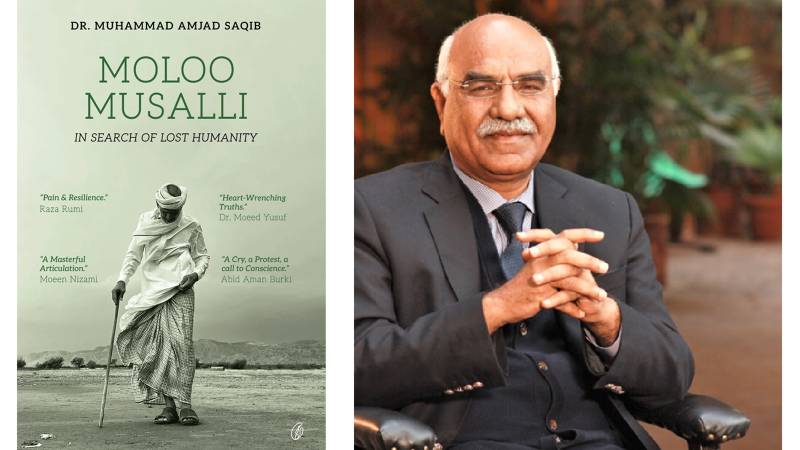
In their book Economy Studies, de Muijnck and Tieleman call for the decolonisation of economics. They express concerns that Euro-centric theories of economics textbooks often sideline topics of power, discrimination, racism, colonialism, exploitation, and unequal life chances. Thus, they argue for including minority and global South voices that address these topics. My review of Muhammad Amjad Saqib’s book is inspired by this call.
Distinguished economist, Akmal Hussain draws from politics, economics, history, religion, and folk poetry to argue that rent seeking elite have extracted Pakistan’s resources and attributes this behaviour to the colonised mind of the elite. The solution is to decolonise this consciousness by reconnecting with a folk cultural tradition that resists injustice and nurtures universal human solidarity. This decolonisation is about shifting from an extractive economy to building human capabilities.
Like Hussain, Saqib draws from religion and poetry in his book Moloo Musalli (a diminutive epithet for the oppressed). The difference is whereas the former is an economist who provides academic study, the latter is a social entrepreneur who highlights stories of everyday people in his collection of articles. The idea, however, is the same - draw solidarity for the marginalised.
Human Dignity
Saqib posits that lower caste members remained marginalised even after embracing Islam that center stages universal equality. This casteism lies at the root of structural inequality in Pakistan and more broadly the Indian subcontinent. He emphasises that the chief concern of the Moloo Musalli goes beyond schools, hospitals, and clean water to human dignity. He poignantly presents the voice of Dost Muhammad, a shoemaker, “they see me as nothing more than a piece of shoe – an object to be used and discarded”. This reminds me of Tina Sani’s rendition of Mori Araj Suno:
“All I need is a morsel of respect
I have no desire for palaces and mansions
I just want a small nook to live my life”
Saqib cautions that the oppressed do not achieve freedom by pleading but revolts that leave trails of blood. He adds that “chains do not break on their own; they must be shattered. Prisons do not crumble by chance; they must be torn down”. This is reminiscent of Anthony Hopkins’ spiel from Amistad:
“The natural state of mankind is ... freedom ... And the proof is the length to which a man, woman or child will go to regain it once taken. He will break loose his chains. He will decimate his enemies. He will try and try and try, against all odds, against all prejudices, to get home.”
Systems of Oppression
While Saqib delineates the stories of individuals, he focuses on systems of oppression. Apart from deep-rooted casteism, he highlights the system of compound interest rates, as the most insidious root of poverty, which exploits bonded labour. He poignantly presents the voice of a peasant farmer, “we can neither repay the debt nor break free from this bondage”. I agree with Riaz Majid’s review that Saqib’s collection of stories should be amplified through “visual narratives”. This reminds me of video clips on brick kiln workers. Herein lies an opportunity to build indigenous educational resources based on Saqib’s collection of powerful stories.
Amjad Saqib shifts the blame from individual failings to systems of oppression, highlighting compound interest and bonded labour as the true drivers of inescapable poverty
Saqib sustains this systemic approach to socio-economic problems throughout the book. He writes that criminals “reflect the decay within our society. They gave back what we offered them”. Instead of railing against individuals, he emphasises that “we are all complicit”. On change, he writes that it does not arrive with charity but upward mobility when the children of the marginalised acquire education. He adds that “governments turn the poor into beggars”. This reminds me of Jason Hickel’s book The Divide, where he criticises foreign aid that keeps the developing countries poor in an extractive system.
Islamic Economics
Saqib’s prose is replete with religious themes that center stage the marginalised. On the elite, he writes that “the God who blessed you with this abundance also commanded you to share it with the less fortunate”. Thus, upward mobility is not about charity but for the rich to recognise that the poor have a right in their wealth. He also writes about crimes induced by envy in an inequitable society where the elite live in comfort while others struggle with financial insecurities. No wonder, Islamic ethics caution against hasad (envy).
I find elements on Islamic Economics in his writings. He states that “resources are not scarce … resources follow passion” and that “God created this world with (sufficient) resources”. This reminds me of the critique levelled by Asad Zaman on the concept of scarcity in economics. Saqib writes that “effort alone doesn’t yield results. True blessings come from divine grace”. This is as reminiscent of Islamic morality as it is of Michael Sandel’s book The Tyranny of Merit, where he questions the myth of meritocracy.
Saqib highlights that society is defined by how it treats its most vulnerable. He writes that “as long as one person remains poor, we all are poor”. No wonder, he pushes back at religious entrepreneurs with “perfumed garments” and “luxurious lives”, who preach “contentment” whilst people live in abject poverty. He highlights a stark contrast that an ordinary Pakistani earns in a month what the elite spend on a single meal.
Values
Saqib laments “the death of our values, our culture, our sense of responsibility … the death of the East itself, of all that we once held sacred”. He questions if we are imparting “civility, ethics, and the ability to discern right from wrong”. This point becomes starkly relevant when the plight of the oppressed draws some to “capture pictures” as they “thrive on spectacle”.
He argues that legal changes do not necessarily translate to changes in societal attitudes. This reminds me of Cristina Bicchieri’s book Norms in the Wild, where she argues that social norms don’t change just by providing more information or resources. Effective change emerges when our expectation on how others in our network group behave and what they believe changes. Herein may lie an answer for Saqib’s quest to draw solidarity for the marginalised Moloo Musalli.
Resistance
Saqib’s stories showcase the plight of the oppressed, but they also highlight their remarkable resistance. On Arshad Mahmood, who was born in a prison, he writes that “despite the inhumanity he experienced, Arshad did not repay society with hatred”. This provides a narrative of agency that we are not mere victims of the cards dealt to us. Such stories help us break nasty stereotypes of the marginalised that are created by the privileged. It’s as if the latter merely project the negative aspects of their own personality onto the oppressed. No wonder, Saqib writes that “Pakistan of the wealthy has no right to label the Pakistan of the poor as dishonest. The slap meant for their own faces lands on ours”.
On multiple occasions, he talks about individuals like Muhammad Aslam, Nadeem David, Hafeez Arain, and Nazeer Ahmed Wattoo, who despite having little to no formal education, exhibit wisdom and compassion, and a drive to change things for the better. They give without seeking any recognition. Saqib amplifies Wattoo’s belief that one does not have to attend Harvard to understand development as “life itself will show you the way”. Instead of looking towards development economists and highly paid consultants, Saqib highlights “love the poor, live among them, learn from them and design a mutual support system”, as “development without community involvement is impossible”. The narrative is of agency and participation.
Overall, Saqib’s provides a powerful collection of stories that emphasise systemic thinking, values, human dignity, and an overarching narrative of resistance. He pushes for a decolonial narrative, as he questions that economic success requires English, religious prayer requires Arabic, cultural sophistication requires Urdu and Persian, all of which are far removed from the indigenous languages. Tahir Kamran writes in his review that “even in an absurd and indifferent universe, dignity lies in resistance” for it shows “what it means to be human in the face of abandonment”. This reminds me of Pankaj Mishra that even if the arc of the moral universe does not bend towards justice, we do our part for it imbues our life with meaning.