

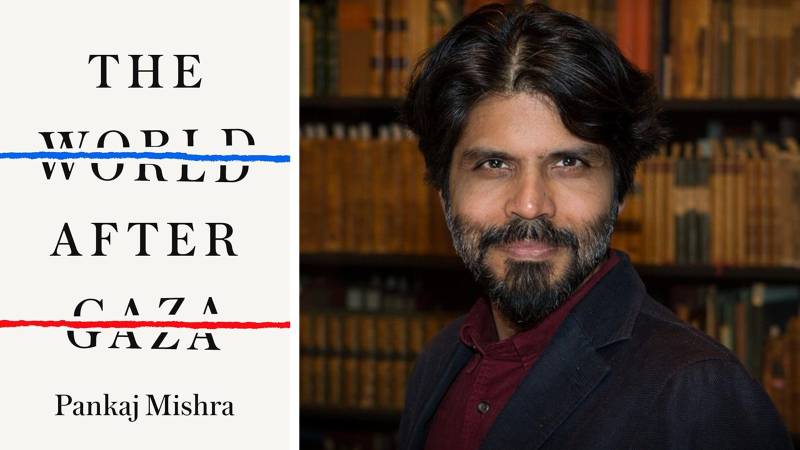
The election of Modi and Netanyahu to power for an extended period has shown the failure of democracy to contain right wing populism. This is because such electoral autocrats weaken what Yuval Noah Harari calls the self-correcting mechanisms of democracy, i.e., independent judiciary, media, and academia. In such broken systems, large swathes of Zionists and Hindutvists dehumanise Palestinians and Muslims based on their majoritarian prejudice, which has resulted in an ongoing genocide in Gaza and systemic discrimination and lynchings in India. Pushing back at such a heinous violation of human dignity is often perilous, as the oppressors weaponise victimhood. This is why the voices of internal critics like Ilan Pappe and Pankaj Mishra matter significantly. Discovering Mishra has been uplifting after the letdown by liberals like Shashi Tharoor who seem to have lost the plot altogether. Mishra’s book builds on his essay "The Shoah after Gaza," and a synoptical review is as follows.
Mishra makes it clear that “the most fanatical Israeli leadership in history” exploited 7 October to make the “Gaza Strip uninhabitable” so that the Gazans would “either die out … or flee the territory” (pp 3-4). Additionally, whilst Israeli snipers shot “children in the head, often twice”, soldiers danced “in the lingerie of dead … Palestinian women” and inserted “hot metal sticks … into the rectum of naked prisoners”, the far-right factions of the Israeli public deplored “inadequate retribution by the IDF” (pp 6-7). Mishra emphasises that “no disaster”, whether the financial crisis or the global pandemic, “compares to Gaza”, as the “savagery” has been abetted by “the world’s richest and most powerful democracies” (p 8). Illustrating such power, he adds that American billionaires launched “smear campaigns against protestors on college campuses”, who have shown an “uncommon kind of courage” in contrast to their elders mired with “cowardice (and) conformity” or “dazzled by power and money” (pp 9, 278-279).
Occupation, Genocide, Ethnic Cleansing and Weaponised Victimhood
Mishra highlights that “Zionists achieved a Jewish majority through systematic ethnic cleansing” and “theft of Palestinian land and property” (p 78). He writes about the “brutality … of Israel’s occupation”, the “sadistic gratification” drawn by settlers speaking in American accents on “shooting Palestinian villagers”, and the “successive military assaults” that treat Palestinians as “laboratory rats” for testing high-tech weapons and surveillance systems (p 84). He adds that Israeli soldiers trumpet “their massacres on social media” and broadcasters call for “the total extermination of Palestinians” (p 190). Mishra is also critical of liberal Zionism, depicting it as “buying time for a non-existent ‘peace process” whilst claiming “moral superiority” (p 111).
Mishra states that “in the 1940s and 50s, the Shoah was not seen (as) separate from other atrocities” and that the “memory of the Shoah” was a belated construction with “specific political ends” (pp 118-119). He quotes Shalom Goldman, that for the “American Jewish community … Israel could do no wrong” and that “only an anti-Semite could find something to criticise” (pp 171-172). He notes that “violent expansion and siege mentalities” can be mutually reinforcing, that “the memory of the Shoah has been perverted to enable mass murder”, and that “men have always made their massacres seem necessary and righteous” (pp 19, 231, 280).
Internal and External Criticism
Mishra references internal criticism by various Jewish personalities. He mentions that Netanyahu is the “political heir” of Jabotinsky’s Zionism, according to which Israel should be “militantly uncompromising, with no concessions to Palestinian Arabs” (p 31). However, Jabotinsky’s followers were “compared to Nazis and fascists” by the likes of Hannah Arendt and Albert Einstein (pp 31-32). Mishra alludes to Jean Amery, a Holocaust survivor, who noted the “systematic torture of Arab prisoners in Israeli prisons” and opined that “where barbarism begins, even existential commitments must end” (pp 23, 30). He mentions that Marek Edelman, a commander of the Warsaw Ghetto uprising, denounced the “Israeli philosophy … that you can kill 20 Arabs as long as one Jew remains alive” and said that “Israel is a chauvinist, religious state” (pp 36, 99).
Mishra notes that Jacob Talmon, an Israeli historian, wrote that Israel would become like the “arch persecutors of the Jews” (pp 41-42). Similarly, Yeshayahu Leibowitz, a philosopher, “warned against the Nazification of Israel”, just as Boaz Evron, an Israeli columnist, opined that Israelis could end up treating “non-Jews as subhumans” and mimicking “racist Nazi attitudes” (p 42). Leibowitz also predicted that Israeli policy would result in “mass expulsion and slaughter of the Arab population” (pp 107-108).
Mishra points out that “yesterday’s victims are very likely to become today’s victimisers” as in the case of the Dalits who “joined their upper-caste tormentors in killing and raping Muslims during the Gujarat pogrom supervised by Narendra Modi
Among non-Jewish critics, Mishra alludes to Dorothy Thompson, who was expelled by Hitler for anti-Nazi reporting, but deemed “the equation of anti-Zionism with antisemitism” as “dangerous” and advised against “an exacerbated consciousness of persecution” (pp 40-41). He references James Baldwin who pointed out that Israel “embodied white supremacy”, as it sold arms to the apartheid regime in South Africa” (p 11). Likewise, Archbishop Desmond Tutu equated the situation in Palestine with apartheid South Africa (p 209). Similarly, Nelson Mandela expressed that “the people of South Africa” would never forget Israel’s support for the apartheid regime” (p 264).
Zionism and Hindutva
Like the author Azad Essa, Mishra writes that India is Israel’s biggest customer, as it uses Israeli “know how in their occupation of Kashmir” and employs Israeli spyware against activists and journalists (p 46). Unlike the vlogger Kay Rated, he mentions that “India’s military occupation” in Kashmir has “consumed tens of thousands of lives” (p 83). Additionally, Mishra explains that inequitable growth in India and Israel has helped xenophobia, ultra-nationalist demagogues, and instigated “cultural purification” (p 260).
He states that like Zionism, the racial ideology of Hindu nationalists served to address a perceived “lack of manhood” (pp 48-49). He adds that Hindu nationalists promote “authoritarian and exclusionary politics as emancipatory” and forge a “hyper-masculine … national identity” based on a narrative of “humiliation, helplessness and insecurity” that “Hindus were enslaved for a thousand years” (p 243). Hindu nationalists also depict “dissenters as colonised minds and imperialist tools” (p 244)
Additionally, “far right Hindu trolls constitute … Netanyahu’s largest fan club”, as for them Israel is an example of “how to deal with Muslims in the only language” they understand, i.e. force (pp 50-51). Mishra notes that Hindu nationalists admire both Nazism and Zionism, as both cleansed their states of “potentially disloyal elements” and encouraged “a militaristic ethos among their citizens” (p 54). He also points out that “yesterday’s victims are very likely to become today’s victimisers”, as in the case of the Dalits who “joined their upper-caste tormentors in killing and raping Muslims during the pogrom supervised by Narendra Modi in the state of Gujarat in 2002” (p 81).
Western Complicity and Opportunism
Mishra notes that Hitler admired the US “racist policies of citizenship, anti-miscegenation and immigration” and was obsessed with “the British exploitation of India and the American genocidal conquest of native American lands” (pp 68-69). He emphasises that it was “normal for Asians and Africans to be exterminated, terrorised, (and) imprisoned” and that “Hitler seemed exceptionally cruel” only because he applied colonialist procedures to Europe (p 236). However, American discourse deflected from “slavery, colonialism, and imperialism” towards “Nazi and Soviet totalitarianism” (p 205). Mishra adds that British policy obstructed “rescue possibilities” and that barriers to “Jewish refugee emigration were higher in the United States” (pp 151-153). Additionally, unlike the liberation in movies like Life is Beautiful, Jewish refugees were “condemned to a state of limbo for years in displaced persons camps” which “replicated some of the humiliations of German camps” (pp 156-159).
Mishra writes that to gain an “entry ticket to the European Union”, countries like Hungary, Poland, and Romania that had collaborated with the Nazis embraced a “definition of antisemitism (as) criticism of Israel” (pp 120-121). He emphasises that of the millions of Germans “involved in killing Jewish civilians” only 164 were tried for murder (p 129). He notes that “nearly 90 percent of antisemitic crimes are committed by right-wing white Germans” but Germany received “moral absolution” by projecting its antisemitism “onto a minority of Middle Eastern immigrants” and demonising Muslims (pp 139-141). This helps explain why Germany proclaims its “undying support for Israel” while ignores its genocide of the Herero people in Namibia (pp 143-144).
Mishra emphasises that “some of the most fervent upholders of the memory of the Shoah” are Europe’s and America’s most antisemitic personalities (p 185). He states that white nationalists “feel a deep affinity with Israel” that has rejected “cultural pluralism” (pp 185-186, 189). Additionally, he writes that Germany has become complicit through its “unconditional solidarity with Netanyahu, Smotrich, Gallant, and Ben-Gvir, in murderous ethnonationalism” (p 149).
Decolonisation
Mishra emphasises that the most consequential event of the 20th century was not the Shoah, the Cold War, the World wars, or the collapse of communism, but rather decolonisation (p 210). He adds that many whine about “wokeness and cancel culture” whilst suppressing critical inquiry of “racism and imperialism” (p 220). For instance, Elon Musk wanted to “ban the word decolonisation” and a British writer claimed that decolonisation is a “toxic, inhumane ideology” (p 226). Mishra notes that Zionist leaders replicated the prejudice of European elites against “degenerate natives” and presented Israel as an “outpost of civilisation” against “barbarism” (p 246). However, he states that decolonisation allows youth to argue that “Israel is a cruel settler-colonialist … regime” supported by far-right Western politicians and fellow liberals (p 232).
Overall, the focal points of Mishra’s thesis, as I understand, include that the oppressed can become the oppressors, massacre is justified through weaponised victimhood, Nazism was colonialism and imperialism applied within Europe, opportunism explains offloading the guilt of the Holocaust, muscular hyper masculinity is promoted to address perceived lack of manhood, and decolonisation helps identify settler colonialism and unequal treatment of genocides.