

Our public sector development paradigm has long been captured by high-visibility, capital-intensive infrastructure, including grand highways, urban flyovers, and sprawling canal networks that look impressive on maps and carry immediate political currency. We must confront the fact that this preoccupation has generated a profound structural blind spot within our governance apparatus.
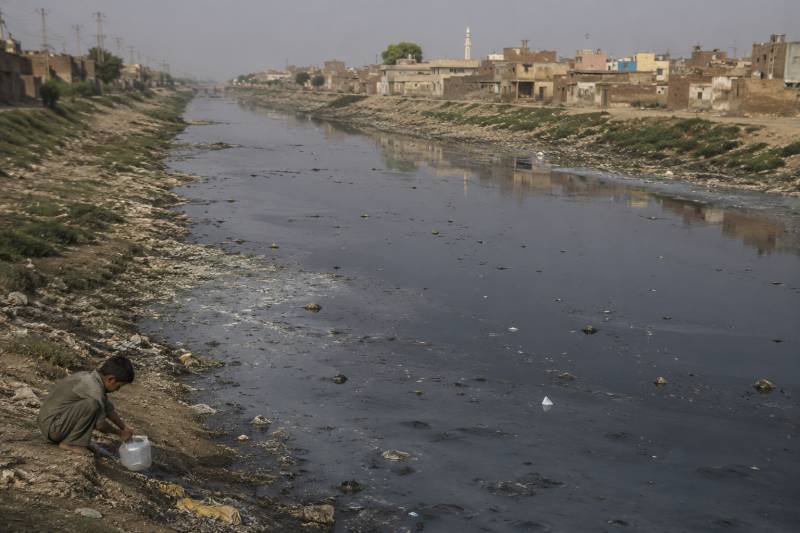
We have inadvertently normalised an institutional culture in which municipal and industrial wastewater is routinely routed into the very aquatic ecosystems meant to sustain life. This is not a natural condition or a mere accident of neglect; it is the result of systematic planning and investment choices that treat our natural rivers, canals, and wetlands as open dumping grounds, completely bypassing the statutory mandate for ecological stewardship and wastewater treatment.
This infrastructure bias imposes an exceptionally devastating cost due to Sindh's unique and unforgiving hydrogeological profile. Unlike other regional basins blessed with abundant alluvial freshwater aquifers, roughly 70 to 78 per cent of Sindh's native land area is underlain by highly saline or brackish groundwater. For the vast majority of our population, this native groundwater is completely unfit for human consumption, making our surface canal network a literal lifeline rather than an agricultural convenience.
In fact, millions of rural households depend entirely on the thin, fragile freshwater lenses that float precariously atop the native saline groundwater, sustained solely by lateral seepage from unlined canals. When municipal authorities and industrial operators discharge untreated waste directly into these canals, the contamination moves rapidly and systematically into this primary drinking water supply.
Our concurrent focus on massive concrete canal-lining projects, with completed schemes costing Rs 82 billion, ironically worsens this trap by acting as an impermeable barrier that blocks lateral groundwater recharge, drying up these vital freshwater "sweet spots" and forcing vulnerable communities to consume raw, toxic water.
The consequences of this priority mismatch are not abstract environmental concerns; they are written on the bodies of our children. For decades, policy conversations have treated childhood stunting as a symptom of food insecurity and dietary deficits alone. However, contemporary medical and technical evidence present a stark indictment of our water governance: only 47 per cent of Pakistan's population has access to safe drinking water, and unsafe water remains the primary driver of child undernutrition.
The data has settled the science, and the lived experience of our communities provides the moral urgency; what we now require is the collective institutional will to act on this evidence at the scale the crisis demands
The biological mechanism is Paediatric Environmental Enteropathy, a chronic inflammatory syndrome triggered by the repeated ingestion of environmental pathogens from contaminated water. This persistent exposure causes villous atrophy, compromises the intestinal barrier, and diverts a child's metabolic energy towards sustaining a localised immune response rather than physical growth or cognitive development.
This explains why improvements in food availability alone have failed to reduce stunting rates, which affect 44 per cent of children nationwide and climb to a heartbreaking 50 per cent in rural Sindh. With waterborne diseases accounting for 40 per cent of all communicable illnesses and causing approximately 53,000 child deaths annually, this public health cascade imposes an annual economic burden conservatively estimated at 4 per cent of Gross Domestic Product.
To understand why this public health emergency persists, we must honestly examine our budgetary and structural allocations. In the FY2025–26 provincial development plan, the state allocated a staggering Rs 143 billion to the Works and Services Department for roads and highways, compared with a mere Rs 1.018 billion for the entire environmental protection sector, a budget that was further reduced to Rs 541 million in FY2026–27.
This means the environmental protection budget represented less than 0.37 per cent of our infrastructure spending, leaving regulatory bodies completely starved of operational capacity. We readily mobilise immense administrative will, clear rights of way, and structure public-private partnerships for elite urban transit corridors, while leaving the city's primary sewage treatment plants to operate sub-optimally or decay into near-total dysfunction.
The current incentive architecture within our bureaucracy heavily rewards one-off, high-visibility capital projects over the continuous, institutionally demanding operational funding required to keep public health-critical systems functioning.
Past interventions have repeatedly shown that infrastructure spending alone, without governance reform, produces only temporary or limited results. Judicial commissions have catalogued these shortcomings in exhaustive detail, highlighting how the installation of over 2,000 reverse osmosis plants at the cost of billions resulted in widespread non-functionality because they were implemented without water-testing laboratories, regulatory oversight, or an operational framework for ongoing maintenance.
The encouraging news is that workable, empirically proven approaches already exist within our own country and in contexts with comparable financial constraints. We can look internationally to Cambodia's Phnom Penh Water Supply Authority, which achieved a world-class turnaround from bankruptcy and heavy political interference by securing legal and financial autonomy, enforcing billing discipline, and professionalising management.
Closer to home, our own Orangi Pilot Project provides a brilliant blueprint for community-government partnership, demonstrating that when communities fund and build internal lane sewers, the state can achieve far greater coverage per rupee spent by focusing strictly on external trunk sewers and treatment plants.
Furthermore, decentralised biological wastewater treatment systems (DEWATS), which use gravity-driven anaerobic reactors and planted gravel filters, have proven highly efficient in small towns and institutions across South Asia, requiring no chemical inputs and minimal electrical energy.
For Sindh, the path forward requires integrating these technical and economic lessons into a structural, rather than symptomatic, planning discipline. The Sindh Strategic Water Plan, currently under procurement, must serve as our primary framework for basin-level thinking, explicitly linking water allocation, quality management, and predictive decision-support models across each canal command.
We must introduce a strict statutory rule in the Annual Development Programme prohibiting the approval of any major infrastructure project exceeding Rs 500 million without a parallel, fully funded wastewater treatment arrangement for the area it affects. We must also establish a protected minimum constitutional floor of at least 5 per cent of the provincial development budget, legally ring-fenced for environmental protection, sewer rehabilitation, and water quality monitoring.
Legislative consolidation is equally urgent; we must merge antiquated colonial-era water laws and later fragmented ordinances into a single, cohesive legal framework to eliminate competing bureaucracies and establish clear mandates for integrated water resource management.
By scaling community-led sanitation models, enforcing a legally binding ban on concrete canal lining without a seepage analysis demonstrating that such lining will not result in the eradication of drinking water sources for the poor, establishing real-time public water quality monitoring networks, and strictly applying the polluter-pays principle to industrial discharges, we can turn our constitutional guarantee of a healthy environment into a tangible reality.
The data has settled the science, and the lived experience of our communities provides the moral urgency; what we now require is the collective institutional will to act on this evidence at the scale the crisis demands.