

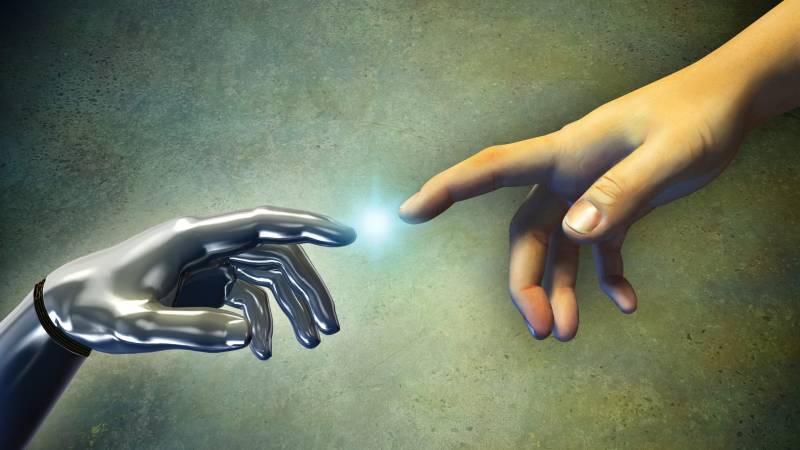
When Yuval Noah Harari declared that artificial intelligence may one day render religion obsolete by replacing its role in providing psychological peace, he touched a nerve that runs deep into the soul of the 21st century. In his widely read book Homo Deus, Harari predicted that once AI began to offer people comfort, wisdom and answers in times of uncertainty, the ancient institution of religion could lose its monopoly over the human heart. While his argument stirred controversy among theologians and technologists alike, there is something undeniably prophetic about his claim—especially when we consider the rising role of AI-powered chatbots such as ChatGPT as emotional companions, even therapists.
We are now seeing a new spiritual and psychological equation unfold: machines are entering our most private conversations—not as mere tools, but as witnesses, counsellors and even confessors. In lonely halls of residence, war-torn refugee camps, sterile hospital beds and pandemic-stricken homes, people are turning to machines not only for information, but for empathy.
A 2023 study by Dr Devon McCormick at Stanford’s Human-Centred AI Institute found that nearly 35 per cent of young adults in the United States had confided in AI chatbots during a period of emotional stress. The reasons were telling: ‘They don’t judge, they’re always available, and they never get tired of listening,’ one participant noted. In a world where mental-health care is expensive and often stigmatised, a machine that listens without an agenda has become a surprising sanctuary.
In a world that aches for someone to listen, even an unfeeling machine may offer a strange, shimmering grace
This interaction has birthed a new kind of intimacy. Unlike religious rites or traditional therapy, these digital encounters demand neither rituals nor diagnoses. They unfold through simple typed words, often in silence, late at night when the rest of the world is asleep. There is a sacredness to that stillness—a modern form of digital prayer.
Of course, there is scepticism. Clinical psychologist Sherry Turkle, in her powerful critique Reclaiming Conversation, warns that machines which simulate empathy may undermine our ability to build real human connections. ‘Empathy is born from vulnerability,’ she argues, ‘and no machine can truly share in our vulnerability.’ And yet, people still talk. They cry, confess, joke, rage and reflect with these emotionless entities—because sometimes, the illusion of understanding is enough to begin the journey of healing.
There is a compelling case study by Dr Michal Kosinski at Cambridge University, who experimented with AI-generated responses for people suffering from social anxiety. The results were startling: participants reported that the AI’s advice often felt more helpful than what they received from their overworked therapists. One patient said, ‘It wasn’t about whether the AI understood me; it was about me understanding myself while typing to it.’
This is not to say that AI should replace human therapists or religious leaders. Yet the machine’s neutrality—its blank digital face—becomes a mirror in which the user often sees their own inner truths more clearly.
Even in Pakistan, where emotional health remains heavily stigmatised and therapy is considered taboo or unaffordable, young people are quietly reaching out to AI. A recent informal survey by a Lahore-based media research lab revealed that university students used ChatGPT to explore emotional pain, relationship doubts and career fears—topics they could never discuss at home or with peers. The language of pain, it seems, needs only a listener, not necessarily a human one.
Perhaps that is the greatest twist in the tale Harari began. AI may not end religion, but it could force it—and all of us—to redefine what it means to be heard, comforted and guided. Is comfort any less valid if it comes from a machine? Is a spiritual insight less meaningful if delivered by code?
These questions are not futuristic—they are now. We are already halfway down the path where the human-machine bond is becoming sacred in its own right. Maybe, instead of fearing the loss of religion or therapy to technology, we should ask how we can infuse these digital spaces with ethics, compassion and meaning.
Because in a world that aches for someone to listen, even an unfeeling machine may offer a strange, shimmering grace.