

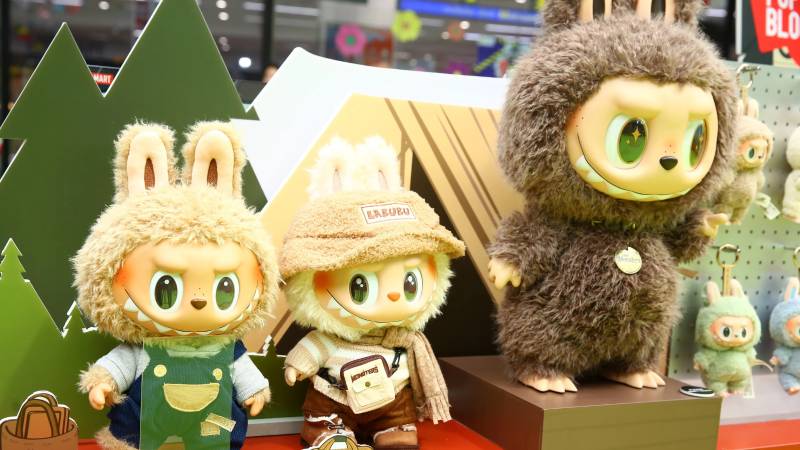
In the age of social media and iPad kids, anything can become a trend in 2025. All it really takes is one viral TikTok to get the ball rolling. The latest contender? A goblin-faced, nylon-coated plastic doll named Labubu. Maybe the craze hasn’t fully gripped Pakistan yet, or perhaps I’ve dodged the microtrend bullet. Regardless, it would be idealistic to ignore the global phenomenon Labubu has become.
Born out of a Chinese brand, PopMart, Labubu is part of “The Monsters” line of collectible designer toys. Created by Kasing Lung, a Hong Kong-born artist and the mind behind the character, Labubu first emerged in 2015. Ten years later, through clever marketing and powerful branding, the doll has managed to shake up the global collectible scene.
While Labubu’s initial popularity was largely confined to China, its international breakout came via the magic of influencer culture and celebrity endorsement. K-pop star Lisa served as the catalyst for the doll’s global fame after posting about it on Instagram. From there, the phenomenon snowballed. In the early months of 2025, Rihanna was photographed with a Labubu clipped to her Louis Vuitton bag, followed by Kim Kardashian and David Beckham, who took to Instagram to show off his daughter’s Labubu doll gift to him. Thus began the rampage.
In the age of environmental awareness and digital fatigue, it cannot be denied that consumers of such products are aware these are simply the result of microtrends that will fizzle out in months, if not weeks. Self-awareness is there; however, so is the desire to partake in such global events. Because how else do you keep up with the conversation at a kitty party if your Louis Vuitton bag isn’t sporting a Labubu? It’s practically an unspoken dress code now. Maybe it’s irony that fuels our participation; after all, to parody the elite, one must occasionally dress like them.
Which brings us back to the question: why? Why is it that people partake in such trends knowing the shelf life is laughably short? Humans are social animals, so perhaps we want to ride any quick-burning, high-intensity aesthetic wave. And while there's nothing wrong with that in the moment, one has to wonder what will happen fifty years from now, when the plastic we once clipped onto handbags fills landfills to the brim.
In times of geopolitical uncertainty and the desperate desire to find some happiness, these microtrends are a way to keep us optimistic
In a place like Pakistan, where the boundaries between lower, middle, and upper class are so starkly defined, one has to wonder: is it really worth delving into trends such as this? Today it's a Labubu doll; tomorrow, it might be another irresistibly ‘limited-edition’ item with the same destiny of being dumped in the basement along with the Stanley cups and reversible octopus plushies.
Instagram resellers and upscale toy shops in cities like Lahore and Karachi have caught onto the Labubu trend, offering dolls priced between PKR 3,000 to 8,000. A quick scroll through resale pages shows listings that sell out quickly, especially for rarer editions. And in high-end malls or cafés, it’s not unusual to see one clipped to a leather handbag, less as a toy, more as a subtle social signal. In a country where inflation is running high and youth unemployment is rising, participating in such trends signals that you’re not just globally aware, but economically untouched.
It’s all pointless, and yet, somehow, entirely the point.
Which begs the question: do trends such as that of acquiring a Labubu doll fuel the class divide not just in Pakistan, but worldwide? And if we as a generation are so painfully self-aware of our actions and their repercussions, should we not be breaking away from such trends?
Cynicism aside, when looking at the bright side, perhaps now we can all extend our congratulations to the company PopMart, whose share price has seen a significant increase since Labubu's global popularity surged, with estimates ranging from a 170% to over 500% increase in the past year. Perhaps, in times of geopolitical uncertainty and the desperate desire to find some happiness, these microtrends are a way to keep us optimistic.
One has to wonder how long we can keep chasing these short-term surges of happiness. But you never know. Maybe the same Labubu dolls we toss in the basement in a few months could end up being worth thousands in 2075. I suppose we’ll just have to wait it out. And if nothing else, our future kids will have a pretty weird time explaining why grandma once dropped five thousand rupees on a plastic goblin.