

“It is hard to imag-ne a more stupid or more dangerous way of making decisions than by putting those decisions in the hands of people who pay no price for being wrong.” (Thomas Sowell)
Sugar has become a bitter pill to swallow.
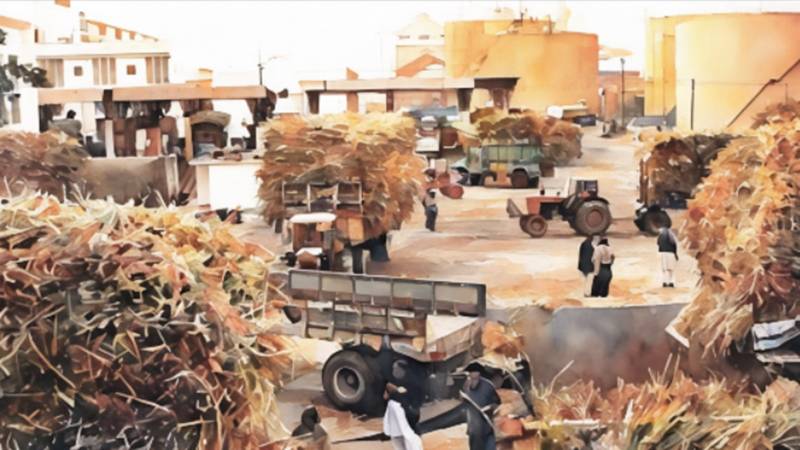
Greed, exploitation, lack of transparency, nepotism, cronyism, unprofessionalism, and the conflict of interest are some of the key components of the exploitative economic model pursued by the Pakistani ruling elites. The unbridled greed behind the commodity called sugar is evident in the decision to export and then import it, while prioritizing tax preferences. The federal government, in a paradoxical move, approved the import of 500,000 metric tons of sugar in a bid to address supply gaps and stabilize prices amid growing concern over inflation and commodity shortages. The supply situation deepened due to the government's earlier decision to export 765,000 metric tons of sugar. Federal Minister for National Food Security and Research Rana Tanveer Hussain stated that, due to food emergency, the federal government approved the import of 500,000 metric tons to stabilize local prices with immediate effect.
The Shahbaz Sharif-led PML-N government anticipated a sugar shortfall of around 500,000 metric tons in the coming months. Both the people of Pakistan and the economic experts and the IMF were taken aback by the approval given by the government. The former’s fury stemmed from the paradoxical consideration and the latter due to the violation of certain commitments.
Imagine the spike in the import bill. Reportedly, the government's decision to import 0.5 million tons of sugar—300,000 tons through Trading Corporation of Pakistan (TCP) and remaining 200,000 tons via private sector—was going to spike the import bill by $275-280 million. Earlier, report by the Auditor General of Pakistan dropped a bombshell on the government agencies—the Trading Corporation of Pakistan (TCP) and Passco—having concluded that the two entities in question caused a loss of $31.32 million to the national exchequer owing to the import of wheat at inflated rates from 2017 to 2022.
Reportedly, the IMF refused to buy government's food emergency claim (as a result) the latter cancelled the tender in question. Had the dam not been built against the government's decision, it would have caused hefty loss to the national coffers.
In a face-saving move, following an agreement between the government and the sugar industry and subsequent statement from the Ministry of National Food Security and Research, the federal government has fixed the ex-mill price of sugar at Rs 165 per kilogram
This raises a crucial question: why did the government allow the export of the commodity when the exported metric tons could have covered the anticipated shortfall? Apparently, following the export of the commodity, its price shot up to a record high of Rs 200 in the local market. Initially, the export decision allowed sugar barons to reap benefits, and now they're being further facilitated through preferential tax treatment. Economic experts warned that this move might land the federal government in trouble due to potential violations of written commitments under the IMF program, specifically regarding refraining from granting preferential tax treatment or engaging in commodity purchases. This happened as the IMF put cold water on the government’s decision of importing the item in question.
The government’s move to import the sugar generated unprecedented backlash from across various sections of society, who see it as nothing but a nexus between profiteers and those in power.
A closer look reveals that the beneficiaries of this lucrative business are none others than the ruling elites and their crony capitalists. This greedy business is happening in the name of supporting domestic demand, allegedly due to a shortage resulting from the earlier export decision made by the incumbent government led by Shahbaz Sharif. And this is happening in a country that is teetering on the brink of an epic economic crisis, hence seeking bailout packages from global lending entities like the IMF. The bigger question is: why are the hefty amounts from the bailout packages being wasted in this manner? Why was domestic demand neglected while exporting sugar? Who were the masterminds behind this illogical decision-making?
In a face-saving move, following an agreement between the government and the sugar industry and subsequent statement from the Ministry of National Food Security and Research, the federal government has fixed the ex-mill price of sugar at Rs 165 per kilogram. And the provincial governments have been directed to ensure the availability of sugar to the public at the announced rate. We have witnessed in preceding years that announcements such as this rarely materialize due to a lack of price control mechanisms. Consequently, we see hoarding and black marketing.
The root cause lies in the pro-rich policies pursued by our policymakers, which have been historically preserved like sacred structures, undermining our social protection programs. Daily, people cry out against the crumbling healthcare system, forcing them to opt for private healthcare, which is exploitative at its core. Similarly, our debilitating education system pushes people towards private education, burdening them with exorbitant fees.
This raises a fundamental question about the priorities of our policymakers and the impact of their decisions on the most vulnerable segments of society.
Those already in the lap of luxuries are being facilitated and fed by the prevailing economic system can be measured from that we witnessed a whopping hike in the salaries of cabinet ministers and parliamentarians. Not long ago, President Asif Ali Zardari promulgated the Federal Ministers and Ministers of State (Salaries, Allowances and Privileges) Amendment Ordinance, 2025, raising the monthly salaries of federal and state ministers by up to 188%. In February, the lawmakers secured a massive 138% pay raise as the NA passed the Members of Parliament Salaries and Allowances (Amendment) Bill 2025 with a majority vote. Since birds of same feathers flock together, both the opposition (PTI) and the treasury benches were on the same page regarding the massive spike in question. This suggests that all are driven by self-interest rather than collective well-being of the majority tucked into utter poverty and deprivation. In stark contrast, when it came to increasing salaries in the federal budget 2025-26, employees received a meagre 12 percent increase. The PML-N-led government came under fire for this exorbitant increase in salaries for those already enjoying luxuries. Does the privileged class, comprising cabinet ministers and lawmakers, experience inflation and rising living costs differently than ordinary employees? It seems that facilitating and benefiting the already privileged is the top priority of our rulers. They continue to feather their own nests at the expense of the poorest sections, who are already struggling with the back-breaking rising cost of living. The burden of bad financial governance is passed on to the common people through utility bills, further exacerbating their plight. Reportedly, 45 percent of Pakistan’s population lives below the poverty line, according to a World Bank report recently released.
This disparity raises questions about the fairness and equity of our economic policies. While the ruling elite prioritize their own interests, the majority of the population struggles to make ends meet. Recently, the public decried the hiring of retired bureaucracy for important and lucrative posts based on their political influence or personal connections. Those who spoke out against such hiring presented a convincing argument, questioning the impact on the youth bulge - educated but struggling with unemployment and job layoffs due to multiple growing economic crises.
We are an agricultural country. However, the established order continues to undermine agriculture - the very backbone of the country. When growers take their produce to the market, they don't get a fair price as prices are brought down by capitalists and industrialists - not to mention the plummeting prices of wheat this year that broke the back of farmers - the spinal cord of the body politic.
Last but not the least, every monsoon rain and consequent loss of human life and infrastructure is a grim reminder that successive ruling elites have learned no lessons from past experiences when nature unleashed its fury. Poverty, inflation, deteriorating law and order situations, and climate-induced calamities disproportionately impact the wider sections of society, whereas the ruling oligarchy, living in luxury, remains immune to climatic ravages, inflationary pressures, and poor law and order.
While various countries across the continents have formulated mechanisms to clean the ocean, just to keep the oceanic atmosphere clean and habitable for the species living in it, our rulers have failed to provide basic services such as clean drinking water, better healthcare at the doorstep, standardized education, and decent and peaceful living. This utter indifference to the needs of the vast majority in the country is glaring. While the salaried class struggles to make ends meet, one can only imagine the economic conditions of the impoverished masses. The rising curve of increasing energy prices like petrol and diesel will unleash an inflationary impact, needless to say, upon ordinary people. According to the Pakistan National Human Development Report 2020, released by the United Nations Development Programme (UNDP), the total privileges enjoyed by Pakistan's most popular groups, including the feudal class, the corporate sector, exporters, large-scale traders, high-net-worth individuals, the military establishment -and state-owned enterprises, were documented at Rs2,660 billion in 2017-18, or around 7% of the country's Gross Domestic Product (GDP), these privileges can be broken down into favourable pricing, lower taxation and preferential access. The report's lead author, Dr Hafeez Pasha, believed that the corresponding cost of social protection programmes (2019) was Rs624 billion. Diverting just 24% of these privileges to the poor could double their benefits. Redistribution along these lines is a crucial first step to alleviating inequality. The same report placed the blame of institutional failure at the doors of regulatory structures, having concluded: "Poor regulation by the National Electric Power Regulatory Authority (NEPRA) and the Oil and Gas Regulatory Authority (OGRA) increases the cost burden on end consumers and hinders socio-economic development. The State Bank of Pakistan has been unable to control the build-up of a credit monopoly in the financial sector. As a result, low-income individuals are denied access to credit.
“Pakistan: The Economy of an Elitist State" by distinguished author Dr Ishrat Husain, offered insightful input on the topic. It is pertinent to take some excerpts from the intellectual enterprise. The author quoted economic experts writing "Daron Accemoglu and Robinson (2012) in their study, why nations Fail, demonstrate that it is the institutions that determine the fate of nations. Success comes when political and economic institutions are' inclusive ' and 'pluralistic ' , creating incentives for everyone to invest in the future. Nations fail when institutions are 'extractive' protecting the political and economic power of only a small elite that takes income from everyone else. Institutions that promote good governance and facilitate broad based and inclusive growth have come to occupy the current consensus on development strategy. According to Accemoglu and Johnson (2003) ,good institutions ensure two desirable outcomes: relatively equal access to economic opportunity ( a level playing field) ,and the likelihood that those who provide labour or capital are appropriately rewarded and their property rights are protected.
He has not only traced the historical background in terms of capital capture by the elites but have also identified the very faces behind this networked economic model. He mentioned that"" The four groups identified in the 1999 edition of this book -the landed aristocracy, industrialists and big business; the civil bureaucrats; the military officials ; and the professionals -have expanded in numbers and new entrants have penetrated this class of elites but the nature, characteristics and dynamics have remained the same. The notable difference observed in recent years is that some members belonging to lower-middle income groups have also found an entry point by acquiring higher education and joining the military, civil service, and other professions. But by and large, the probability of a child born in a poor or lower-middle class remaining in the same class after entering adulthood is statistically quite strong as social upward mobility remains quite limited. The behaviour and norms of new entrants in the group of elites, with very few exceptions, begin to conform to the central tendency exhibited by their peers. Many civil society organizations and media anchors and owners have also joined these ranks. Thus, the expectation that the urban middle educated classes, civil society organizations, and the media would act as the countervailing forces to the onslaught of the elites has remained unfulfilled. The impulses of greed, self-gratification and acquisition of wealth by hook or crook have become so strong and are so widely condoned that they are eclipsing the ethical values of hard work, integrity, and professionalism. Social ostracism of the corrupt and unscrupulous is no longer an accepted practice .Jean Paul Sartre said,” Every word has consequences. Every silence, too.”
How does the elitist model work in actual practice? What are the mechanics through which the elite capture takes place? How do they accumulate 'rents' and 'wealth'? How do they rig markets? How do they acquire political power?
What are the factors that contribute to the ineffectiveness or dysfunctionality of the institutions such as the judiciary, finance, education, agriculture, tax, and expenditure etc.? A clear understanding of these dynamics would help in designing the strategies that may ultimately lead to dismantling the elitist system of governance. At present, a common citizen without any connections or ability to offer bribes can hardly access any of the daily basic services he needs for himself and his family -drinking water, healthcare , schooling for the children, jobs , security of life and property and access to justice. Political leaders use this helplessness of the common man to their advantage by acting as the middle men between the government functionaries and the poor citizens. The vicious cycle persists irrespective of which political party is in power. The old, defeated leader is replaced by the newly elected one but the tactics remain the same.
Dr Huma Baqai foreign policy and current affairs expert conveyed her strong-worded concern in no uncertain terms posting on her Facebook wall “Blood sucking sugar cartel reigns supreme. Pakistan and the people of Pakistan can go to hell ,we can fight and defeat India but not our greedy , exploitative elite and its capture of our politics … call it what you want cartel , mafia or family gratification , it’s essentially blatant exploitation of the people by the ruling elite of Pakistan.”
Elite capture continues to wreak financial havoc on the lives of the have-nots.
The undemocratic distribution of wealth in conjunction with elite capture is straining both individual livelihoods and the moribund national economy. The time has come to limit cupidity. Those in decision-making centres should realize that the people of Pakistan are bearing the brunt of bad financial governance. With what face will you go to eternity? What will be your reply when subjected to accountability for this bad economic model on the Day of Judgment?
Breaking a bad economic model isn't a difficult concept: break the chain of elite capture that has financially chained the vast majority. Undoing elite capture and promoting a more democratic society in terms of equitable distribution of wealth in Pakistan could involve several strategies. These include but are not limited to:
- Promoting Transparency and Accountability
Strengthen institutions
Transparency in governance - Economic Reforms
Broad-based taxation
Targeted subsidies and welfare
Encouragement of entrepreneurship and job creation - Empowering the marginalized
Education and skill development
Community empowerment - Governance and Policy Reforms
Decentralization
Encouragement of citizen participation
Shaking off the status quo requires those at the helm of the country's affairs to drop discriminatory economic arrangements, which can only be achieved by knocking down the desire for accumulation of wealth, keeping in mind Alexander the Great's great wishes. Here's a lesson for those clinging to power and wealth i. e engaged in monkey business, at the cost of pushing the already economically disadvantaged sections into further financial fragility.
According to legend, Alexander the Great had three ultimate wishes when he was on his deathbed. These wishes are often cited to reflect on the nature of power, legacy, and mortality. The three wishes are:
- Let my physicians carry my coffin: Alexander wanted to show that even with the best medical care, death is inevitable.
- Let my path to the grave be strewn with gold and jewels: This wish highlighted the futility of wealth in the face of death.
- Let my hands be outside the coffin so all can see: Alexander wanted to show that he died with nothing, emphasizing the transience of worldly power and possessions.
These wishes are often seen as a reflection on the impermanence of life and the futility of clinging to wealth and power.
Political will and a clean economic conscience are prerequisites to achieve the desired end. Otherwise, no solution or strategy will be sustainable.
Can we be the nation that fixes its economic landmines -elite capture -undermining national prosperity?
Just wait and watch.