

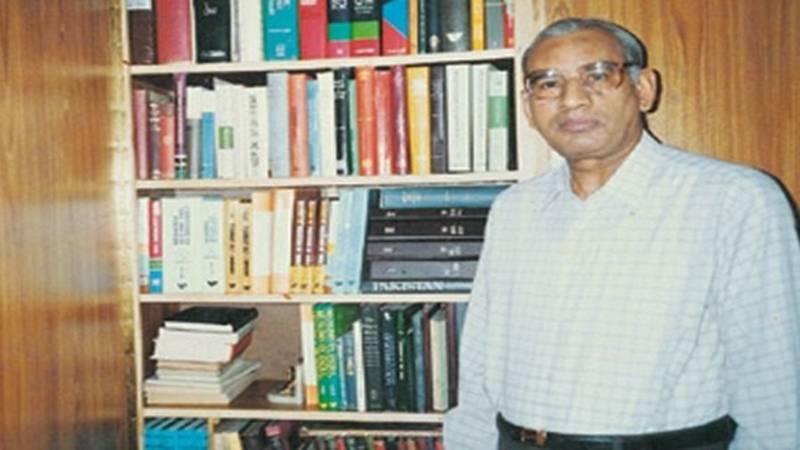
To understand a nation, you must first listen to its dissident voices – the ones that speak in measured tones against the roar of approved history. In Pakistan, for generations reared on a narrative of heroic origins and unblemished ideals, the work of Professor Khursheed Kamal Aziz, known to the world as KK Aziz, is not simply a collection of books. It is a tremor in the foundation of national memory, a necessary disruption that future generations cannot afford to ignore.
Aziz was not a historian who gave us grand, flattering portraits. He was a master restorer, patiently working on the faded, damaged canvas of the subcontinent's past, carefully removing the varnish of propaganda to reveal the complex, often unsettling, image beneath. His relevance for the young people of today and tomorrow lies precisely in this act of restoration.
In an age of digital echo chambers and alternative facts, Aziz’s methodology and moral courage offer are a lesson on how to seek truth, question power, and reclaim a past.
Born in 1927 in British India, Aziz lived through the events of Partition, migration, and the turbulent early decades of Pakistan. He was an academic of the highest calibre, educated at Forman Christian College in Lahore and Cambridge, and he served in prestigious roles, including as the head of the history department at Punjab University and as an advisor to the government. He was not an outsider throwing stones. Instead he was a custodian of the country’s history teaching, and he was deeply concerned about what he saw.
Perhaps Aziz’s most important contribution, and the one that rings with acute urgency today, is his forensic dissection of Pakistan’s official history. In his seminal work, The Murder of History: A Critique of History Textbooks in Pakistan, he did something revolutionary: he took the books that were shaping the minds of millions of Pakistani children and exposed them as instruments of indoctrination, not education.
In an era of fake news and 'alternative facts' where misinformation can spread faster than truth, the Aziz model of scholarship, slow and careful, is more necessary than ever before
He meticulously catalogued the errors, the omissions, and the outright distortions. He showed how history teaching in Pakistan was being manipulated to serve a political agenda, in a number of ways.
Firstly, the rich, pluralistic tapestry of the South Asian Subcontinent – with its Hindus, Sikhs, Buddhists, and various Muslim sects – was flattened into a simplistic binary of “us” versus “them.” Pre-Islamic history was largely ignored, and the contributions of non-Muslims to the region's culture and civilization were systematically minimized.
Some figures were deified, their complexities and contradictions airbrushed away. Meanwhile, historical actors who did not fit the national narrative were vilified or simply written out of the story.
A narrative was constructed that consistently justified the role of the army in politics, creating a culture where military rule was seen not as a disruption of democracy, but as a necessary intervention.
Aziz argued that this was not just bad history; it was a form of intellectual murder. It was killing the ability of young people to think critically, to understand nuance, and to empathize with perspectives different from their own. For coming generations, living in an interconnected world, this lesson is important. A nation built on a foundation of historical falsehoods is like a house built on sand; it cannot stand firm in the face of complex, 21st-century challenges.
Aziz teaches young people to be archeologists of information, to dig for primary sources, and to be inherently suspicious of any story that seems too clean, too heroic, or too perfectly aligned with power.
The kind of interventions that Aziz makes range from pedantic correctives to major gaps and distortions.
For instance, a Class 1 textbook claims: "Who created Pakistan? Answer: The Quaid-i-Azam created Pakistan." Aziz argues that this oversimplification ignores the complex historical, political, and constitutional processes involving the British Parliament, the Muslim League, and Hindu leadership.
Multiple textbooks state that the Lahore Resolution (Pakistan Resolution) was passed on 23 March 1940. Aziz corrects this to 24 March 1940. He also notes that the resolution called for "independent states" (plural), not a single state, and did not use the word "Pakistan."
Many textbooks blame India exclusively for the breakup of Pakistan, ignoring internal political failures, military actions in East Pakistan, and the role of Bengali grievances. Aziz calls this a "tendentious" and incomplete account.
Textbooks claim Iqbal was the "first" to propose the idea of Pakistan in his 1930 Allahabad address. Aziz clarifies that Iqbal did not explicitly demand a separate state; his speech was more about Muslim autonomy within a federation.
If “The Murder of History” was his diagnosis, other works like The Meaning of Islamic History and his writings on Pakistani minorities were an antidote. Aziz had a profound empathy for the voiceless. In a society where the story is almost always told by the victors, he dedicated himself to recording the experiences of those on the margins, be it non-Muslims in Pakistan, or the various Muslim ethnic groups whose aspirations were suppressed by a centralizing state.
In his other works, he documented the systemic discrimination, the legal injustices, and the social prejudices they faced. He did not see this as an act of airing dirty laundry, but as an act of national healing. You cannot cure a disease if you refuse to acknowledge its symptoms. For young people today, grappling with issues of social justice, identity politics, and inclusion, Aziz’s work is a foundational text. He demonstrates that true patriotism involves standing up for the rights and dignity of all your country’s citizens, not just the majority.
He forces the question: What does it mean to be a Pakistani? Is it a monolithic identity defined solely by a particular interpretation of religion? Or is it a civic identity, a shared commitment to a piece of land and its people, in all their diversity? In a world struggling with migration, xenophobia, and sectarian strife, Aziz’s insistence on a pluralistic patriotism is more relevant than ever.
Aziz’s relevance is not just in what he wrote, but in how he lived his intellectual life. He was a model of stubborn integrity. His work made him controversial. He was called a traitor, an agent of foreign powers, and his ideas were often met with hostility from the establishment. Yet, he never wavered. He was not seeking popularity; he was seeking truth.
This is a powerful lesson for a generation navigating the treacherous waters of social media, where likes and shares can often seem more valuable than truth. Aziz’s career is a testament to the idea that some truths are worth standing for, even if you have to stand alone. He relied on evidence, on meticulous research, and on the courage of his convictions. In an era of fake news, where misinformation can spread faster than fact, the Aziz model of scholarship, slow and careful is more necessary than ever before.
KK Aziz passed away in 2009, but his unflinching gaze continues to watch over the conscience of Pakistan. He was, in the truest sense, a patriot. He loved his country not for what its rulers claimed against historical facts, but for what it could become. He understood that a nation that is afraid of its past can have no future.
The challenges of the coming century will require citizens who are not just technically skilled, but who are also historically literate, ethically grounded, and brave enough to face uncomfortable truths – whether we are looking at the economic, political and security problems facing Pakistan, or worldwide issues like climate change, technological disruption and global inequality. In the work of KK Aziz, they will find a key example of how to approach narratives in a deeply divided world.
His love for Pakistan was not the loud, flag-waving kind. It was a profound, anxious love. He believed that a nation, like an individual, could not grow without an honest reckoning with facts. This principle became the bedrock of his life’s work.