

The relationship between Pakistan and Afghanistan has long been one of the most intricate and shifting dynamics in South Asia. Bound by deep ethnic, cultural, and religious ties, the two nations have nevertheless struggled with profound mistrust, unsettled border issues, and competing security interests. Since Pakistan’s independence in 1947, bilateral relations have oscillated between cautious cooperation and open hostility, shaped as much by regional rivalries as by global geopolitical pressures. This analysis traces the evolution of the Pakistan–Afghanistan relationship from independence to the present day, concluding with the current border escalation and its broader implications for regional stability.
When Pakistan emerged as an independent state in 1947, Afghanistan was the only country to oppose its admission to the United Nations. The primary source of this early antagonism was the Pashtunistan issue, with Kabul formally rejecting the Durand Line (1893) as the recognised international border. Afghanistan insisted that ethnic Pashtuns residing on Pakistan’s side of the border be granted the right to self-determination, either through union with Afghanistan or the creation of an independent state.
This early disagreement set the tone for decades of deep suspicion. Pakistan viewed Afghanistan’s stance as a direct challenge to its sovereignty and territorial integrity. The divide deepened during the Cold War, as Pakistan aligned with the West through defence pacts like SEATO and CENTO, while Afghanistan leaned toward the Soviet Union, creating an ideological split that further complicated bilateral and regional security.
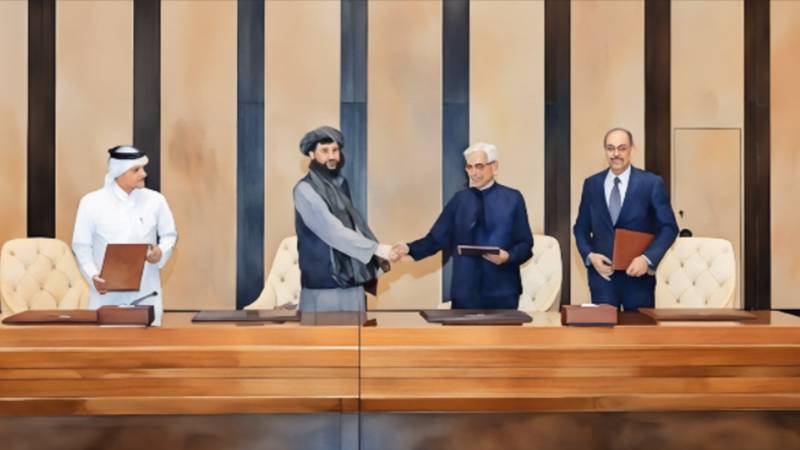
The Qatar-brokered ceasefire remains tenuous, highlighting a dramatic rupture in a relationship once defined by Pakistani patronage of the Taliban
The Soviet intervention into Afghanistan in 1979 thrust Pakistan into a pivotal role. Under General Zia-ul-Haq, Pakistan became the frontline state supporting the Afghan resistance, coordinating extensive aid from the US, Saudi Arabia, and China to the Mujahideen. This effort precipitated a massive humanitarian crisis, with more than three million Afghan refugees seeking safety in Pakistan, which became the world’s largest refugee-hosting nation. While Pakistan’s strategic support was instrumental in the Soviet withdrawal, it came at a high internal cost, introducing militancy and ideological extremism that profoundly affected its internal security for decades. Nevertheless, Pakistan shouldered immense political and social burdens.
Following the Soviet withdrawal, Afghanistan descended into a brutal civil war among rival Mujahideen factions. Seeking stability on its western border and a friendly regime in Kabul, Pakistan eventually backed the Taliban movement, which captured Kabul in 1996. Along with Saudi Arabia and the UAE, Pakistan recognised the Taliban government, viewing it as a means to achieve “strategic depth” and prevent anti-Pakistan influence from gaining ground.
However, the Taliban’s decision to harbour Osama bin Laden isolated Pakistan internationally and made Afghanistan a focal point of global concern. Nonetheless, Islamabad’s approach remained rooted in a desire for regional stability and a functioning Afghan state capable of preventing chaos along its frontier.
Following 9/11, Pakistan allied with the US in the War on Terror, severing formal ties with the Taliban. Despite extensive cooperation, including facilitating NATO supply routes and participating in reconstruction, relations were persistently marked by mutual suspicion. Afghan leaders accused Pakistan of harbouring the Afghan Taliban and Haqqani Network, while Pakistan countered that Afghan soil was being used by the Tehrik-i-Taliban Pakistan (TTP) and external intelligence to destabilise it. Attempts at rapprochement, like the APTTA and the 2020 Doha peace talks, reflected Islamabad’s ongoing effort for dialogue, but by the Taliban’s return to power in 2021, Pakistan’s balancing act had become increasingly fragile.
By 2023–2024, repeated border incidents and failed negotiations had militarised the frontier. Escalating tensions were further complicated just prior to the 2025 border conflict when Afghanistan’s Acting Foreign Minister met with his Indian counterpart. This high-profile move, officially framed as humanitarian and trade cooperation, was interpreted in Islamabad as a strategic realignment aimed at undermining Pakistan’s regional influence. This shift occurred following the failure of India’s ‘Operation Sindoor’. Critics subsequently contend that India provided substantial support and funding to the Afghan Taliban regime, allegedly to empower the TTP and facilitate domestic chaos, thereby destabilising Pakistan through proxy warfare, a strategy that is destined to meet the same fate as Operation Sindoor, marking yet another strategic failure for India.
These tensions erupted into a low-intensity border war in early 2025. On the night of 11/12 October, the Taliban-led Afghan government launched coordinated attacks along sectors of the Durand Line, targeting Pakistani military posts. Pakistan responded immediately with retaliatory counter-terrorism air and artillery strikes targeting TTP strongholds deep inside Afghan territory. The clashes resulted in casualties on both sides and underscored the depth of the current rift, coinciding with Pakistan’s accelerated repatriation of undocumented Afghan refugees, which further escalated diplomatic friction.
In the wake of these clashes, Qatar and Turkey brokered a ceasefire agreement on 19 October 2025. The accord mandated an immediate cessation of hostilities, established communication channels, and committed both sides to curbing militant activity. Islamabad welcomed the truce but cautioned that its success depended critically on Kabul’s willingness to restrain the TTP. While the ceasefire eased immediate tensions, its durability remains uncertain amid lingering distrust and the absence of a robust monitoring mechanism.
Pakistan has consistently pursued peace and stability in Afghanistan, often meeting aggression with goodwill. From supporting the Afghan resistance to sheltering millions of refugees, Pakistan has shouldered immense humanitarian and economic burdens. Despite repeated provocations and security challenges, its policy remains guided by the belief that a stable, sovereign, and economically integrated Afghanistan is vital for regional peace and the shared prosperity of South and Central Asia. Islamabad’s continued patience reflects its dedication to ensuring lasting stability in its immediate neighbourhood.