

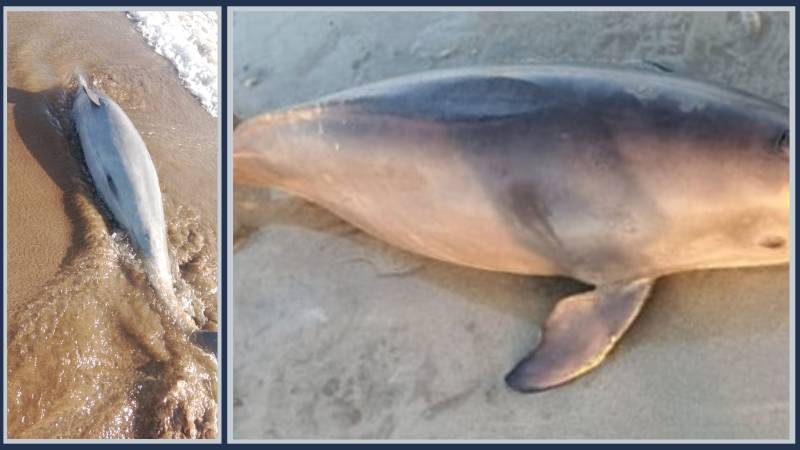
A rare Indo-Pacific finless porpoise (Neophocaena phocaenoides) was recently found dead and stranded on the beach at Ormara, Balochistan, the fourth marine mammal death reported from the province in just two weeks. The incident has intensified concern among conservationists, fisheries experts, and local observers about the increasing threats facing marine mammals along Pakistan’s coastline.
The finless porpoise, known locally as the Tibbi Dolphin, is among the least understood and most vulnerable cetacean species inhabiting the Indo-Pacific region. Along Pakistan’s coast, its population has been steadily declining for years, mainly due to accidental entanglement in fishing gear. Its discreet behavior, staying low in the water, avoiding boats, and rarely surfacing dramatically, makes it difficult to study and even harder to protect.
Over the past two weeks, three finless porpoises and one spinner dolphin have been found dead at different points along the Balochistan coast. The first porpoise was discovered at Gwadar West Bay on 2 November 2025. A second was found caught in a gillnet at Gwadar East Bay on 5 November. The third carcass surfaced at Ormara West Bay on 22 November. On 24 November, a spinner dolphin washed ashore near Pasni, marking the fourth cetacean death in a short span of time.
Although each incident occurred in isolation, their timing and pattern point toward a consistent threat, fishing nets, particularly monofilament gillnets.
These fine-threaded gillnets, almost invisible underwater, are widely used by coastal fishers targeting sardines, mackerel, and other commercially important species. Marine mammals such as dolphins, porpoises, and turtles often fail to detect these nets until it is too late. Once trapped, they suffocate because they cannot reach the surface to breathe.
According to WWF-Pakistan, which has documented cetacean mortality for over a decade, entanglement in gillnets remains the single largest cause of dolphin and porpoise deaths along the Pakistani coast. The organization has repeatedly expressed concern over the continued use of monofilament gillnets in coastal waters, describing them as a “silent but lethal threat” to marine biodiversity.
Moazzam Khan, Technical Advisor at WWF-Pakistan, emphasized that the organization has introduced successful mitigation measures in offshore tuna gillnet fisheries, significantly reducing dolphin mortality in those deeper waters. “Similar interventions,” he notes, “are urgently needed in the coastal fisheries of Sindh and Balochistan.” He has called for the establishment of no-fishing zones, stricter monitoring of fishing practices, and the creation of marine refuges to protect sensitive species such as finless porpoises, spinner dolphins, humpback whales, and marine turtles.
While the recent mortality events have drawn attention to the threats underwater, the region has also witnessed moments of ecological hope. Over the past month, fishers and observers reported unusually large pods of dolphins in the waters near Gwadar and Gunz, displaying bow-riding behaviour as they swam alongside boats, a spectacle that brought excitement and a sense of relief to many.
These sightings offered a reminder of the rich ecological diversity of Pakistan’s 1,050-kilometre coastline. Scientific studies and long-term monitoring suggest that the country’s coastal waters host at least 27 species of whales and dolphins, making them one of the most biologically significant marine zones in the region. November 2025 has been particularly active, with multiple sightings reported across Sindh and Balochistan, an indication that these waters remain valuable feeding and breeding grounds.
Yet, amid these encouraging signs, each new mortality report underscores the fragility of marine life in Balochistan. The death of the finless porpoise in Ormara captured this contrast vividly: a moment of loss set against a backdrop of ecological vibrancy.
The situation highlights the growing need for collaborative conservation approaches that involve local fishing communities, government departments, marine biologists, and international experts. Better monitoring of fishing practices, training fishers in safe-release techniques, and transitioning to less harmful fishing gear could drastically reduce accidental deaths.