

Pakistan’s economy is projected to grow by 3.5 per cent in the current fiscal year, while inflation is expected to climb to 9.9pc, as rising global energy prices and geopolitical tensions threaten to complicate the country’s economic recovery, according to the International Monetary Fund (IMF).
The projections, published in the Fund’s October 2026 World Economic Outlook on Tuesday, point to a challenging year for Pakistan, with economic growth remaining moderate as inflation approaches double digits and the current account is expected to return to deficit. The IMF’s broader assessment warns that economies dependent on imported energy face heightened risks from war-related increases in commodity prices and disruptions to supply.
Pakistan’s growth forecast is below the government’s 4pc target for the current fiscal year and the World Bank’s 3.8pc projection reported last month. The IMF’s estimate also compares with growth of 3.6pc recorded in the previous fiscal year.
The Fund expects headline inflation to rise from 7.1pc in the previous fiscal year to 9.9pc in the current one. It also projects Pakistan’s current account to move from a surplus equivalent to 0.5pc of gross domestic product in FY2025 to a deficit of 1pc of GDP in FY2027.
Although the IMF’s global assessment does not attribute Pakistan’s growth and inflation projections to energy prices alone, its warning highlights a significant risk for a country that relies heavily on imported fuel.
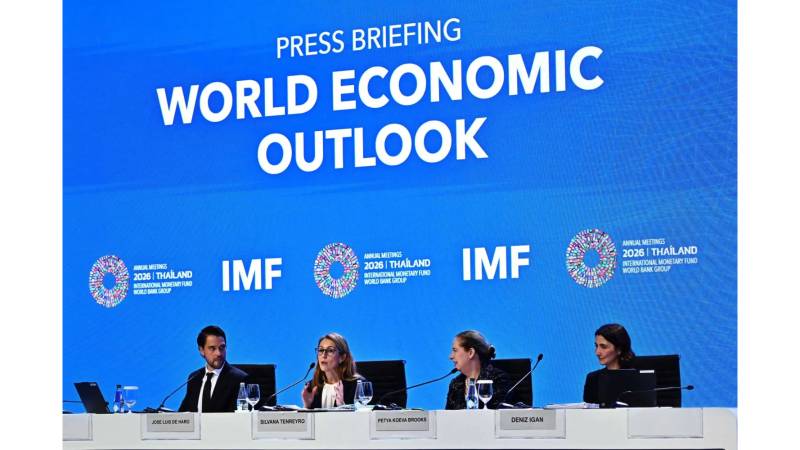
At the launch of the report in Bangkok, IMF Chief Economist Silvana Tenreyro said the global economy remained resilient but faced growing downside risks.
“The global economy has been resilient, but that resilience is under strain with risks tilted to the downside,” she said, identifying war-related increases in energy and commodity prices as a negative supply shock that raises costs and hampers economic activity.
The IMF projects global economic growth of 3.1pc in 2026, followed by 3.4pc in 2027. Global headline inflation is expected to reach 4.7pc this year before easing to 4.1pc next year. The Fund said the technology boom, largely driven by artificial intelligence, has supported trade and investment, but its benefits are unevenly distributed among countries.
Energy-importing economies face a more difficult outlook because higher fuel costs can increase import bills while putting pressure on domestic prices and economic activity. Countries with limited participation in the technology-driven investment boom may also miss out on some of the growth supporting other economies.
Energy dependence exposes Pakistan to external shocks
Pakistan’s exposure to international energy prices is particularly important because a substantial share of its fuel imports comes from the Gulf region.
In its April 2026 assessment of Pakistan, the IMF said the country was a net importer of oil and gas, with 81pc of its fuel imports coming from Gulf Cooperation Council countries. It warned that higher international prices and regional premiums, particularly for refined petroleum products, were affecting the country.
The assessment also cautioned that a prolonged disruption to the physical availability of fuel could have a greater effect on economic activity than price increases alone.
Sustained increases in international oil and gas prices can raise the cost of imports and add to domestic inflation if higher costs are passed on to consumers. Businesses may also face higher production and transportation expenses, while households could see their purchasing power eroded by rising prices.
For Pakistan, these pressures could complicate efforts to maintain economic growth while containing inflation and managing external financing needs. However, the October World Economic Outlook does not quantify how much any further energy price increase would reduce Pakistan’s projected growth.
The Finance Ministry had also identified international oil prices as a risk to the economic outlook. In its October 1 economic outlook, the ministry said the effect of oil prices on purchasing power, input costs and the import bill remained a key concern. It projected headline inflation at 10pc to 11pc in September FY2027, with the subsequent trajectory depending largely on international oil prices.
IMF urges targeted relief and fiscal discipline
The IMF has called for governments to maintain sustainable public finances while protecting households most vulnerable to higher living costs.
At the Bangkok briefing, Tenreyro warned that prolonged disruptions to energy production and transportation could push commodity prices higher. Higher borrowing costs and debt-servicing payments could also leave governments with less room to fund essential public services or respond to future shocks.
The Fund recommended that support for households facing cost-of-living pressures should be temporary and targeted rather than based on broad measures to suppress prices. It also urged countries with high debt and budget deficits to put public finances on a sustainable path.
These recommendations are particularly relevant to Pakistan, where the government must balance the need to protect consumers against the cost of broad-based relief and the pressure to maintain fiscal discipline.
The IMF’s earlier assessment of Pakistan similarly stressed the importance of aligning domestic fuel, electricity and gas prices with costs while providing targeted assistance to vulnerable consumers. It also emphasised stronger social protection and reforms to improve the energy sector’s financial viability.
The Fund identified other risks to the global outlook, including renewed trade tensions, a possible correction in expectations surrounding artificial intelligence investments and extreme weather events that could disrupt commodity supplies.
For Pakistan, the latest projections underline the difficulty of sustaining a recovery amid persistent price pressures and external vulnerabilities. The 3.5pc growth forecast offers a measure of expected economic expansion, but the projected rise in inflation and the return to a current account deficit leave the outlook exposed to further shocks.
Whether the economy can maintain that growth while containing inflation will depend partly on domestic policy choices and on how international energy prices and regional supply conditions evolve.