

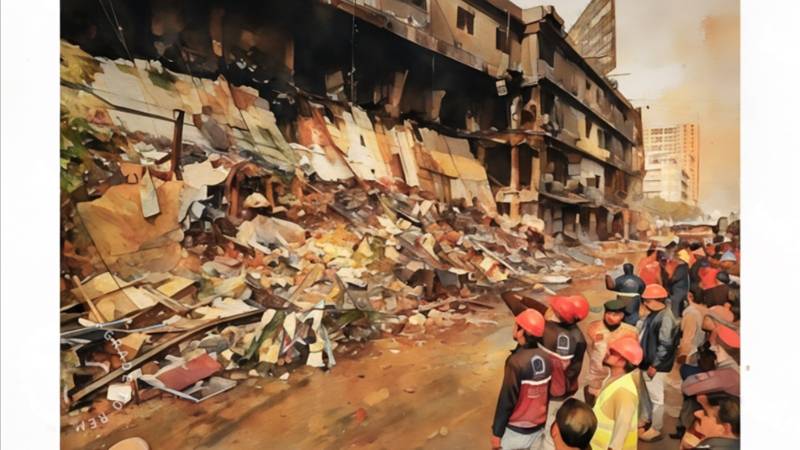
Exactly a week after the Gul Plaza fire, politicians of the two major political parties of Sindh are, not to anyone’s surprise, at each other’s throat. A war of words that flared up between PPP and the MQM, as soon as the news of the Gul Plaza fire spread like wildfire, has been stretched to include the poor state of civic affairs in Karachi, as the two federal coalition partners chide each other for the rundown condition of the megacity.
In a presser this Thursday, the MQM alleged that PPP was responsible for “chronic mis-governance” in Karachi, as it blamed the latter for the Gul Plaza fire and similar previous ones. The PPP retorted in the same coin and referred to MQM’s reputation for “political violence”, in a classic case of the pot calling the kettle black.
And in this blame-game and deflection of responsibility, if there’s anyone, it is the leaders on both sides of the divide who ‘politicise’ success and failures by chest-thumping and blame-shifting, while refusing to own up responsibility or feel empathy for the plight of the masses.
This apathy of our rulers, in response to what might be called, annual fires in Karachi, burns deeper than the flames of the fires they denounce and debate. Apart from reactive responses in the form of cliched condolence messages, compensatory cheques and immediate inquiry committees in the aftermath of, what are mostly foreseeable tragedies, the government representatives brazenly and repeatedly complain that disasters are ‘politicised’, whenever their governance capabilities are questioned in the face of man-made disasters. So much for their double standards.
Is it even fair to make a scapegoat out of the fire crew, when absence of fire extinguishers in the building made things so much worse to begin with?
A remark by PPP Senator Sherry Rehman in the aftermath of this unfortunate incident, which killed at least 71 people with many still missing, stated the same when she said there was no need to ‘politicise the fire’. Making the comments in the Senate after MQM Senator Khalida Ateeb lambasted the Sindh government for its negligence, Rehman stated that the Gul Plaza fire was a “lesson for all of us” but “there is no need for pointing fingers or engaging in politics”.
The Gul Plaza tragedy is ‘a lesson for all of us’, but such sweeping statements by our rulers ‘absolve absolutely’ those bearing responsibility, as such blanket assertions mass-indict all governments, all political parties and all institutions for the rot enabling such disasters, so that no one gets to bag direct blame in the end.
It is natural that the responsibility is expected to lie, first and foremost, with the home administration/government of the city where an avoidable mishap takes place, before we talk about the situation in the rest of the country as not being any better. And while such fires are tragedies that the whole of Pakistan mourns, generalisation discourages accountability of those directly involved and encourages the already prevalent culture of impunity.
As rescue operations progressed earlier this week, it was already evident that the Gul Plaza tragedy was rooted in lacunae and lapses at multiple levels of governance and institutional incompetence. Negligence of safety compliance and poor governance were two key factors that defined the tragedy and became apparent even before the flames were doused.
Identifying factors behind preventable tragedies, such as the Gul Plaza inferno, is not politicization of an unfortunate event, but the expected reaction to an accident that should not have happened in the first place. When things go wrong, citizens/opposition members have a right to ask questions, while expecting competence and integrity from public institutions that are mostly marred by corruption in our case.
And where our governments never tire of taking credit and playing politics on their achievements, however small, to gain traction and mobilise support, why is it wrong when their failures and neglect resulting in fires and fury, are identified and debated? Why does that become ‘objectionable politicisation’? All political parties politicise gains to win laurels and political leverage, but if a tragedy strikes due to bad governance and negligence, they shift blame and start calling out the criticism that targets them, as politicisation.
The ill-fated Gul Plaza, located on MA Jinnah road, was first engulfed by a deadly fire that gutted over a dozen shops, in August 2016 ; the second catastrophic fire, almost a decade later on January 17, 2026, sealed its precarious fate.
Building fires are not rare in Karachi. During the last one decade, starting from the first time Gul Plaza battled fires in 2016 to it being razed to ashes this month, Karachi has witnessed at least 12 fires. In the year 2021 Chawla Market caught fire, Chase-up Departmental store in June 2022 followed by a fire at the Cooperative Market the same year. In November 2023 RJ Shopping Mall, in 2024 Rimpa Plaza followed by Express and Noman Plaza, while in February 2025 Clifton Shopping Centre was ravaged by a deadly inferno. In June last year, it was the Millennium Mall that was burned and battered.
Who and what is to be blamed for Karachi’s record with fires, if not its civic administration and governments? PPP, despite ruling Sindh for nearly two decades, has fixed Karachi’s issues in a cosmetic way, at best and negligently, at worst. The MQM only erected a legacy of strikes, city extortion and land-grabs. There’s a comprehensive failure in ensuring compliance with safety and building standards in the city, enabled only by bad governance and rampant corruption.
Gul Plaza was an old, cramped commercial building with a much higher number of shops housed in its basement and other floors, than it was meant to hold. While the delayed response of the fire department is being widely condemned, firefighters are only one visible, easy to blame, part of the larger firefighting mechanism. Allegedly, the fire crew arrived late, ran out of water, lacked equipment, and failed to control a fire that broke out around 10.15pm on Saturday but continued to smoulder until Tuesday morning. Is it even fair to make a scapegoat out of the fire crew, when absence of fire extinguishers in the building made things so much worse to begin with, adding to the fire fighters job manyfold.
The systemic failure of buildings without fire exits, smoke alarms, or sprinkler systems, and lack of awareness regarding fire safety, with no fire drills ever conducted, people wouldn’t know what to do if a fire breaks out, and they didn’t in this case too. The question is not as much what caused the fire but why a debilitated, worn-out structure with no safety backup was functional for decades, without anyone raising an alarm. It's institutional decay and bad governance at its worst.
The building had few emergency exits, lacked fire-venting infrastructure with no fire safety alarms. How an aged building in the heart of Karachi was allowed to function without these features is the most important question that is being asked. Statutory authorities charged with compliance and public safety like the Sindh Building Control Authority exist to monitor and enforce abidance.
In the absence of checks and implementation, how many such buildings without requisite disaster safety infrastructures stand in Karachi and other cities, like death-traps that may ensnare anytime, is anybody’s guess. When building safety codes are ignored with impunity, when regulation is foiled by political interference, and when accountability is a rarity easy to circumvent, the results are calamitous. While regulations exist only on paper, enforcement is negotiable, deliberately neutralised.
With citizens angered and disappointed, the towering human and economic toll, the unanswered questions about fire safety regulations, smouldering ashes at the Gul Plaza will eventually cool down; however, public anger and mistrust at the apathy and insensitivity of those responsible will continue to flare.