

The privatisation of Pakistan International Airlines (PIA) is presented as a unfortunate but imperative necessity, a remedial measure that is needed after several decades of inefficient, financially unmanaged, and incompetent running. More is hidden than is revealed behind such a presentation.
The sale of Pakistan International Airlines is not a technocratic response to a managerial issue, but is instead a result of a larger political, economic imperative, one that over the last thirty years has transformed the Pakistani state.
The prevailing argument, put forward by financial bodies, finance ministries, senior administrators, and the economics establishment, has been that PIA has represented a huge burden on the exchequer.
It has been characterised as overstuffed, mismanaged, and unreformable as a public sector entity. But the question asked least has been as to how such a state came to pass.
The airline was rendered toothless by political intervention, the awarding of positions based on patronage, procurement fraud, and chronic indifference, long before it came to be declared inevitable to privatise because it could no longer be efficiently run by the state.
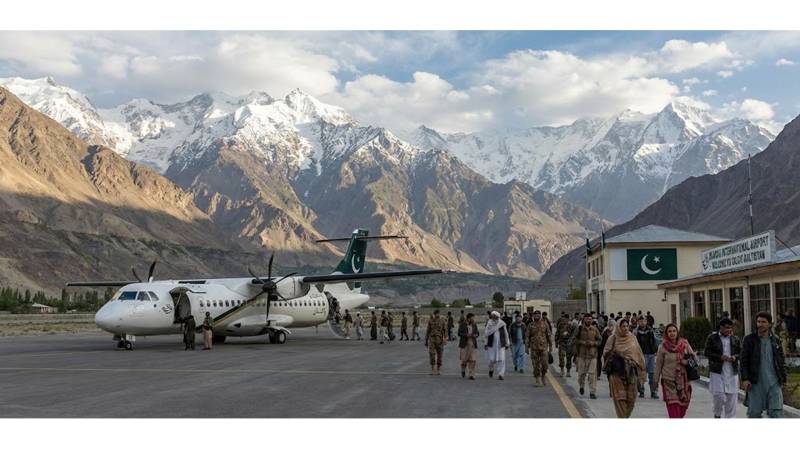
However, the plausibility for privatisation is premised on a very narrow and ahistorical approach to public services. The state-owned airline is much more than a profit-seeking business that needs to maximise profits. The state-owned airline is a tool for national integration. Remember that PIA was offering subsidised services to remote areas like Gilgit, Skardu, Chitral, Gwadar, and Mohenjo-Daro. These areas have never attracted any airliners because they are commercially unviable. However, with privatisation, this approach is totally rejected. Privatised airlines are not interested in flying to remote areas but rather to satisfy their stockholders.
A central contradiction of Pakistani neoliberalism is revealed here: the state actively intervenes to socialize past losses among taxpayers while ensuring future benefits are privatised for a handful of people
The weakness of resistance to the privatisation of PIA is quite telling in and of itself. The trade unions and working class were strong enough to wage an effective resistance campaign that resulted in a withdrawal from the agenda of privatisation a decade ago. That's no longer the case today. While the lack of noise in the sale of the airline may be taken to imply that the population is in agreement with the idea of the sale of the airline, it should be recognised that the popular resistance is simply a victim of the dismantling of the working class power that has resulted from the application of neoliberal policies.
Equally disturbing, however, are the conditions under which PIA has been sold. The assets and routes of the airline, not to speak of its inherent strategic value, have been sold well below cost. Moreover, the composition of the acquiring group has raised suspicions about the competition that has just occurred. However, it would appear that the “free market” that has been created has very little to do with what would actually be observed in practice. Experience in Pakistan suggests that privatisation has been simply another way of handing the country to an elite.
This highlights the underlying contradiction in the Pakistani experience with neoliberalism. The privatisation of enterprises has often been justified on the grounds of minimising the role of the state in the economy. Indeed, the opposite happens. Rather, the state makes its presence felt by restructuring property and handing it over to those who matter. Any losses incurred during nationalisation are made social, whereas the future benefit of the national asset will be privatised. The cost of the undertaking will be borne by workers, the periphery, and the taxpayers, whereas the benefit will go to the same handful of people.
An opposition to the privatisation of PIA, therefore, would not argue against inefficiency or against the need for reform. An opposition to the privatisation of PIA will argue against a philosophy that seeks to undermine public entities before disposing of them according to the tenets of policy correctness. An opposition to the privatisation of PIA will also challenge the philosophy that seeks to confine the value of public institutions within the boundaries of profitability. This philosophy would suit a country that lacks much in the area of public provisioning.
The sale represents another step in the withdrawal of the Pakistani state itself from even a minimal welfare role. Whether it leads to efficiency, stability, or financial salvation is a question that opens itself up to uncertainty. One thing is clear, though: the privatising process has come to be viewed less as a matter subject to policymaker choice than as a matter not subject to question whatsoever. Perhaps that is the most telling aspect of the situation.