

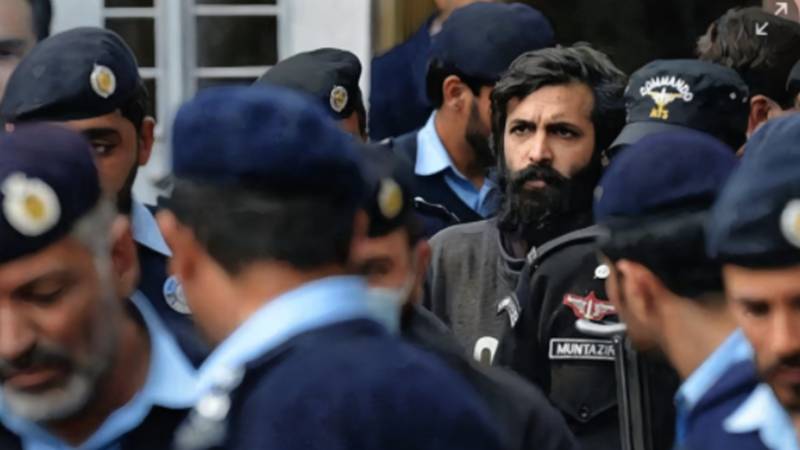
In one of the most harrowing incidents of misogyny, femicide and violence against women ever to occur in the country’s history, 27-year-old Noor Mukadam was tortured, beaten, abused, raped, killed and beheaded in July 2021.
High on patriarchy, power, privilege and prejudice and intoxicated by the inebriety of chauvinistic masculinity, a monstrous Zahir Jaffer mercilessly charged on his helpless victim, extinguishing the Noor, who had haplessly made at least six attempts to escape from Zahir’s savage detention at his home in Islamabad.
It has been four long, highly frustrating and gruelling years, not only for Noor’s family, but also for the women of Pakistan who have been earnestly following the progress on the horrifying murder case, as it ascended through the hierarchy of the country’s courts of law, hoping that justice would be salvaged and served; justice not only for the ill-fated Noor, but a symbolic win for all women, equipping and empowering them in their own struggles for justice against acts of violence and, perhaps, a turning point in women’s fight for accountability in crimes callously committed against them.
Noor Mukadam was found murdered at Zahir’s house in Islamabad on 20th July 2021. Subsequently, Zahir was handed the death sentence by a trial court, which he had challenged in the Islamabad High Court in the year 2023. The IHC too had upheld the sentence, after which he approached the apex court. The appeal at the Supreme Court was taken up for hearing by a three-member bench this week that maintained the verdict, dismissing Zahir’s plea.
Upholding Jaffer’s capital punishment was the threshold that has led to finally ensuring fair play for slayed Noor, and for all women who have been repeatedly denied justice in Pakistan; justice refused by a broken criminal justice system, societal norms and penalising patriarchal preferences and potencies.
Right from the moment Noor was murdered, his killer’s family has been claiming insanity to evade retribution for Zahir’s spine-chilling crime. The Court’s unambiguous stance against this use of mental illness as a garb for premeditated murder and the weaponisation of mental illness in legal defence, and its refusal to bow to elite pressure while dealing with a powerful and well-resourced criminal, has marked a momentous moment in the country’s legal history.
It is a moment of historic significance; one that is being lauded and celebrated by human rights activists, lawyers, journalists and the civil society as a “victory for women” and a victory for justice. Calls for judicial reforms are being made with this verdict as the starting point, citing it as an opportunity to reform the criminal justice system.
This might be a moment of victory for a criminal justice system but, bear in mind that the system was never strong enough to dispense justice on its own, especially where it involved taking on the rich and the powerful
Justice should be the expected outcome of a crime; but the fact that dispensing justice, in a murder case as starkly horrifying as Noor Mukadam’s, becomes an occasion to celebrate for us goes a long way to show what an elusive entity justice has been reduced to in the country.
Notwithstanding that justice was inordinately delayed for Noor, it was finally served, bringing long-awaited relief to the whole country, although not fully, as yet. There are apprehensions galore and steps towards Zahir’s walk to the gallows might be replete with obstacles.
Hence, Zahir Jaffer must reach his long-delayed and deserved end sooner than later; Noor’s killer must be hanged to death before his affluent and fraught family put their money and connections in an overdrive to save him, stalling the process of the fateful end that he must meet.
I’m not going to offer an excuse here for demanding immediate execution of Zahir’s death penalty and that he be hanged without a day’s delay, despite the fact that most of us practice restraint in regard to death sentences and, in principle, oppose capital punishment.
It was not unexpected that at this moment, the most troubling fear in the minds of those closely following Noor’s case for years would be that if Zahir’s death sentence is delayed further, there’s a palpable possibility of it being converted into either life imprisonment through some lacunae, or that he be granted presidential pardon on the basis of purported mental instability.
Zahir’s well-resourced and connected family will try their best to delay his sentence so as to find loopholes and escape routes, providing the convict with an eventual chance at absolution. Routed through a bail, parole or a mitigation of the life imprisonment term, the conversion would make it easy for someone with US citizenship and Zahir’s money to make the most of this facilitation and eventually flee the country.
The Supreme Court already commuted Jaffer’s death sentence on the rape charge against him to life imprisonment, while the kidnapping sentence was reduced from 10 years to a year. Hopefully, implementing the final verdict will bring some semblance of a closure to Noor’s family after their very long ordeal trying to secure justice for their daughter.
This might be a moment of victory for a criminal justice system but, bear in mind that the system was never strong enough to dispense justice on its own, especially where it involved taking on the rich and the powerful. Therefore, this is also a moment of the same system’s test against challenges posed by a very rich family to save their depraved and ill-bred son; challenges that will continue to threaten till Zahir is sent to the gallows.
The courts’ verdicts in Noor’s case were shaped not only by legal arguments, but also by a well-mobilised civil society and a digitally active public. It was the muscle of the masses, the build-up of mob pressure to finish off what was an open and shut case; it was the inexorable strength of the social media and public opinion that managed to enable an unprecedented precedent of justice for all Noors.
The keyboard warriors, the online activism, the hashtags proliferating across platforms tactfully transformed public grief and rage into digital mobilization and movements that became the strength behind the struggle towards justice for Noor.
From an immune sense of impunity dominating the society there has emerged accountability enabled alleviation which is very reassuring, but it is yet not the time to allow complacence to set in, since Zahir is still alive and breathing.
Noor and her family had to pay a very heavy price to offset this “rare achievement” moment of the criminal justice system and the “victory for women”, since, unfortunately, if it wasn’t for the extremely violent and horrendous nature of the whole episode of Noor’s murder, it would probably not have received the attention and court justice that it did.
We may ask ourselves here why only the most horrifying acts of violence against women, ones that shake us out of our stupor and senses, merit our attention and justice? Why women are expected to ‘watch out’ all the time for crimes committed against them, be vigilant, on their guard and, yet, acts of routine violence against them go unnoticed.
During the course of the Supreme Court hearings there were reportedly some remarks that reflect the deeply didactic and patriarchal mindset of our society. One of the honourable judges expressed displeasure over reports that Noor and Zahir were living together. “This happens in Europe, not here,” he commented, adding that a man and woman living together out of wedlock was “unfortunate” and “against religion and morals”.
Such unsubstantiated statements by those dispensing justice will only encourage the public to resort to the already rampant victim blaming. Archaic and bigoted ideals regarding victims dominate the narratives surrounding cases of violence against women, and there’s a dire need to break away from such tropes and stereotypes.
Zahir’s watchman and gardener were present during the time when Noor was being held and subjected to violence. While scrutinizing their complicity we should remember that their inaction in preventing Noor’s murder was not just about two individuals failing to do what they should have done and, subsequently, enabling violence against a helpless woman.
The domestic helpers were well aware that a young woman was being held under coercion by their employer and being subjected to violence, but might probably be too afraid for their own lives and welfare in case they helped Noor escape or informed the police. Their role cannot be examined in isolation of the socio-cultural dynamics of our elite classes who often treat their domestic servants like slaves and intimidate them with fatal threats even over routine matters.
Zahir’s death sentence must be executed before the case that shook the Pakistani public out of its reverie, slips out of the public’s combined concern and recall. It was the gruesomeness of the deeply unsettling incident that upset and upended people’s peace of mind for long.
And if Zahir Jaffer walks free, after 3 years, 8 years or even15-20 years, all gains made so far, the judicial integrity and independence practiced in every court since July 2021, the daring digital drives, the public’s perpetual push, would all be lost forever.