

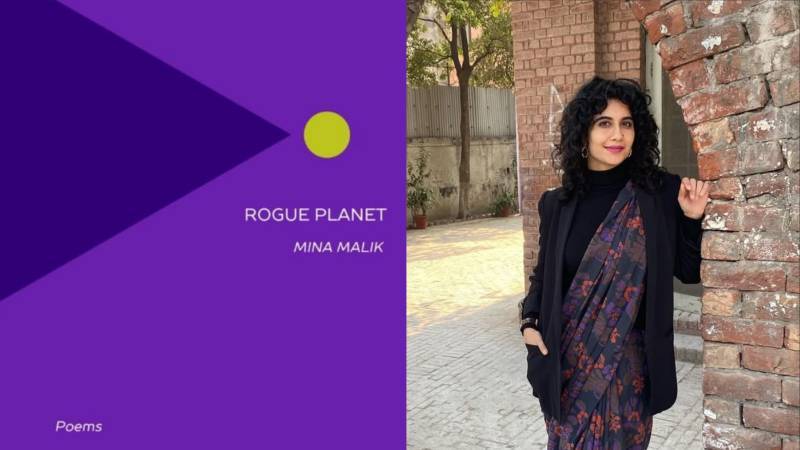
Marriage and the loneliness it can contain are everyday realities, yet this loneliness is often expressed through forms of suffering that are particularly associated with women in Pakistan: letting themselves go, seeking comfort in mindless consumption, relying on medicines for “blood” and “sugar,” or investing in emotionally destructive relationships with their children.
Mina Malik gives this loneliness a new striking literary form, writing of a gradual withering away while maintaining a carefully curated closet of shoes, shirts and cufflinks; a life preserved for others through possessions not belonging to the wife’s even as she slowly erodes.
At its heart, this is a journey in which the woman remains perpetually suspended, chained to the expectation of rescue. The universality of this condition is remarkable. Despite the struggles that have secured women a voice, rights and greater autonomy, the underlying narrative persists: a woman’s value is too often measured by whether she is chosen, saved, or claimed by another. The old patterns repeat themselves with startling resilience, revealing how deeply entrenched these expectations remain.
Malik paints infidelity with a sharp awareness of how paths that once converged in hope can become strangely unfamiliar over time. The devastation is quiet rather than dramatic, found in altered routes, missed turns and the gradual realisation that what was once shared can no longer be recognised. What remains is the lingering uncertainty: What now? Where do I go from here?
Anyone who has experienced the breakdown of a marriage or the loss of love will recognise the pain embedded in that question. It is a question born not only of grief but of disorientation, of suddenly finding oneself without the map that once gave shape to everyday life.
Yet there is a particular loneliness that emerges in societies preoccupied with appearances, where maintaining face often takes precedence over acknowledging pain. In such spaces, loss is not merely endured but, in fact, it is managed, concealed and performed around. The dissolution of a marriage becomes not only a private sorrow but a public burden, measured against expectations of respectability, success and social acceptance.
It is this isolation that Malik captures so acutely. Her work understands that heartbreak is rarely confined to the relationship itself. It extends outwards into family networks, social circles and communities that often demand silence where honesty is needed most. The result is a loneliness compounded by the inability to articulate it fully, a grief that must be carried discreetly, lest speaking it aloud transform personal vulnerability into social failure.
What lingers after reading her is not simply the sadness of broken relationships or the ache of vanished love. It is the recognition that survival itself is a form of resistance
Her sharpest lines emerge from what remains unspoken, such as the quiet observations of a physical unravelling too dangerous to name, for fear that what is spoken aloud might become destiny. She captures a life lived in anticipation of loss, of a love that slowly evaporates, a marriage that disintegrates so quietly its collapse is almost imperceptible. There are no dramatic endings, only the gradual erosion of certainty until what once felt permanent survives merely as memory. The deepest wounds are not those inflicted in a single moment, but those that accumulate in silence, leaving behind the haunting question of when exactly a shared life became a recollection.
Running alongside this emotional landscape is Malik’s attention to the ordinary. The ordinary may appear mundane, but one is taught that, with patience, there is magic to be found in folding socks. There is satisfaction in clean clothes neatly arranged in cupboards, in the rituals of care that sustain a household and give shape to a life. Yet the pain does not reside in the labour itself. Rather, it lies in the futility of effort that goes unseen and unacknowledged, and what hurts most is not the work but its invisibility.
For when the investment of time, care and selfhood results only in sending the fruits of one’s labour to be consumed by another, the experience becomes a form of violation. The self is steadily depleted in the service of wanted ones who are enjoyed by intruders until existence itself begins to feel dispersed, absorbed into the needs and desires of those around you.
What remains is a hollowed-out shell, echoing like a conch filled with the secrets of the sea. And from within that hollow space, one waits once more to be rescued. Only this time comes the devastating realisation that no one is coming.
The planetary imagery that runs through her work offers a compelling way of understanding this condition. From a distance, planets appear locked in repetitive, almost mindless motion, tracing the same paths over and over again. Human lives can feel much the same, caught in recurring cycles of hope, disappointment, attachment and loss.
Women, in particular, are often expected to orbit around the needs and desires of others, their trajectories shaped by obligations they did not choose but inherited. The promise of rescue by love, marriage, motherhood or social approval becomes its own gravitational force, holding them within familiar patterns even as those patterns repeatedly fail them.
Yet what ultimately distinguishes one planet from another is not the orbit itself but the matter from which it is composed. Beneath the predictable movement lies a unique set of properties, pressures and possibilities that determine its fate. Some celestial bodies collapse under their own weight, while others ignite, which probably comes down to the much dreaded concept of sabr and shukr. Some remain cold and distant, while others burn with such intensity that they alter the space around them.
Women may find themselves trapped within familiar orbits, but they are never reducible to them. Their significance lies in their interior worlds, in their resilience, their capacity for reflection and their refusal to disappear even when circumstances conspire to diminish them.
From this uncertainty emerges the image of a planet in motion. Unlike a rolling stone, it may not gather moss, but it is nonetheless shaped by every encounter, every gravitational pull. It moves through a universe of other planets, each caught in its own orbit, circling endlessly in pursuit of survival, connection and meaning.
The journey becomes less about rescue and more about endurance (sabr, shukr), about how lives are altered through contact, attraction, abandonment and return. Every encounter leaves its mark. Every orbit changes the body that travels it.
I like to think of Malik herself as one of those luminous bodies. Her writing does not merely document loneliness, betrayal or loss but actually transforms them into something illuminating. She writes with a clarity that exposes the structures that confine women while refusing to surrender to them. Like a star burning fiercely against the darkness, her work compels attention not through spectacle but through its unwavering light, illuminating experiences that are so often endured in silence.
What lingers after reading her is not simply the sadness of broken relationships or the ache of vanished love. It is the recognition that survival itself is a form of resistance. The women who inhabit her work are not merely waiting to be rescued. They are celestial bodies navigating recurring cycles of longing and loss, carrying the traces of every orbit long after the moment of encounter has passed. If their paths seem repetitive, their inner lives are anything but. It is their substance, their resilience and their capacity to endure that ultimately define them.
And so, while society may remain preoccupied with appearances and prescribed destinies, Mina’s work reminds us that true value lies elsewhere: not in being chosen, saved or validated by another, but in the ability to generate one’s own light. Like a star whose brilliance cannot be ignored, she illuminates the quiet devastations of ordinary lives and, in doing so, ensures that neither the women she writes about nor their experiences remain unseen.