

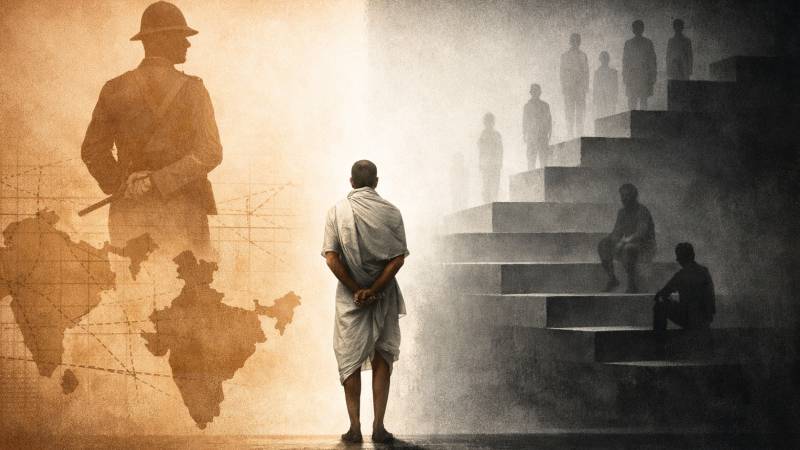
At the height of the British Empire, imperial rule was sustained not merely by armies and administrators but by a carefully constructed moral logic. Empire justified itself as a civilisational mission grounded in hierarchy, sacrifice, and duty. Domination was rendered ethical by being framed as responsibility. Two figures articulated this worldview with unusual clarity: Alfred Milner, the empire’s hard strategist, and Rudyard Kipling, its moral poet. Mohandas Gandhi, during his South African years, stood neither outside this framework nor fully against it. He understood it—and for a significant period, sought to work within it.
Milner, appointed High Commissioner in South Africa after the Second Boer War, confronted a familiar imperial dilemma: how to reconcile defeated white settlers to British rule while maintaining stability. His solution was unapologetically racial. Political order, Milner believed, depended on guaranteeing white supremacy over the Black African majority.
His private correspondence reveals a conviction that governance became manageable only once Africans were excluded from political rights and meaningful land ownership. This was not an aberration but a governing principle. The institutional logic Milner advanced—white unity secured through Black exclusion—laid the foundations of the segregationist order that later hardened into apartheid.
Where Milner provided the mechanics of imperial power, Kipling supplied its moral vocabulary. The White Man’s Burden (1899) framed domination as reluctant altruism, depicting colonised peoples as childlike, stagnant, and incapable of self-rule. The poem did not invent imperial racism; it sanctified it. Exploitation could thus be understood as a duty, and inequality as a moral necessity. Within this worldview, the colonised were not imagined as citizens-in-waiting, but as permanent dependants, objects of governance rather than participants in it.
Gandhi arrived in South Africa fully aware of this imperial moral universe. The popular myth that he was a naïve humanitarian who slowly “discovered” racism does not survive scrutiny of his early writings or political strategies. Gandhi did not initially challenge the racial hierarchy that underpinned the empire. What he contested was the position assigned to Indians within it. His grievance was not against racial classification itself, but against the British decision to place Indians alongside the African majority at the bottom of the colonial order.
In making his case, Gandhi frequently drew upon the language of Victorian racial thought. He invoked ideas of Indo-Aryan kinship, cultural refinement, and civilisational proximity to Europe. Indians, he argued, were not “raw” or uncivilised; they possessed history, discipline, and moral capacity. They therefore deserved a status distinct from that assigned to Africans. This was not a rejection of the empire’s logic but an attempt to renegotiate India’s position within it.
Empire revealed itself as a closed moral economy, incapable of admitting non-whites as equals, regardless of merit or sacrifice
Gandhi’s actions were consistent with this strategy. By organising the Indian Ambulance Corps during the Boer War and later during the Zulu Rebellion, he demonstrated loyalty to the Crown and a willingness to shoulder what imperial ideology defined as the responsibilities of civilisation. These were not merely humanitarian gestures. They were political acts, intended to secure recognition for Indians as deserving imperial subjects—rights to be earned through service, not claimed through resistance.
Even Gandhi’s seemingly modest demands followed this logic. His appeals for separate post office entrances or distinct railway accommodations were not pleas for racial equality or social integration. They were demands for differentiation. Indians, he insisted, should not be treated “like natives”. The phrase is jarring today, but it accurately captures the moral terrain on which Gandhi operated. He implicitly accepted racial stratification as a given while seeking to reposition his community within it.
Defenders of Gandhi often argue that these positions must be read strictly within their historical context, and that his views evolved. Both claims are true—but incomplete. Context explains Gandhi’s strategy; it does not dissolve its moral content. And while Gandhi did evolve, evolution does not erase inheritance. What changed over time was not his early acceptance of hierarchy as such, but his faith in the empire as a vehicle for reform.
The decisive turning point came not with a sudden moral awakening, but with political disillusionment. Despite years of loyalty, service, and accommodation, Gandhi remained, in imperial eyes, a “coolie”. The promise of imperial citizenship proved illusory. Empire revealed itself as a closed moral economy, incapable of admitting non-whites as equals regardless of merit or sacrifice. It was this recognition—less the discovery of injustice than the exposure of imperial bad faith—that transformed Gandhi from petitioner to opponent.
Yet the hierarchical reasoning Gandhi absorbed in South Africa did not simply vanish when the external enemy changed. It reappeared, in altered form, during his conflict with B. R. Ambedkar. The terrain had shifted from race to caste, but the moral method bore a family resemblance. Just as Gandhi once sought an elevated position for Indians within the empire, he later sought to preserve a reformed Hindu social order rather than dismantle caste altogether. His opposition to separate electorates for Dalits reflected not indifference to suffering, but a belief that hierarchy could be morally managed without being destroyed.
Ambedkar rejected this premise entirely. For him, caste was not a distortion of Hindu society but its organising principle. It was not a moral flaw to be corrected through reform, but a structure to be annihilated. Where Gandhi feared fragmentation, Ambedkar feared permanence. Their disagreement was not merely tactical; it was philosophical. Gandhi sought to humanise inherited systems of domination. Ambedkar sought to exit them.
This contrast is sometimes softened by noting Gandhi’s later campaigns against untouchability. But opposition to cruelty is not the same as opposition to hierarchy. Gandhi’s moral universe remained one in which social order, however softened, was to be preserved. Ambedkar’s final break—symbolised by his conversion to Buddhism in 1956—represented a rejection not only of caste, but of the entire moral framework that had justified inequality, from Kipling’s poetry to imperial policy.
The tragedy of this history lies precisely here. Gandhi fought the external empire with extraordinary courage and moral force, but struggled to abandon the internal hierarchies that the empire had normalised and moralised. To acknowledge this tension is not to diminish his role in the anti-colonial struggle. It is to recognise that liberation from empire did not automatically entail liberation from hierarchy. That task fell more decisively to those who refused to negotiate with inherited systems of domination—and chose instead to walk out of them altogether.