

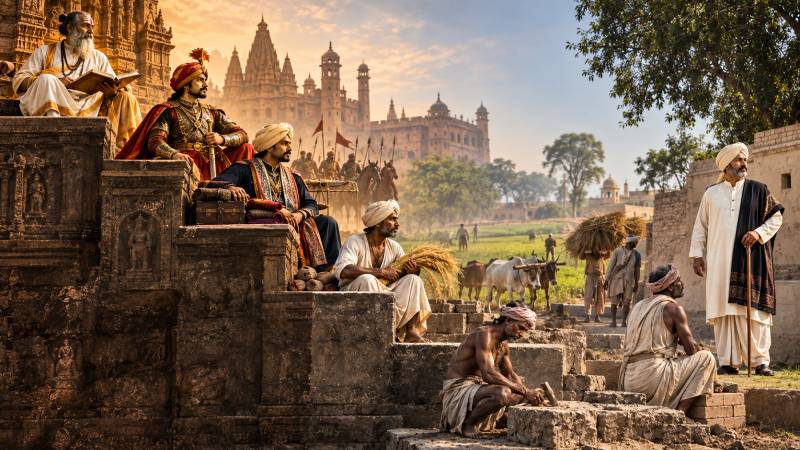
“The Shudras are the life and sinews of the country”, Jyotirao Phule wrote in Gulamgiri in 1873. More than a century later, researchers in a Punjabi village heard a landowning respondent dismiss the poverty of a labourer with an equally revealing sentence: “He belongs to Chaudhry Big Landlord”. One line recognises the worker as the strength of a country; the other turns him into somebody’s possession. Between them lies the unfinished history of South Asia. Shudra, Ati-Shudra, Dalit and kammi are not interchangeable words. Shudra named the fourth order in the classical varna scheme; communities stigmatised as “untouchable” were often placed outside it as Ati-Shudras or avarnas. Dalit became a modern name of self-assertion.
Kammi in much of rural Punjab denotes hereditary service groups in relation to landowning zamindar communities. These genealogies differ, but their social mechanics overlap: birth predicts work; work is marked as low; land, education and authority stay elsewhere; marriage guards the boundary; dependence is renamed custom. We must reject two comfortable evasions. One is that caste belongs only to Hindu scripture and crossed the border no further than the Radcliffe Line. The other is that every inequality is merely class and will disappear with higher income.
Religion, land, occupation, gender and political power interact differently in each region. A secular investigation asks: who is made to serve, who is permitted to command, and how is that arrangement reproduced?
Jyotirao Govindrao Phule learnt caste not as abstraction but as insult. In 1848, while joining a Brahmin friend’s wedding procession in Pune, he was rebuked for walking as an equal. He returned home wounded, then converted humiliation into a programme. That year he and Savitribai Phule began a school for girls. She had first been taught at home by Jyotirao; she then walked out to teach those whom respectable society preferred to keep ignorant. Orthodox opponents hurled stones and brickbats. The couple did not retreat.
Savitribai should never appear as a footnote to her husband. She became an educator, organiser and writer in her own right. Together the Phules opened schools for girls and oppressed communities, supported widows and challenged the monopoly over knowledge. Brahmin colleagues aided them at points; the struggle was not a biological quarrel between every Brahmin and every “untouchable”. Their target was Brahmanical power: an order that made inherited rank appear natural, sacred and administratively useful.
In Gulamgiri—Slavery—Phule dedicated his indictment to American abolitionists. The comparison was polemical and some of his ancient history does not survive modern scholarship. Its governing insight remains: domination is safest when the dominated mistake it for order. He called that condition “mental slavery”. Those who produced revenue through “the sweat of [the ryot’s] brow”, he argued, were denied the education it financed. His demand was not charity, but schools in every village and public power answerable to labour. He had no romantic answer to the British Raj. Colonial rule opened limited spaces in education, print and administration that anti-caste reformers could use. Phule used them, while accusing government of spending poor people’s taxes on upper-class education and offices.
Later scholarship shows how the colonial census and archive gathered fluid local identities under the single hard category of caste. The Raj neither invented hierarchy nor liberated its victims. It catalogued and governed through difference. This is the setting in which Mohandas Karamchand Gandhi’s campaign against untouchability must be judged. A simple prosecution or acquittal will not do. Gandhi made the degradation of the “untouchable” a national question and lived in ways that violated caste practice. His ashrams admitted families then shunned as untouchable; financial supporters withdrew; he cleaned latrines; he promoted education and called untouchability a moral stain. His position on caste also changed significantly over time.
The record contains another Gandhi. In the early 1920s he defended caste’s organising capacity and hereditary occupation, while distinguishing an idealised varna from its abuses. In later years, he rejected restrictions on inter-dining and intermarriage and eventually declared that caste must go. This was moral evolution, not a detail to be erased. It was also political strategy. Gandhi feared that an outright early assault on the social foundations of caste-Hindu support would fracture the nationalist coalition and give the Raj an argument for postponing self-rule.
Bhimrao Ramji Ambedkar saw the cost of this strategy from below. He did not ask upper castes to purify their conscience and then speak for his people. He demanded education, legal safeguards and an independent political voice for the Depressed Classes. Ambedkar’s enduring challenge was precise: “There will be outcastes as long as there are castes.” Abolishing the insult while preserving the graded structure that produced it could only replace mastery with guardianship. The collision became unavoidable in 1932. The British Communal Award offered the Depressed Classes separate electorates. Gandhi, imprisoned at Yerwada, began a fast unto death, arguing that separate representation would divide Hindu society.
Ambedkar believed that joint electorates would allow a caste-Hindu majority to select compliant Dalit representatives. Under immense public pressure, the Poona Pact substituted reserved seats within joint electorates for separate electorates, while increasing the number of provincial seats. Gandhi’s life was saved. The principle of autonomous Dalit political choice was curtailed. Was Gandhi using the caste wound to strengthen the struggle against the Raj? Partly, if “using” means recognising that no movement for freedom could ignore millions excluded from common wells, schools, streets and institutions. It would be unfair to reduce his work to cynical mobilisation. It is equally unfair to hide the nationalist interest beneath moral vocabulary. He sought to bring the oppressed fully inside a reformed Hindu community and a united anti-colonial nation. Ambedkar asked the prior question: inside on whose terms, and represented by whom?
The difference was not between compassion and cruelty. It was between reform led by the dominant and emancipation directed by the oppressed. Gandhi’s vow made untouchability politically impossible to ignore; Ambedkar’s resistance revealed why concern without independent power can become another form of control. India’s later constitutional order absorbed more of Ambedkar’s language: equality before law, non-discrimination, affirmative action and Article 17’s abolition of untouchability. These were historic gains, earned by movements rather than bestowed by a benevolent majority.
A Constitution cannot eat at a separate table, refuse a tenant, punish a marriage, allocate a sewer or decide whose hand may touch a village water source. Law can outlaw the practice while society reproduces it through endogamy, land, networks and occupation. Special laws against atrocities and manual scavenging, and repeated judicial intervention over sewer deaths, show that independence ended foreign rule but not inherited rank. The rise of Hindutva adds a further contradiction. Its organisations can invite Dalits into a broad Hindu political identity, celebrate selected anti-caste icons and mobilise marginalised communities on a scale older elites could not. Badri Narayan’s field research describes this as active assimilation of Dalit and tribal identities into a larger Hindutva narrative.
The secular and humanistic starting point is equal citizenship: no birth fixes a person’s occupation, dignity, residence, spouse or political voice.
Inclusion in a voting bloc, however, is not the same as redistribution of social power. The old contradiction returns: Hindu when numbers matter, untouchable when equality matters—at the marriage hall, in the village council or at work. Leaders of the Rashtriya Swayamsevak Sangh now publicly say that temples, water sources and cremation grounds should be open to all and that caste discrimination must end. That statement should be acknowledged. It should also be tested. Does social harmony—samrasta—mean that the person assigned lower status is warmly embraced without the hierarchy being dismantled?
Are Dalits free to lead, define history, control institutions and challenge unequal property? An insider memoir such as Bhanwar Meghwanshi’s ‘I Could Not Be Hindu’ records the distance that can exist between fraternal slogans and daily caste conduct. The relevant test is equality, not incorporation. Pakistan cannot watch this argument from a safe ideological balcony. Many Muslims reject caste as contrary to their declared equality, and that rejection has often become a reason not to study the hierarchy operating among them. In Punjab, terms such as quom, zaat and biradari arrange marriage, reputation, patronage and electoral support. Landowning groups are frequently distinguished from hereditary service groups called kammis. The absence of the four-varna scheme does not prevent inherited status from organising material life.
Research from a Punjabi village found kammis largely landless, with poor access to education and income opportunities. Around seven in ten kammi families in that study were tied to highly unequal service relations with higher-caste households. The telling defence— “He belongs to Chaudhry Big Landlord”—turned dependence into welfare: how could the worker be poor when the patron was supposedly responsible for him? The same relationship allowed the patron to decide what care was due and the worker to remain without enforceable rights. Another village study found that landowning zamindar communities and kammi groups did not intermarry; education, a profession or higher income did not necessarily wash away inherited stigma. This matters because marriage is caste’s quiet constitution.
Dining together for a photograph is easy. Allowing a daughter or son to marry across the boundary tests whether equality has entered the home. The seyp system of customary services, debt, gifts and patronage may weaken or change, yet the expectation of deference can survive its old economic form. It would still be careless to call every landless labourer a kammi or every landowner an upper caste. Class and caste are neither identical nor separate compartments. Property can reinforce inherited status; inherited networks can decide who acquires property, housing, credit or office.
Haris Gazdar and Hussain Bux Mallah have shown how colonial land records and postcolonial policy in Pakistani Punjab sustained the divide between agricultural landholders and non-agricultural service groups, even in access to a residential plot. A poor member of a dominant biradari and a successful kammi may both disturb the pattern, but the pattern remains. In Sindh, the vocabulary and social map differ. Landless haris, including many scheduled-caste Hindus, face landowner power and bonded labour. In cities, sanitation work has been associated disproportionately with Christians and Hindus from historically stigmatised caste backgrounds. Recruitment advertisements have sometimes specified non-Muslims for sewer and cleaning jobs. Amnesty International’s investigation records how caste, religious identity, dangerous work and institutional neglect compound one another.
A society that calls a worker impure while sending him into poisonous waste has not escaped untouchability; it has modernised the job description. Pakistan abolished bonded labour by statute in 1992 and promises equality before law. The distance between promise and village or municipal practice is the familiar South Asian distance between citizenship on paper and status in life. Police, revenue officials, local politicians and employers often inhabit the same patronage network. A worker asked to complain against his landlord, brick-kiln owner or contractor may be asked, in effect, to appeal to the very hierarchy that governs his residence, debt and vote.
The internal rift cannot be healed by another sermon on tolerance. Tolerance leaves one person in the superior position of tolerating another. Nor is the answer a competitive accusation—Hindu caste against Muslim hypocrisy, India against Pakistan. That contest merely gives each ruling group an alibi. The secular and humanistic starting point is equal citizenship: no birth fixes a person’s occupation, dignity, residence, spouse or political voice.
First, name and measure the injury. India records scheduled castes but still needs honest enforcement data at the level where discrimination occurs. Pakistan’s refusal to speak plainly about caste, descent and hereditary occupation keeps victims statistically invisible. Voluntary self-identification, privacy safeguards and independent surveys should map disparities in land, school completion, public employment, housing, wages and hazardous work. Data should not freeze identities; it should expose the doors that remain closed.
Second, legislate against discrimination by caste, descent and inherited occupation in education, employment, housing, healthcare, credit and public places. Pakistan needs a comprehensive equality law with accessible local remedies and an independent commission. India needs faster investigation, witness protection and accountability for officials who dilute existing protections. In both countries, the burden should not fall on the poorest person to finance a heroic lawsuit.
Third, attack the material base of deference. Secure tenancy, distribution of residential land, transparent land records, collective bargaining, enforceable minimum wages and freedom from debt bondage matter more than ceremonial meals. Sanitation must be mechanised; no person should enter a sewer without the stringent safeguards required for genuinely exceptional emergency work. Workers must have contracts, protective equipment, insurance, health surveillance and the right to refuse lethal conditions. Public procurement should exclude contractors who reproduce hereditary labour chains.
Fourth, rebuild public education as the common room of citizenship. Phule’s nineteenth-century charge remains current wherever the taxes and labour of the poor finance institutions their children cannot enter. Every settlement needs a properly funded school, trained teachers, transport where required, safe toilets and serious scholarships. Curricula should teach Savitribai Phule and Jyotirao Phule, Ambedkar and the history of labour, alongside Pakistan’s own concealed hierarchies. Children should learn to examine power, not inherit contempt.
Fifth, replace patronage with voice. Representation should not mean a landlord or dominant party selecting the acceptable face of an oppressed community. Local councils, trade unions, peasant organisations and sanitation-worker associations need legal space, public funding rules and protection from retaliation. Women from landless and stigmatised groups require direct representation because caste-like status is enforced through both labour and control of marriage. Those most affected must help design the remedy, audit its delivery and control its budget.
Public language must also change. Chaudhry Sahib may remain a courtesy; it cannot remain a constitutional office in the village imagination. Kammi may describe a historical service relation; it cannot be allowed to mean a lesser human being. The same applies to caste slurs and paternal labels in India. Equal seating, common utensils, open water sources and dignified workplaces are not trivial gestures. They are the everyday proof that a law has crossed the courthouse door. The strongest alliance will not be organised around a common religion but a common denial: landless tenant, Dalit agricultural worker, Christian sweeper, Muslim kammi artisan, bonded brick-kiln family and underpaid woman worker are all denied control over the value they create. Their histories are not identical, and nobody’s identity should be dissolved into a convenient class slogan. Solidarity becomes real when it respects difference while demanding the same non-negotiable rights. Partition drew a border through Punjab and created two states with different constitutional stories. It did not abolish the inherited command that one family should own, and another should serve. Phule’s words still reverse that command: the workers are the country’s life and sinews. Freedom will remain incomplete while the person who feeds a village, builds a city or cleans its waste must lower his eyes before an inherited title. The way out begins when ancestry loses its power to allocate respect. No child is born to serve. No occupation lowers the worker. No majority owns another citizen. That is neither Hindu nor Muslim reform. It is the minimum meaning of a republic.