

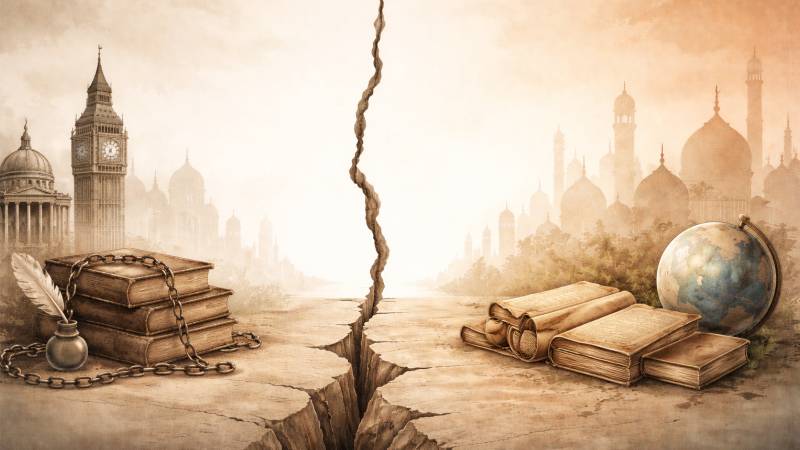
When it comes to understanding the effects of colonisation here and its role in shaping our cultures for learning, a question arises that cannot escape our thoughts: have we really managed to overcome what it left behind for us? Our textbooks cautiously call the pre-partitioned land the subcontinent, or at best, undivided India, before it was partitioned with painful memories. It was a land of wonderment with its long string of multiple histories since ancient times. The legacy that has become part of our psyche today tells a story of how we arrived at the point where we are today.
Whichever way we define colonisation, the process laid its essence on the dehumanisation of a culture or a civilisation. If we don’t see it in Macaulay’s Codes of 1860, which are still part of our legal system, we can definitely see intentional racism in his Minute on Education, in 1835. In today’s Pakistan, we see little concern for reforming the Pakistan Penal Codes—unless with the intention of further draconian measures, devised to use against citizens to limit or restrict their basic freedoms of thought and expression.
However, pre-colonial dynamics of power also cannot be sidelined when calling out what led to the collective hard memories of the Raj. The knowledge systems here were once fluid. Some historians from colonial times have discredited the way they contributed to the fields of science, linguistics and grammar, architecture, philosophy, and also the science of statecraft, with much credit to Kautilya, Ashoka, and Akbar.
There existed before a complex social and learning system, which was a product of multiple belief systems and the movements countering them, as we could see in the Lokayata and Charvaka movements that opened doors for rational scepticism in response to the dogmas of the time.
We later saw Buddhism and Jainism taking forms before the arrival of the Muslims and Portuguese Jesuit missionaries, all merging with the rich culture of knowledge transmission. We also have examples of the Hellenistic era, interactions with Chinese scholars visiting Nalanda and Taxila universities, which were later destroyed by the incoming White Huns invaders.
All that contributed to an environment of thought, the learning of a people who either chose to remain part of a particular system or resolved to set themselves free through reforms. But all that has become part of a past which one can no longer fathom today. Where did all that go, and why could the legacy not render useful lessons for us anymore? There cannot be a linear connectivity to the past to understand our ancient knowledge.
Romila Thapar, in her essay “Science as Culture,” explained the juxtaposition of science and superstition, and the fanciful stories later attributed to an era long gone. There are some exaggerated grandiose claims by later nationalist propaganda, whereas some merited appreciation of the ancient works, such as Al-Biruni’s Tarikh al-Hind, went unnoticed.
A pattern of dehumanising the “other” civilisation persists, thus politically initiating the war of narratives over who should morally have the right to control the masses
The disconnect from their historical linear progression, as opposed to the connectivity with scientific advancement seen throughout the European Enlightenment and Industrial Revolution, lies in how the understanding of science in history has been constructed.
Perhaps this is the reason why James Mill found the claims of Aryabhata’s mathematical wonder, among many others, to be fictitious in his extensive The History of British India, which influenced Macaulay’s exposition on the West’s superiority over the Orient. Perhaps also inherent were the observable hereditary and occupational discrimination, the caste-based hatred, and restricted knowledge for hierarchical elites, which laid open vulnerabilities.
One wonders then, if caste-based discrimination and hegemony were already present in pre-colonial times, what makes British colonisation more demonic? The answer lies mainly in the unintended consequences of inevitable economic needs and the industrial advancements of the time. The East India Company was an establishment that required the consolidation of power structures for maximum returns. One such was the need for a mass schooling system for all, while the intention was not to keep it restricted only to the elites.
But in 1882, an educationist, linguist, and historian of the time, Dr G. W. Leitner, criticised a particular policy on the Educational Cess (tax) introduced by the British for the establishment of schools. This not only affected the indigenous education system but also became a contentious cause for communal tensions. Before this system, indigenous schools were funded by village communities, but it caused a disturbance among them, as they considered it alien and threatening, leading them to feel a loss of identity and ownership.
One may disagree with Dr Leitner’s criticism of ending a strong indigenous education, but in the absence of viable alternatives, a system was bound to favour only a few who subscribed, while alienating the rest who found it outrageous. This contributed towards a growth of religious alienation, which became more isolating and distinctive, more as a reaction to a loss of agency in learning.
A pattern of dehumanising the “other” civilisation persists, thus politically initiating the war of narratives over who should morally have the right to control the masses. Hindutva propaganda on the erasure of Muslim history from textbooks in India, and Pakistan’s reminiscing of a glorious Muslim past, are consequences of colonial policies that resulted in deep communal divides.
The inherent problem with the content taught at schools under the National Curriculum of Pakistan, previously the Single National Curriculum, has been criticised for being less relatable to the geo-economic and cultural realities of the provinces, under the National Curriculum policy.
Nationalist politics and the growth of polemicist ideas and dispositions, as can be learnt from how the Arya Samaj and Muslim reactions came to be, are important lessons as byproducts of the colonial past. Pakistan adopted the policy of religion-based divide as a lesson for control and intimidation of the population. What else could explain a constitution that doesn’t treat all citizens equally, where fundamental rights are subject to certain conditions, and constitutional amendments further undermine democracy and freedom of religion, thought, and conscience?
Embracing differences and eliminating discrimination is a need for today. In today’s era of decolonisation, in the context of the post-Second World War and the resultant creation of blocs in the wake of the Cold War, the United Nations laid down its universal principles for human rights. On education, due deliberations were carried out on how the matter of religious, cultural, and ethnic identities should be ensured. A clause affirming communities’ right to choose the kind of moral and religious education was added to the UDHR, to which Pakistan is a signatory.
The lessons for us here are not of colonialism, but of how humans interacted with the language of power and violence. Yes, brutality indeed became internalised as a consequence, but the problems persist in power structures within cultures which are oppressive and cause bias and hate. It is that part of the culture and colonial legacy that needs to be let go of.