


The social currency of our modern age is a bankrupt one, traded in fake news, tailored truths, and the reflexive venom of comments written by those who never bother to read. In this era of the "half-truth tweet," our mental space is constantly under siege by digital intruders. To stop these attacks, I have found only one true shield: the act of serious reading. For me, reading is not merely a pursuit of pleasure; it is a pursuit of clarity. It is a joy doubled when shared with a circle of lively friends who prefer to cherish new ideas rather than trade in outrage. It was in this spirit of seeking truth that I recently finished Nicholas D Kristof’s memoir, Chasing Hope: A Reporter’s Life.
While the author is a journalist, this is not a book for the "cafeteria press" who roam the halls of power or linger in assembly offices. It is a manifesto for the witness. Kristof writes for the reporter who chooses to stand in the trenches of human suffering on behalf of society, documenting injustice with the sole purpose of demanding the world’s attention.
ND Kristof has spent more than four decades hurtling towards the most dangerous trouble spots across the globe. Armed with nothing more than a notebook and a conviction that bearing witness can bend the moral arc towards justice, he has dedicated his life to reporting on human suffering and resilience.
In Chasing Hope, his first solo memoir, the two-time Pulitzer Prize winner steps back from the front lines to examine the improbable path that turned an Oregon farm boy into one of the most influential journalists of his generation. Written during a time of eroding public trust in the press and following his own personal brushes with mortality, the book serves as both a poignant love letter and an urgent defence of a craft that Kristof insists remains a profound act of hope.
Kristof writes for the reporter who chooses to stand in the trenches of human suffering on behalf of society, documenting injustice with the sole purpose of demanding the world’s attention
The memoir opens in a cinematic fashion aboard a failing propeller plane plunging towards the Congo rainforest. The year was 1997. Kristof and a handful of colleagues had just been involved in a tragic accident where an innocent man was killed on a runway in Goma. With the landing gear shredded and hydraulic fluid drained, the pilot shouted for everyone to assume the brace position. As the forest rushed up to meet them, Kristof found himself instinctively scribbling notes in his reporter’s notebook. He did this not out of bravado, but out of a deeply ingrained habit. That single scene distils the central tension of his life, which is the reporter’s compulsion to document suffering even at the risk of becoming part of the tragedy itself.
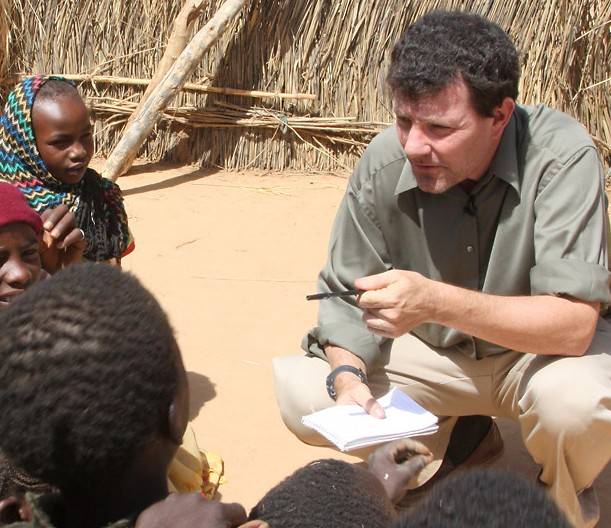
From this near-death opening, Kristof pivots smoothly to his origins in rural Yamhill, Oregon. He reveals how an unassuming childhood forged the survival instincts that would later carry him into active war zones. Thrust into the editor’s chair of his eighth-grade school newspaper because his classmates simply refused to do the job themselves, the young Kristof discovered the quiet power of the printed word. He recalls his first clumsy effort using a toy printing press in kindergarten, which produced a two-sentence account of a neighbourhood bike accident. He remembers the indignation he felt when customers read the entire paper and still declined to pay the two-cent fee. These early experiences taught him that journalism is rarely glamorous and almost never lucrative, yet it possesses the unique ability to challenge authority even in the smallest of places.
Kristof’s account of his father’s refugee past adds significant emotional depth to the narrative. His father, of Armenian, Polish, and Romanian descent, was part of a family that experienced an improbable rescue after World War II. The debt Kristof feels towards the diplomats and journalists who saved his father’s life serves as a quiet moral engine driving his own professional work. Readers see how personal history can sharpen a reporter’s empathy without turning objective reportage into a mere autobiography. For budding journalists, the lesson is clear: the most compelling voices often emerge from those who have first learned to listen to their own complicated backstories.
The narrative gathers momentum as Kristof moves through his years at Harvard and Oxford, admitting with disarming candour that he frequently felt like an imposter among his peers. He describes bluffing his way through academic tutorials, hitchhiking across dangerous stretches of Pakistan, and learning Arabic while making mortifying linguistic mistakes. These chapters are not mere résumé padding; they show how a young reporter develops the specific combination of audacity and humility that the job demands. Kristof’s willingness to expose his early stumbles offers aspiring correspondents a rare gift, providing them with the permission to be inexperienced while still relentlessly pursuing the story.
Once he joined The New York Times, Kristof’s rise was swift but never effortless. He credits the legendary editor Abe Rosenthal with spotting potential in an eager cub reporter, and he traces his own evolution from a foreign correspondent to a prominent opinion columnist. Along the way, he met and married Sheryl WuDunn, whose steady presence became both an emotional anchor and an intellectual partner. Their collaboration on the groundbreaking project Half the Sky receives thoughtful treatment here. It is presented not as a victory lap, but as evidence that journalism’s greatest impact often occurs off the front page through sustained advocacy built on rigorous, on-the-ground reporting.
Kristof does not shy away from the darker personal costs of the life he chose to lead. He recounts the pain of losing friends to plane crashes and gunfire, the psychological toll of covering genocides in Darfur and Bosnia, and the ethical tightrope of deciding when a reporter must intervene to help rather than simply observe. Yet, he refuses to descend into cynicism. Chapter after chapter returns to the same conviction: stories that are told truthfully and forcefully still have the power to save lives. He cites the civil rights movement’s reliance on brave Southern correspondents like Claude Sitton, whose narrow reporter’s notebooks became iconic talismans of the trade. The message for young journalists is bracing: courage is not the absence of fear, but rather the decision to keep filing the story even when one is terrified.
What elevates Chasing Hope above the typical journalistic memoir is Kristof’s refusal to romanticise the profession. He acknowledges the industry’s failures, the death threats that now arrive by the drawerful, and the public’s growing contempt for the media. This hostility is captured in the disturbing T-shirts that read, “Rope. Tree. Journalist. Some Assembly Required.” At the same time, he insists that good journalism remains indispensable to a functioning society. Whether he is covering the political rise of Donald Trump or watching the Arab Spring collapse into carnage, the truth remains the same: the reporter’s job is not to predict the future, but to make the present impossible for the public to ignore.
Throughout the book, Kristof returns to the physical image of the reporter’s notebook. Measuring four inches by eight inches, it is small enough to slip into a hip pocket yet sturdy enough to survive war zones and plane crashes. It becomes a symbol of continuity in a profession that has been transformed by satellite phones, podcasts, and social media. For the next generation entering the field amid layoffs and algorithmic distrust, that small notebook stands as both a practical tool and a moral compass.
Chasing Hope ends exactly where it began: in motion, chasing the light of truth. Kristof has written a memoir that is at once deeply personal and expansively instructive for anyone interested in the state of the world. It reminds readers, especially those just starting their careers, that journalism at its best is neither glamorous nor safe. It is, instead, an act of stubborn optimism fuelled by the belief that shining a light into the darkness can still produce meaningful change. In an era when many question whether the craft still matters, Kristof’s answer rings clear and defiant. It does matter, and the proof lies on every page of this remarkable book.