

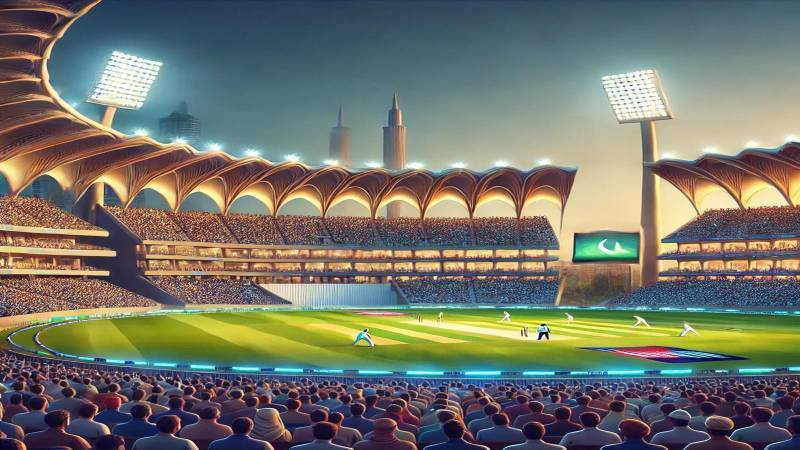
I come from Nushki and Quetta, Balochistan—an area often pushed to the periphery, both geographically and in the narratives that define us. But if there’s one thing that binds this nation together, one thing that makes us forget our differences and brings us under a single banner, it’s cricket. Cricket is not just a sport here; it’s a celebration, a festival, a force that unites. And there is no greater example of this than the Pakistan Super League (PSL).
The PSL is more than just a tournament—it is an annual phenomenon that grips the entire country in anticipation and frenzy. For months, we wait. And when it finally arrives, it takes over our conversations, our emotions, and our hearts. Balochistan is no exception to this love story. In 2023, when an exhibition match, a match on a grand scale, was finally held in Quetta after 1996, the stadium was packed beyond capacity. For instance, if 10 people were inside, 50 were outside, a simplified ratio, numbers were in tens of thousands—just to be part of the moment, just to witness the game that represents something bigger than itself, to be part of the historic moment.
Yet, every time Balochistan is mentioned in mainstream narratives, it is often through a lens of conflict, deprivation, and neglect. But I have made it my life’s mission to rewrite these narratives. I have said this on many platforms, including when I was announced as a winner for Young Woman of the Year at the global Women Changing the World awards: we must tell the world the truth of who we are, and I will recalibrate biases and rewrite narratives. And in this effort, Quetta Gladiators—the PSL franchise carrying the name of my city—has played an unexpected but crucial role. When international stars and national icons don the Quetta Gladiators jersey, when our city’s name is broadcast across television screens with pride, it changes something deep within us. For once, Quetta is in the news not for struggle but for triumph. For once, the world sees us through a lens of strength, resilience, and talent. It may just be a cricket team to some, but for us, it is a representation. It is proof that we exist, that we matter, and that we can stand tall alongside the rest of the nation.
As long as the PSL lives, as long as Quetta Gladiators fight on, the story of Balochistan will continue to be rewritten—not in tragedy, but in triumph
And if I talk about my journey, I am no exception to this love for the game. Since childhood, I have had interest in watching the sport. When Pakistan won, I was ecstatic; when we lost, I was heartbroken. Then, in 2016, the PSL was introduced, and suddenly, my passion had a new dimension. This was our league, our franchise, our moment. And above all, Quetta was being represented.
I still remember those first seasons. In 2016, the matches were held in Dubai, and Quetta was seen as an underdog, with sceptics dismissing our chances. But we defied expectations. For the first four years, Quetta dominated, making it to the finals two times and finally lifting the trophy in the fourth edition. I was just 13 then, I had just entered my teenage phase. I remember, I would finish my homework early before every match, excited for the night ahead. As the sun set, I would take my spot in the TV lounge, my heart pounding with anticipation.
My family would sleep, but I couldn’t. I stayed up even for the post-match ceremonies, absorbing every moment. And then, after the excitement had settled, I would look around and realise I was alone in the quiet of the night, a young teenager would get scared and so I would rush to my room, tired but proud, sneaking away to get whatever little sleep I could before school the next morning. But it wasn’t just me. Across Balochistan, in places where infrastructure lags behind, where development is far behind many metropolitan and cosmopolitan cities of Pakistan, PSL nights are a rare delight amidst the daily struggles. In small tea stalls or at small grocery stores, or hotels or petrol pumps, people gather around flickering TVs, eyes glued to the screen, momentarily leaving behind the routines of daily life. In some villages where electricity can be unpredictable, people tune in on old radios or huddle around mobile screens, following every ball, every cheer, every roar of the crowd with the same intensity as if they were in the stadium themselves. Then there are posh gatherings and meetups, dinners hosted to watch the match together. In those moments, cricket is more than just a sport—it is a shared joy, a celebration, a connection to something greater than ourselves. It’s a conversation of people next day at schools, colleges workplaces…
And for me, this is more than just a story—it is a journey. A journey that began with a schoolgirl who had written her first novel at 11, which wasn’t yet published, but who dreamed fearlessly nonetheless. A young girl who rushed to finish her homework before every match, who sat alone in the TV lounge, eyes fixed on the screen, watching in awe as her team played, never imagining that just a few years later, she would find herself on the other side of the equation. To go from that child—innocent, wide-eyed, lost in the magic of the game—to standing alongside the very team and being announced their youth ambassador is beyond articulation. To represent the team as ambassador and as country’s youngest novelist and self-published author… is surreal. It is humbling. It is proof that sometimes, life gives you back the dreams you once whispered into the night.
This is why cricket is more than a game. It is identity. It is hope. It is belonging. It is a chance to reclaim our stories. And as long as the PSL lives, as long as Quetta Gladiators fight on, the story of Balochistan will continue to be rewritten—not in tragedy, but in triumph.