

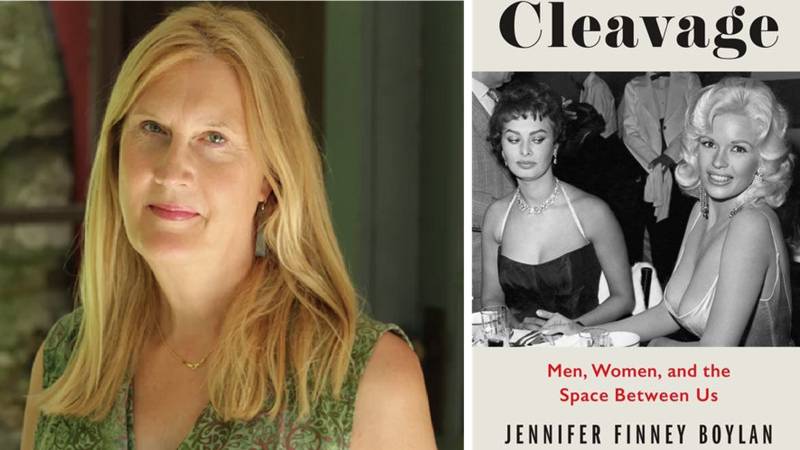
Jennifer Finney Boylan is the author of nineteen books, including her memoir She’s Not There which was the first best-selling work by a transgender American. She is also the writer of the book Mad Honey, co-authored with Jodi Picoult. She is a transgender activist and has been the inaugural Anna Quindlen Writer at Residence at Barnard College and a former contributing writer for the New York Times. In December 2023, she became the president of PEN America, a non-profit organisation whose goal is to raise awareness for the protection of free expression in the United States and worldwide through the advancement of literature and human rights. She graduated from Wesleyan University and John Hopkins University and she holds doctorates honoris causa from Sarah Lawrence College, the New School, and Wesleyan.
In her book ‘Cleavage: Men, Women and the Space Between Us’, Jennifer explains her life-story to the reader in intricate detail using anecdotes from her life – her transitioning biologically from being male (with which she never felt comfortable even though she does say she enjoyed being a boyfriend and husband and a father) to being a woman (and the consequences of that from thinking about your dress, to think about your security) and the impact the transition had on her life, her surroundings, her work, and her marriage. She explains how supportive her spouse ‘Deedie’ and her two children were towards the transition even though it was tough on them as well.
She explains through the eyes of a transgender human - someone with the lived experience of facing opposition, criticism and backlash - as to how the world can sometimes be a big bad place for those struggling to find themselves and forge an identity which doesn’t conform to the normal tick-box ones that we have in our world every day. She even recounts the case of one transgender who committed suicide because she was so unhappy and quotes the statistic that 41 percent transgender human try to commit suicide at some point in their lives. That is an alarmingly high number of individuals.
Title: Cleavage: Men, Women and the Space Between Us
Author: Jennifer Finney Boylan
Publisher: Celadon Books
To read about how Jennifer’s own life is upturned in surprisingly challenging yet interesting ways, I’ll leave it for the reader to pick up a copy of this articulate novel, as Jennifer finds her way through life and reaches old age the reader feels they too have been lived the journey and have gone through the transition with her and you feel only empathy, kindness and love for her throughout the book. Jennifer notes that she had known she was a girl when she was as young as being four or five-year-old.
She explains her weight issues so succulently that I laughed my head off when I read the line: “Pour away the Diet Coke and sweep up the SlimFast. For nothing now can come to any good.” Because though I personally have never tried SlimFast, my cousin has and dieting does seem to be many of us, with our weight struggles. But for Jennifer in particular she explains how when she transitioned from being biologically male to being a woman, she had to start worrying about her weight. She goes on to explain: “I lost a lot of weight that year, but I think that an even stronger motivator of my diminishment was the worry I carried around before coming out in public. I was so uncertain what the future held: Would I lose my family? Would I lose my job? Would I ever be able to write another book? What was going to happen to me?”
Jennifer is angry at the cleavage between men and women, and how they divide the worlds in which they exist
Jennifer writes that transgender humans often go through a second adolescence in which they have to negotiate the adolescent urge to be cool kids, the pretty ones, the thin ones. When Jennifer transitioned, her children welcomed her home with a “Welcome home Maddy” (combination of Mommy and Daddy) sign but she still has lingering questions about what it means to be a man, woman, transgender. She examines how we can’t just neatly divide the categories. And how gender is a social construct, as is explained in the book.
Jennifer is angry at the cleavage between men and women, and how they divide the worlds in which they exist. I will leave it to the reader to read the issue of “passing” (when someone is perceived as the gender they identify as rather than their sex assigned at birth) and how Jennifer went through it because it is a riveting account and also increases your knowledge base about a dimension unknown to many of us – it was certainly new to me. But when Jennifer arrived at the other end, it seems she at least was happy and she seems to have succeeded overall in maintaining a positive outlook towards life and for that I admire her and see her as an inspirational journey. Jennifer points out that people say she can’t be a woman because she can’t get pregnant but there are several women who can’t get pregnant. Or because she’s never had her period, but there are some women who have never had a period. You can’t be a woman because you don’t have the double X chromosome, it is said but there are several women who have XXY chromosome, or other genetic mosaics or Y chromosome and never know it.
As long as Jennifer “feels” right as a woman, it is her right to be seen as one and treated as one. There are cleavages between transgender individuals and cis men and women, between lesbian and gay individuals and no matter what we do for a long while, these cleavages will persist. Jennifer’s exceptionally well-written book is a must read for all and a reminder to include those on the margins, in the wider net of society, as we move towards building a more inclusive future for our future generations