


I have always been drawn to the works of the “New Journalists.” This style of reporting fuses meticulous research with the vivid techniques of literary fiction, plunging the reader into scenes that feel like a novel while ensuring every detail remains anchored in truth.
The New Journalism movement emerged in the 1960s and ‘70s, born from the cultural upheaval of a restless United States. While no single writer founded the movement, the genre gained official recognition in 1973 when Tom Wolfe and EW Johnson edited the anthology The New Journalism. From there, the movement branched into various sub-genres: immersion, advocacy, precision, and, most wildly, the ‘Gonzo’ journalism of Hunter S Thompson.
In my search for the intellectual roots of Thompson’s life, I waded through his own bibliography and various memoirs written by his inner circle. However, I kept returning to one specific title: The Gonzo Way: A Celebration of Dr. Hunter S Thompson. It was written by Anita Thompson, Hunter’s widow and devoted assistant until his death in 2005.
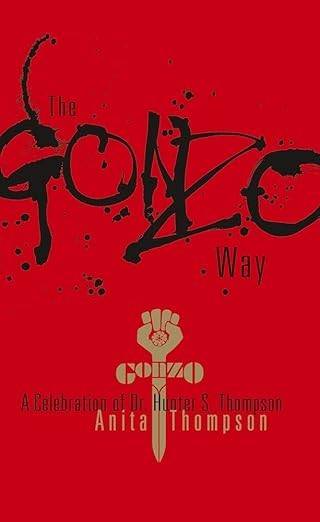
Title: The Gonzo Way: A Celebration of Dr Hunter S Thompson
Author: Anita Thompson
Publisher: Fulcrum Publishing, Golden, Colorado, USA
Price: $14.95 / eBook: $9.99
When a digital copy eluded me, I turned to Professor Manoj Kumar, the Principal of Government Boys Degree College in Bhit Shah. I fired off a brief, informal text message requesting the book and waited with my eyes glued to the screen of my cell phone. First came the single grey tick, sent. Then the double grey ticks, delivered. Less than a minute later, the ticks turned blue. Anticipation surged. Exactly as expected, a clean PDF of the book landed in my folder. Professor Manoj had delivered once more. Then and there, I thanked him.
Before plunging into the pages, I had to define the ‘Gonzo’ essence itself. This is one of the most electrifying sub-genres of New Journalism. It delivers raw, intensely personal reporting where the reporter strides forward as the hero of the story, refusing to linger on the sidelines. The first-person voice controls every sentence. Satire cuts with razor-sharp teeth, and raw emotion flares unfiltered. It is a style where words explode in wild exaggeration, carrying dark giggles yet landing with brutal force.
Professor Manoj sent the book at midday on Thursday, the 12th of March 2026. After a reading and notetaking, I found that Anita Thompson has written the book every Gonzo fan secretly wanted but never knew they needed. It is a manifesto that strips away the myths of drugs, guns, and chaos to reveal the actual operating system behind the legend.
At just 112 pages, The Gonzo Way reads like a love letter crossed with a survival manual. It is not another biography; rather, it consists of seven hard-won lessons Anita distilled from her years at Owl Farm. These lessons offer practical wisdom for anyone who wants to live with the same ferocious vitality Hunter did.
The book’s structure is simple, beginning with a foreword by Douglas Brinkley and Anita’s own preface. Brinkley, a distinguished historian and Hunter’s close friend, provides the essential literary context to frame the legacy of Owl Farm. Following this introduction are the seven lessons, each short enough to read in one sitting yet deep enough to linger for weeks.
What makes the book sing is Anita’s clear voice, unsentimental, and shot through with the same dark humour Hunter loved. She never apologises for the wild parts of his life; she simply shows how they were never the whole story. By dividing the work into seven distinct captions, she provides a map for those who wish to buy the ticket and take the ride.
Redefining politics as a localised art form, the Gonzo philosophy demands that you control your own narrative and environment to keep outside absurdity at bay
On 20 February 2005, a single shot echoed through the Woody Creek valley, and the Zen den at Owl Farm became a house of mourning. For Anita Thompson, the world lost a legend, but she lost a husband, a mentor, and a best friend. In the wake of this shock, Anita chose to be fuelled by his fire rather than crippled by his death. The Gonzo Way is the manifestation of that choice, distilling Hunter S Thompson’s wild spirit into seven timeless lessons for a life of ferocious vitality.
In the first lesson, “Learning: That’s What It’s All About,” Anita reveals that Hunter S Thompson was a scholar of life before he was a counter-culture icon. Long before the fame, he was a copyboy at Time. He spent his nights learning from Kierkegaard's existential ‘leap of faith,’ Schopenhauer’s struggle against an irrational ‘Will,’ and Alan Watts’ Zen focus on the ‘eternal now.’ These thinkers provided the intellectual armour he used to navigate the absurdity of the American experience.

He sought the architectural grace of F Scott Fitzgerald, the master of the jazz-age threnody, and the stripped-down, muscular precision of Ernest Hemingway. He re-typed their pages to "feel the rhythm" of their prose, internalising the skeletal structure of the Great American Novel. He did not stumble into the success of Hell's Angels: The Strange and Terrible Saga of the Outlaw Motorcycle Gangs (Random House; 1967); he earned it through fifteen years of studying the craft. Hunter S Thompson lived by a simple code: “If you don’t know, come to learn. If you know, come to teach.”
Lesson Two clarifies the most misunderstood aspect of the Gonzo legacy: the ‘Too Much Fun Club.’ This was not mere hedonism; it was a rigorous aesthetic requirement. To Hunter S Thompson, a dull moment was a failure of character. He would smash canes in bookstores or pour ice water on audiences to transform every gathering into theatre. If a situation failed to bring a laugh or a story worth retelling to the table, he considered it ‘wrong’ and would simply restart the day.
In Lesson Three, Anita redefines politics as a localised, tactile art form. She reveals Hunter S Thompson not as a partisan hack, but as a political master who understood that real power requires controlling one’s environment and narrative. He transformed Owl Farm into a functional command centre to keep the intrusive absurdity of the outside world at bay. His 1970 run for Sheriff of Pitkin County serves as the ultimate case study; he didn’t just want a badge; he demanded environmental control. The lesson is a quiet thunderclap: “if you are not winning the battle for your own environment, you are losing it to someone else.”
Lesson Four highlights the communal core of this philosophy: “We” is the most important word in politics. Hunter S Thompson’s “we” included readers, friends, and strangers. This collective identity turned personal rebellion into a lifelong tribe. By founding the Woody Creek Caucus and fighting for the freedom of the unjustly imprisoned Lisl Auman, he operated on one question: “What is the desired effect?” He proved that the strength of the community determines whether the individual is winning or losing.
Lesson Five presents a revolutionary concept: Truth is the easiest path. Hunter S Thompson chose honesty as his default setting because ‘you can fall back on the truth, but you can’t fall back on a story you made up.’ This approach frees the individual from the exhausting labour of maintaining lies. Anita presents this commitment to raw honesty as both an ethical choice and a practical tool for living.
Lesson Six explores the power of language. Hunter S Thompson used the magnificent prose of the King James Bible to sharpen his vocabulary and stay true to his thoughts. This honesty was the single thread tying his sweet and cruel sides together. He believed that a true story is the only reliable starting point for any great tale. By staying true to the facts, he remained true to himself.
Anita presents the final commandment in Lesson Seven as a total refusal to justify one's life. Hunter S Thompson never apologised to critics or friends. This stance protected his freedom and kept his creative energy pure. The section reads like a benediction for a life lived boldly. The Latin phrase res ipsa loquitur; the thing speaks for itself, let people to capture the essence. Or let your work provide its own evidence. There is no need for defensive explanations.
The final reckoning reveals that The Gonzo Way is no mere headstone for a fallen icon. It is a clarion call. Anita Thompson has distilled a life of legendary chaos into a crystalline map for personal excellence. She proves that while Hunter S Thompson was truly sui generis, a singular creature in a class of his own, the fires he stoked were never meant for the eccentric alone. They are universal flames. They wait for any soul with the courage to reach into the heat.
Through these seven lessons, we find that the Gonzo essence was never forged in chemicals or firearms. Instead, it breathed in the relentless, scholarly pursuit of truth. It lived in the sacred protection of the “we” and the unyielding mastery of one’s own environment. Anita reminds us that we are the sole authors of our own myths. We are the architects of the very rooms we inhabit.
If you are tired of playing a small part, if you are drowning in the grey, filtered spin of a modern life, this book is your survival manual. Anita’s message is a quiet, powerful benediction. Live with ferocious vitality. Let your actions provide their own evidence. Never look back with a sideways glance of regret. The ticket is bought. The ride is yours. Buy the ticket. Take the ride. Dare to be the hero of your own story.