

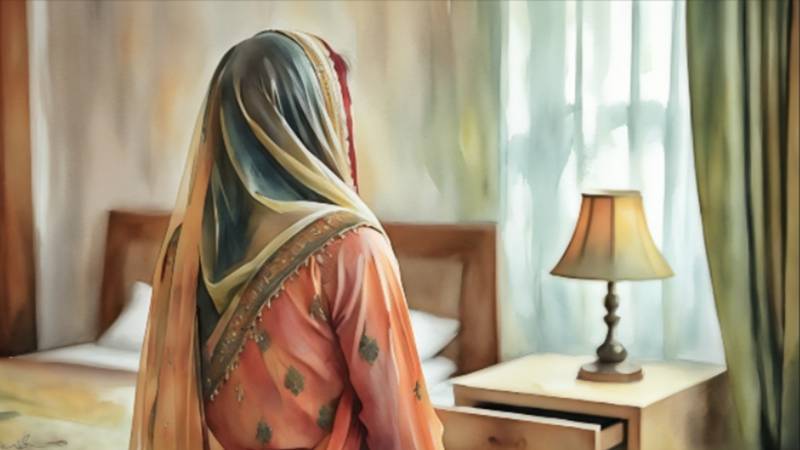
I will never forgive my father, she said to herself, as she looked at her ticket. She was waiting at the airport for her departure announcement. She felt free. The smell of coffee and the soft murmur of announcements hung in the air. For the first time, she felt peace.
All her life she had been running, suppressing her emotions, but in that moment she realised she was no longer standing in a battlefield — she was present, she was feeling. Suddenly, she heard a voice: “I’m coming, Father. Don’t go without me.”
That one sentence, 'I am coming, Father,' took her back to her childhood. Ten-year-old Amal was standing in front of a mirror, tying her ponytail and thinking about what she would eat in the park. Ice cream, of course. Just then, her father honked the car horn. She was only a few moments late, but he drove away, shouting, “I told you not to be late. Now stay here and keep getting ready, I’m leaving.”
Those words wounded Amal deeply. She felt as if she had never had a childhood like other children. She was lost in the memory when suddenly she heard that little father’s voice again: “I am here, my love, waiting for you.”
She blinked and realised she was back in the airport lounge, waiting for her departure. Her whole life began to play before her eyes, as if she were rewinding it.
She was born in Minchinabad, a village of muddy, rutted roads, the acrid smoke of dung fires, the distant bleating of goats, and cracked, peeling school walls in a place where literacy was rare. Even boys were seldom supported to complete their education, and for girls it was nearly impossible. Yet Amal had always carried within her a passion for learning.
She remembered the day her father burned her books, just two days before her exams, yet she still managed to sit for the papers by lying that she was attending stitching school
She came from a coarse, uneducated family. As she sat there, she thought about how other parents moved mountains for their children, giving them warmth and love. If only my grandparents had given my father some manners, she thought bitterly, perhaps my childhood would have been different.
She remembered the day her father burned her books, just two days before her exams, yet she still managed to sit for the papers by lying that she was attending stitching school. She used to hide her books in a corner of the kitchen, the only place her father never entered — and why would he, when men considered the kitchen beneath them? He banned her from studying altogether and married her off simply because she was a girl.
On her wedding day, Amal’s long hair and large brown eyes peeked from beneath a heavy bridal gown. Henna-scented hands shimmered with jewellery, the lights weighed heavily on her, and the guests’ voices filled the air. Yet beneath the weight of it all, she carried a small hope: perhaps her husband would be different.
He was. He was kind. But within months, the questions began: when would they have a baby? Soon she discovered she could never conceive. Another wound. Another sense of loss.
One evening her husband took her hand and said he wanted a child — and another marriage. It struck her like betrayal. Tears streamed down her cheeks, soaking her lashes. Yet she held his hand and told him she understood: he deserved a child, he should marry again. But she could not stay. She begged him to keep their separation a secret from her family.
They lived in Bahawalpur, and for a while the divorce was kept hidden. Eventually, he gave her talaaq, determined at least to provide her mehr. Amal left for Lahore, where she stayed in her friend’s hostel. When her family discovered the truth, they cut all ties with her, shaming her for being divorced.
Yet Amal refused to stop. She provided private tuition, secured admission into a Master’s program, and later secured a job at an NGO working on girls’ education. She had found her calling: to ensure that other girls did not suffer what she had endured. She completed her Master’s degree, earning her living and reclaiming her sense of self. Finally, she decided to leave the country for good, to start afresh.
But one day she received a call: her father had been arrested for killing his sister after she asked for her share of property. Amal’s heart ached. Somewhere deep within, a fragile part of her still longed for the love, protection, and assurance her father had never given. Whenever she thought of him, tears welled up — because he was the first man who had broken her heart, the deepest scar of all. Neither her divorce nor her inability to bear children had wounded her as deeply as her father’s absence of love.
She was still lost in thought when the departure announcement broke her reverie. A man’s voice rang out: “Come on, Fatima, it’s time to go, princess, or we’ll miss our flight.”
And in that moment, Amal realised: no matter what happens in life, never stop working on yourself. She could not choose her father, her childhood, or her circumstances — but she could choose her effort, her will, her reactions.
Never lose sight of who you are as a woman, she thought. Because the moment you let your guard down is the moment you truly lose.