

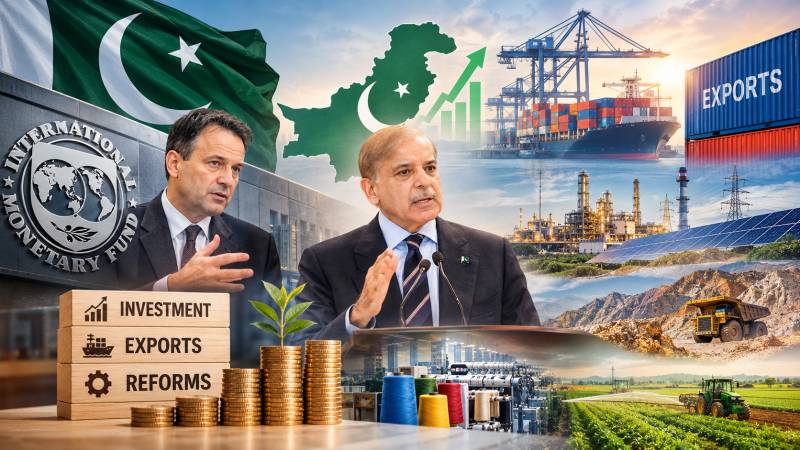
Pakistan needs to increase investment, expand exports and accelerate structural reforms to sustain its economic recovery, as the International Monetary Fund (IMF) and government officials highlight weaknesses in the country's investment climate, energy sector and state-owned enterprises.
IMF Resident Representative in Pakistan Mahir Binici has called for greater domestic and foreign investment, improved agricultural productivity, better labour standards and stronger coordination between federal and provincial governments to support sustainable economic growth.
Speaking at a seminar organised by a research institution, Binici said Pakistan's investment rate remained below desired levels and stressed the need to improve the business environment, develop workforce skills and explore new international markets for exports.
He also highlighted the pressure created by rising international oil prices and Pakistan's dependence on imported energy, warning that supply chain disruptions and higher import costs were complicating efforts to maintain economic stability.
His remarks come as Pakistan seeks to move beyond macroeconomic stabilisation under a $7 billion IMF loan programme and establish a more sustainable model of growth driven by exports, investment and private-sector activity.
Prime Minister Shehbaz Sharif has also reiterated the government's commitment to export-led growth, saying economic stability must now translate into greater industrial activity and investment.
Addressing the American Business Council of Pakistan on Thursday, Sharif said the government had provided Rs400 billion in tax relief in the budget to support exporters, manufacturers, businesses and salaried employees.
He said Pakistan offered investment opportunities in its mineral resources worth trillions of dollars and that the government was working to attract international investors. He also pledged to establish a mechanism to address investors' concerns and remove bureaucratic obstacles.
The prime minister said agriculture, industry, artificial intelligence and information technology would be important sectors for future economic growth.
Pakistan has also been promoting its mineral resources to international investors, particularly copper and gold deposits. At the Pakistan Minerals Investment Forum earlier this month, Sharif called for a shift from exporting raw minerals towards domestic processing, refining and manufacturing to generate greater economic value.
The government has highlighted the Reko Diq copper and gold project in Balochistan as a major investment opportunity, with production expected to begin in 2028.
However, attracting investment and expanding exports remain significant challenges for an economy that continues to depend heavily on imports and external financing.
According to the Pakistan Bureau of Statistics, merchandise exports reached $11.34 billion during the first four months of the 2026-27 fiscal year, an increase of 8.52 percent compared with the same period last year.
Imports, however, increased by 12.59 percent to $25.96 billion during July-October, widening the trade deficit by 15.97 percent to $14.63 billion.
The figures underline the gap between export growth and the country's rising import requirements, particularly for energy, machinery and industrial inputs.
Economists have also called for a shift away from an economic model heavily dependent on domestic consumption and real estate towards stronger exports of goods and services.
Greater value addition in established export industries, including textiles, sports goods and surgical instruments, alongside investment in research, technology and artificial intelligence, could help Pakistan diversify its export base and access new markets.
The IMF has similarly emphasised the need for structural changes to improve productivity, strengthen competition and reduce regulatory and trade barriers.
Under a staff-level agreement reached on October 7, Pakistan committed to reforms in taxation, energy, governance and state-owned enterprises. The agreement, which remains subject to approval by the IMF Executive Board, could unlock approximately $1.2 billion in additional financing under the Fund's Extended Fund Facility and Resilience and Sustainability Facility.
The IMF has also called for Pakistan to phase out its existing fuel subsidy programme, arguing that its broad targeting and fiscal cost make it difficult to sustain.
The scheme, introduced in September to provide relief to lower-income motorists amid higher international oil prices, offers weekly fuel vouchers worth Rs500 to motorcycle and rickshaw users. Eligible vehicles with engines of up to 800cc also receive a discount of Rs100 per litre under the programme.
IIMF spokesperson reiterated that any future fuel assistance should be limited, time-bound and targeted through existing social protection programmes, with spending accommodated within the fiscal year's budget.
The government has also been pursuing the privatisation of state-owned enterprises to reduce their financial burden and improve operational efficiency.
At the sixth Pakistan Prosperity Forum in Islamabad on Thursday, Adviser to the Prime Minister on Privatisation Muhammad Ali said government financial support to state-owned enterprises had increased 31 percent to Rs804 billion.
He said the government's primary responsibility was to formulate policies and ensure effective regulation rather than operate commercial businesses.
Official Finance Division figures show that loss-making state-owned enterprises recorded combined losses of Rs342.8 billion during the first half of fiscal year 2025-26, while profitable enterprises generated Rs423.3 billion in earnings.
Government support to the enterprises stood at Rs804 billion during the period, while receipts from them amounted to Rs839.8 billion, resulting in a positive net fiscal flow of Rs35.8 billion for the government.
Ali said the initial phase of Pakistan International Airlines' privatisation had brought Rs80 billion in fresh equity into the airline and generated Rs10 billion for the government. A further Rs90 billion is expected from the next phase of the transaction in June 2027.
He also said the planned privatisation of three electricity distribution companies — Islamabad Electric Supply Company, Gujranwala Electric Power Company and Faisalabad Electric Power Company — had entered the due diligence stage.
The government expects these transactions to attract private investment and management expertise into sectors that have faced longstanding financial and operational difficulties.
For Pakistan, the challenge is not limited to attracting foreign investors or securing additional external financing. It also needs to improve the competitiveness of domestic industries, expand its export markets, strengthen public institutions and create a predictable business environment.
The IMF has warned that weak governance, high energy costs and structural inefficiencies continue to weigh on economic activity. Its latest assessment also emphasises the importance of private-sector investment, improved productivity and reforms that support higher-value economic activity.
As Pakistan attempts to consolidate the gains made through economic stabilisation, the ability to turn investment commitments and reform plans into productive industries, jobs and sustained export growth will remain a key test of its economic recovery.