

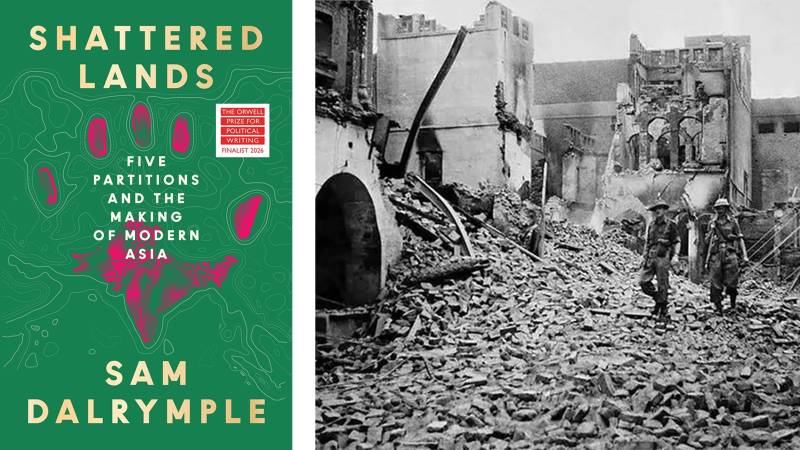
One would think it is hard to add anything new to the historical account of the eighty-year-old partition of British India when all the documents have been made available in the public domain for decades now. Sam Dalrymple’s Shattered Lands: Five Partitions and the Making of Modern Asia shows that casting a wider net over space and time makes it possible to create a gripping narrative of the decline and departure of British colonial rule from Burma to Bangladesh in a few decades. (The author sees the secession of East Pakistan and the emergence of Bangladesh as the continuation of the blood-soaked history of multiple partitions, starting with the partition of Bengal in 1905.)
The book challenges the traditional narrative that treats the partition of India in 1947, and the emergence of the two nation-states of India and Pakistan, as an isolated and unique denouement of the Raj. The sweeping grasp of the book discusses five partitions and the birth of twelve states as a continuum: Burma, Aden and the Gulf states, Pakistan-India, the Princely States, and finally, the secession of East Pakistan and the emergence of Bangladesh.
The partition of Burma in 1937 provided a blueprint for Muslim leaders like Rehmat Ali, in later years, to demand the partition of India based on the Muslim-majority provinces in the north-west and the east. On the contrary, the Hindu leadership deemed the partition of Burma as “natural” because it was not part of Bharat according to the Vedantic interpretation; but they opposed the demand for Pakistan as “unnatural” because this amounted to the vivisection of Bharat. By the same logic, the modern-day sheikhdoms, which were integral to the Raj, governed from the Bombay Presidency, where the currency was the Indian rupee, and passports were also Indian, were not to be part of independent Bharat. Thereby, Gandhi’s Swaraj, and Ram Rajia, sought its foundations in a mythical age wherein non-Hindus had no place, despite the Congress claiming to represent every Indian in the 20th century.
The book challenges the traditional narrative that treats the partition of India in 1947, and the emergence of the two nation-states of India and Pakistan, as an isolated and unique denouement of the Raj
The Raj was beating a hasty retreat after World War II, leaving behind arbitrary international borders and the uncertain fate of 550 semi-autonomous states. The book gives oft-ignored details of the massacre of Muslims in the state of Hyderabad, and how Vallabhbhai Patel colluded with the RSS, even though the organisation had been banned after their involvement in the assassination of Gandhi. The actions taken by the Razakars to defend the state against Indian attempts to integrate it into the new state made it into a religious conflict. The Nehru-appointed Sunderlal Committee on the massacre gave “a very conservative estimate between twenty thousand and forty thousand Muslims had been killed during and after the ‘Police Action’. Other scholars suggested a number as high as two hundred thousand.” (p. 279)
The book elaborates on the important but always ignored role of Prime Minister Mr Feroz Khan Noon in acquiring Gwadar and settling the border with Iran (p. 302). He was dismissed by President Iskander Mirza, and yet the two remained courteous and friendly (p. 330). This is far removed from the politics of hatred and personal enmity in Pakistan over the last few decades.
This is a very well-researched and elaborately referenced book of history. The author has an easy-flowing style of writing which makes reading a pleasant experience. Sam Dalrymple has a background in filmmaking; that experience probably adds to the vivid cinematic descriptions of events and characters.
Another interesting feature of the book is the inclusion of personal diaries, oral histories, forgotten archives, and accounts given by poets and fiction writers in numerous languages. Faiz Ahmed Faiz and Saadat Hasan Manto are quoted among numerous literary individuals.
It is almost customary to blame the colonial powers for drawing international borders arbitrarily, leaving behind divided tribes, split nationalities, and unresolved territorial disputes. But we must remember the borders were not as meticulously demarcated in the premodern age of empires. The borderland folks would move freely unless there was an invasion and a war. And, of course, there was no political concept of a nation, nationality, self-determination, etc. So, today’s borders remain arbitrary, even artificial, in almost every modern nation-state; the colonial powers just made it worse.