


“To this day, when I watch the videos of what happened and see myself being thrown to the ground by police, I can’t process that I’m looking at myself,” said Simón, a 23-year-old student at Purchase College using an alias for safety concerns.
Simón was one of 68 students and faculty members violently attacked and arrested by riot police at a Gaza solidarity encampment at Purchase College on 2 May 2024. He was never given a reason for his arrest.
“I had no idea what RTC was until that day,” he said, referring to Raise the Consciousness, the student divestment organisation demanding that Purchase College and the greater SUNY system “divest from companies with ties to the Zionist entity”, boycott Israeli academic institutions, fully acknowledge the “genocide taking place in Gaza” and more.
At the time of this report, over 3,100 students and faculty at American universities have been arrested at protests since 7 October in support of Palestinian liberation and opposing U.S. involvement in Israel’s assault on Gaza and the West Bank, which has been defined as a genocide according to the Office of the United Nations High Commissioner for Human Rights and other prominent international human rights organisations such as Human Rights Watch and Amnesty International.
“It was almost like one of those outdoor music festivals in a way,” Simón said, describing the encampment prior to police interference.
Students played games and music between teach-ins and other advocacy activities across the grassy quad between Purchase’s main dormitory buildings, one of which was formerly named ‘Big Haus’ before students successfully protested in past years to change it, as the campus was built on the estate grounds of a small plantation. The building is now simply called ‘Central’.
As finals were approaching, the university alerted students of a customary “quiet hours” period to take place starting at 10 p.m., which the university had repeatedly used as a tool to prevent protests from occurring, although quiet hours only referred to reducing noise levels in the code of conduct.
Approaching 10 p.m. that evening, university police officers began closing in around the encampment, blocking pathways towards it to prevent students both from joining or leaving the quad. The university police chief, Dayton Tucker, warned protesters they would be arrested if they did not disperse.
“Quiet hours had nothing to do with being outside and at that point, we were just sitting silently in a circle on the quad and linking our arms,” said Simón.
In August 2025, the State Department confirmed it had revoked over 6,000 student visas since January as part of his immigration agenda and countless other executive orders that test the limits of presidential power
Drones and helicopters began flying overhead. Outside police officers dressed in full riot gear arrived at the encampment and quickly advanced towards the students to make arrests.
Watch the video on Instagram.
“Two officers slammed me into the table with the food for protesters. I remember falling to the ground on top of crushed oranges,” Simón said.
One officer dug his knee into Simón’s lower back and leaned with his full body weight to hold him down. “It was a surreal experience. My brain couldn’t process what was happening.”
Simón was then handcuffed and dragged towards the nearby car park where he waited for nearly an hour alongside other students for a police van to take him to one of six precincts across Westchester County where they sporadically detained protesters.
“I kept asking why I was being arrested. They never answered. I didn’t find out until after I was released,” he said.
“I had bruises all over my body and wore long clothes to hide them afterwards,” he said. “I couldn’t eat an orange for two months.”
The Palestine Exception
As a new academic year begins, attacks on students, academic freedom and free speech have exponentially increased. Within its first 100 days, critics of the Trump administration argue that his second term has brought on an incremental rise in authoritarianism by withholding federal funding from universities across the nation.
The Trump administration has cracked down on international students at U.S. universities protesting against Israel’s genocide in Gaza and attacks on neighbouring countries. In August 2025, the State Department confirmed it had revoked over 6,000 student visas since January as part of his immigration agenda and countless other executive orders that test the limits of presidential power.
In the name of combating antisemitism, Trump and his allies have used the growing support for Palestinian liberation on college campuses to usher in a wave of policies that experts have argued harken back to a McCarthy-era erosion of basic civil liberties and public integrity in a rules-based order.
Scholars and legal experts note that while aggressive suppression of free speech and criticism towards U.S. foreign policy, particularly in the Middle East, has grown less emboldened to mask any fascist or racist undertones, it is far from the first time that students have been aggressively targeted for advocating for Palestinian rights.
“There was always a kind of injunction applied for Palestine,” said Dr Fawzia Afzal Khan, Professor of English and Gender and Sexuality Studies at Princeton University and former Director of the Women and Gender Studies Department at Montclair State University.
Palestine is not just a single issue. It’s the issue that connects all other progressive causes
Arriving from Pakistan to study at Tufts University in 1979, Khan was struck by the extent of misinformation and indoctrination within American media and academic institutions regarding Palestine, the Middle East, and South Asia. Along with a few other students, she created the Committee for Palestine, one of the first Palestinian advocacy groups of its kind at an American university.
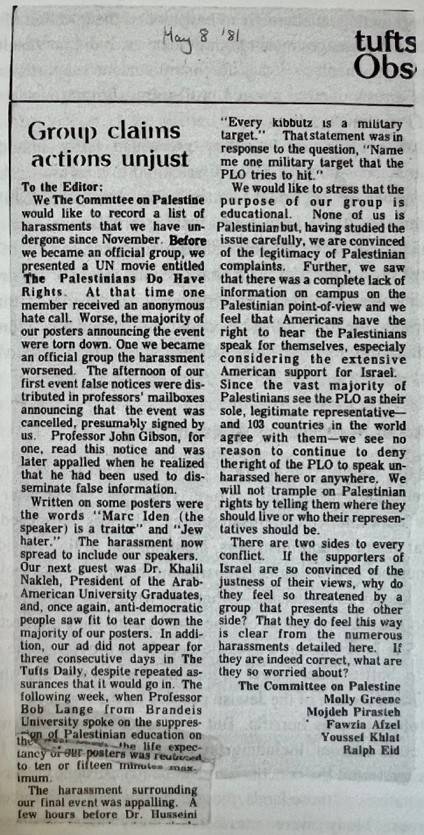
“We had speakers including Edward Said and one of the right-hand people to Yasser Arafat,” she recalled. “There were no Muslim or Palestinian organisations at the time, so Hillel went really hard after us.”
“All of our answering machines were filled with death threats…and just as now, the school didn’t seem to give a damn.”
At the same university this March, Turkish graduate student Rümeysa Öztürk was abducted by plainclothes ICE agents after a pro-Israel group targeted her for an op-ed she wrote criticising the university’s response to Israel’s genocide in Gaza.
A surveillance video documenting her capture sparked worldwide shock and outrage, turning her and other targeted university students into symbols of the Trump administration’s deportation agenda.
“I just couldn’t believe it,” Khan said regarding Öztürk, “especially because Tufts’ reputation rests on being this welcoming bastion of liberal and progressive education for foreign students.”
Öztürk was returned to Massachusetts on 9 May, six weeks after her detainment, after an appeals court rejected the Trump administration’s deportation appeal, ruling that she must be released on bail from immigration detention.
For Simón, who became a U.S. citizen in 2022, the targeting of international students only reinforces his commitment to speaking up. “As an immigrant, the idea that we come together through our shared struggles is truer than ever before,” he says.
Born in Venezuela and orphaned before starting college, Simón described that he had grown accustomed to staying calm in stressful situations like his arrest. He was used to being accountable for and protecting himself. For him, there is a deep resonance with the tens of thousands of Palestinian children in Gaza who have had one or both parents martyred in what is now described as the “largest orphan crisis in modern history” by human rights organisations.
“When I look at what’s happening to international students or at what’s happening in Gaza, I keep thinking to myself if they can do it to them, they can do it to anyone who looks like them,” said Simón. “None of us are safe.”
A Litmus Test for Democracy
“Palestine is not just a single issue. It’s the issue that connects all other progressive causes,” says Khan.
“And universities silencing people or refusing to acknowledge this horrible genocide is going to affect every other kind of issue that academics hold dear.”
In addition to Öztürk, the Trump administration used similar tactics to abduct several other visa students who expressed support for Palestinian liberation, including Mahmoud Khalil and Mohsen Mahdawi, two prominent figures in student organising at Columbia University whose divestment campaign inspired similar student-led solidarity campaigns on college campuses across the world.
Secretary of State Marco Rubio personally authorised Khalil’s detainment using a provision of Section 237 of the Immigration and Nationality Act, which grants the Secretary of State power to deport non-citizens if they meet the threshold of reasonable ground for having “potentially serious adverse foreign policy consequences” for the U.S.
Like Simón, many of Dr Khan’s students have also expressed fear and anxiety about being on campus, particularly her Muslim, Jewish, and international students
Dima Khalidi, founder and director of Palestine Legal, an organisation dedicated to protecting the rights of people in the U.S. advocating for Palestine, characterised Khalil’s unlawful arrest as a “red alert” for universities.
“Universities should embrace their role as facilitators of those shifts rather than being the authors of their own ruin by serving as handmaidens of a Trumpian agenda,” she wrote in an op-ed for The Nation.
The Trump administration has since continued invoking old legislations as part of their immigration campaign, including the Alien Enemies Act, a 1798 wartime law, to deport Venezuelan migrants accused of gang membership to CECOT, El Salvador’s notorious mega-prison.
“Whether you’re an immigrant or not, these cases really highlight the extent to which this administration is willing to shut down dissent to punish people. And it’s further than we’ve ever seen an administration go before,” said Vera Eidelman, senior staff attorney with the ACLU’s Speech, Privacy, and Technology Project.
The Beginning of the End
Returning to Purchase the following semester for his senior year, Simón’s only goal is to get out.
“It feels very bizarre…the idea that I’m supposed to walk across the stage at graduation and shake hands with the people who had me arrested.”
“I’m excited to graduate,” he says. “I’m not looking at it as an accomplishment, but more like now I get to leave and never have to come back.”
Following the violent arrests and dispersal of the encampment at Simón’s university, faculty members signed a joint statement to Purchase College President Milagros Peña condemning the “violent and disproportionate actions” and urging all charges against those arrested to be dropped. The letter also called for an independent investigation of the incident and the “resignations of those culpable for the infringement of student and faculty civil liberties and rights.”
President Peña is expected to resign this May at the end of the semester.
On the anniversary of the encampment attacks, many of Simón’s fellow demonstrators who were arrested took to social media recalling their experience and sharing the impact it has had on them since.
“Since then, all I’ve been met with is apathy,” one student posted. “People really only care as long as they never have to put themselves on the line. And I don’t know if I can live with that.”
In the days after his arrest, Simón was unable to meet with a doctor to check his bruises as he did not have insurance. He suffered from lower back pain in the spot where police pinned him down for weeks afterwards.
As a Maryland resident, Simón had to take time off work over the summer to drive up to New York for his court hearing. He had a clean record and wasn’t familiar with court proceedings. He was assigned a public lawyer and, even while hearing his case decided, was still unclear about the terms of his arrest.
“The hearing took only a few minutes,” he recalls. The judge simply glanced at his file and decided on an adjournment in contemplation of dismissal (ACD) where, if Simón wasn’t arrested in the next two months, the charges would be dropped and his record would remain clean.
Simón’s arrest made him hyper-observant in checking for security cameras and concerned about being identified and targeted again. “I didn’t realise how surveilled campus was until now.”
He carries an extra set of clothes with him everywhere out of concern for being tracked.
Like Simón, many of Dr Khan’s students have also expressed fear and anxiety about being on campus, particularly her Muslim, Jewish, and international students.
“We’re at a historical moment where everywhere you turn, the right wing, extremist forms of thinking, and authoritarian leaders and governments are on the rise. So, I think people are feeling disheartened… I hear that especially with students from countries like Pakistan and others in the Global South. They don’t want to come here anymore.”
“It’s going to end any kind of dominance this country once had,” she said in regard to American universities and institutions setting an inherent global standard on everything from education to diplomacy.
“In a way, we’re watching the end of an empire. And maybe that’s a good thing.”