

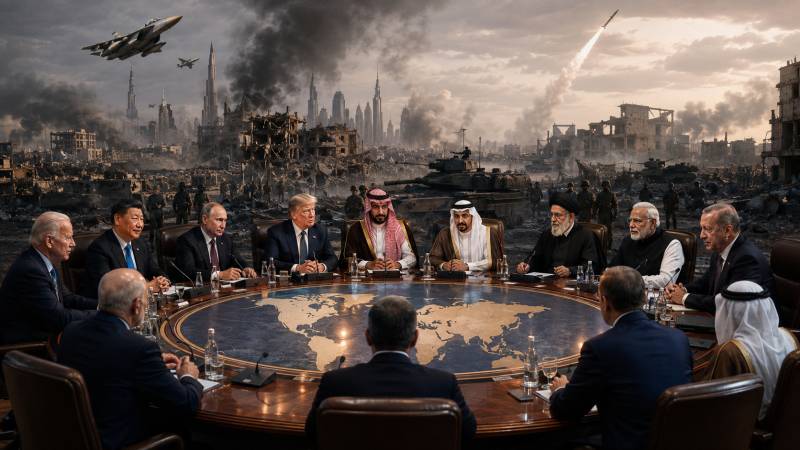
The importance of regional alliances in this chaotic world seems to be a better idea to protect the interests of states around the globe. The increasing China–US strategic competition and the increased conflicts around the globe, including the Ukraine War, the Indo-Pak War of 2025, the Iran–US War, as well as other regional conflicts, have compelled states to join regional security arrangements to protect and achieve national interests. The state of Israel, which was founded in 1948 under the 1917 Balfour Declaration of dividing Palestine into two states, one for the Jews and one for the Arabs, has not seen this declaration successfully implemented, as Israel continues to remain an aggressor and has been supported by Western states until today, as it controls Palestinian and Syrian territories.
Israeli Prime Minister Benjamin Netanyahu’s concept of a Hexagon alliance aims to reconfigure the regional security order. Netanyahu’s initiative places New Delhi in one of the central positions in the alliance as it connects Cyprus, Greece, India, and unnamed Arab and other Asian as well as African states. The initiative aims to strengthen economic, diplomatic, and security architecture against the axis of radical Shia and Sunni alliances in the West Asian region.
The initiative was first coined by Netanyahu in February 2026, aimed at countering the Shia radical alliances led by Iran and its supported nexus known as the Axis of Resistance, and the radical Sunni alliances led by Riyadh, Islamabad, as well as Turkey and Qatar. The framework for the Hexagon initiative works on economic integration, diplomatic alignment, and successful collaboration between states. Although the core of the alliance is Israel, New Delhi remains at the centre of the initiative, and states like Greece and Cyprus are aimed at protecting maritime trade and energy corridors in the Mediterranean Sea, while Arab allies like the UAE are to represent the soft image of the alliance in the West Asian region against regional alliances.
The objectives of the Hexagon alliance are aimed at ending the isolation of the Israeli regime, which has faced international backlash since the Gaza War of 2023 and the genocide in Gaza. The war has altered the balance in favour of Palestinian groups due to the continuous genocide in Palestinian territories and Israel’s ever-expanding policies in the region. Western public opinion seems to have changed narratives portraying Israel and Jews as victims of terrorist acts.
This has raised concern among policymakers in Tel Aviv and Western capitals, as local perception has strengthened against Israel and its policies in the region. The focus of Tel Aviv on presenting the idea of radical alliances led by Tehran and Sunni alliances against the existence of the state of Israel is aimed at countering the narrative in its favour, as it presents itself as the champion of democracy against these radicals and the last standing outpost to defend Western civilisation from the threats of Islamic radicalism.
This war between the two Muslim blocs will lead to the destruction of Muslim states in the region and will strengthen Israel’s influence in the region
To present itself as the defender of global peace, Israel has formed alliances with Muslim states, including the United Arab Emirates (UAE) and has become able to divide the Arab world. The Trump Abraham Accords plan of 2020 was aimed at recognising and establishing diplomatic ties with the Muslim world and is providing Tel Aviv a chance to forge close partnerships with Muslim states and strengthen the regional security order in Israel’s favour.
The Hexagon is not only limited to the security architecture, but the economic benefits cannot be ignored, as the India–Middle East–Europe Economic Corridor (IMEC) project aims to boost regional trade by over 40%, bypassing chokepoints. Although the feasibility of the project is questioned due to increased conflicts in the region and Israel’s Gaza policy, its anti-Iran stance makes it one of the most vulnerable alliances in the region.
The recent attacks on Iranian allies in Syria and Lebanon, as well as Tehran’s continued onslaught against Israel and its partner, the UAE, will further lead towards the idea of the establishment of security alignments. The memorandums of understanding signed with Indian Prime Minister Narendra Modi and the UAE’s ruler Muhammad bin Zayed (MBZ) reflect the strengthening of Abu Dhabi’s partnership with Hexagon allies.
Riyadh’s mutual defence arrangement with Islamabad is viewed in the same context, where Pakistan stationed its forces in the Kingdom to protect it from threats. The regional alignments led by Riyadh, Tel Aviv, and Tehran continue to affect the regional political and security order.
The February war between Iran–US has opened differences between Gulf kingdoms, particularly the United Arab Emirates and Saudi Arabia. The joining of the war against Iran, to pressure Islamabad to act on its side rather than mediate to end the war with Iran, and finally withdrawing from OPEC, have isolated the UAE from Gulf kingdoms and tilted it towards the Hexagon alliance.
Meanwhile, Riyadh chose the opposite path and remained neutral in the conflict as it viewed the expansion of the conflict and the intervention of Arab kingdoms would lead to chaos and the success of the Israeli lobby in engaging Arabs and Iranians with each other. This war between the two Muslim blocs will lead to the destruction of Muslim states in the region and will strengthen Israel’s influence in the region.
Tehran’s continued attacks on the UAE were aimed at stopping MBZ from tilting towards the alliance, as Tehran has accused the UAE of harbouring security and intelligence officials of Israel and the US and launched attacks on Iran from its territory, which compelled them to retaliate. Tehran’s asymmetric warfare has cost Abu Dhabi greatly, as its status as a safe and secure haven and global financial hub has been eroded, and its participation in the Hexagon alliance will further lead it into regional conflicts, which will continue to affect global investments in the country.
The global race for superiority has turned the West Asian theatre into a hot battleground for powers, as Beijing tested its military weapons and technology in the regional security order and has used its modern and sophisticated weaponry in the conflicts in India and Pakistan and the Iran–US War of 2026. The new regional alignments are well supported by the Great Powers, as Washington considers West Asian states excluding Iran as a security partner and traditional sphere of influence and has established around 40 military bases.
The continued conflict in the region will thwart its strategic position in the region and will impact its interests. Whereas its strategic competitor, China, is a major trading partner of West Asia, and its expanding influence via economic and strategic partnerships reflects its commitment to strengthening its role in the regional order. Beijing’s leverage over Tehran has made it one of the most powerful states to dictate the terms of the new regional order, and the recent tour of US President Trump in May 2026 was aimed at securing lasting peace in the region with Chinese President Xi Jinping’s support.
The increased strategic competition and the race for regional alignments will continue to affect the region in the coming times, and there is a chance of conflict erupting again in the region. It is in this backdrop that the theatre of the new conflict for global supremacy is not decided in the Asia-Pacific region but in West Asia.